

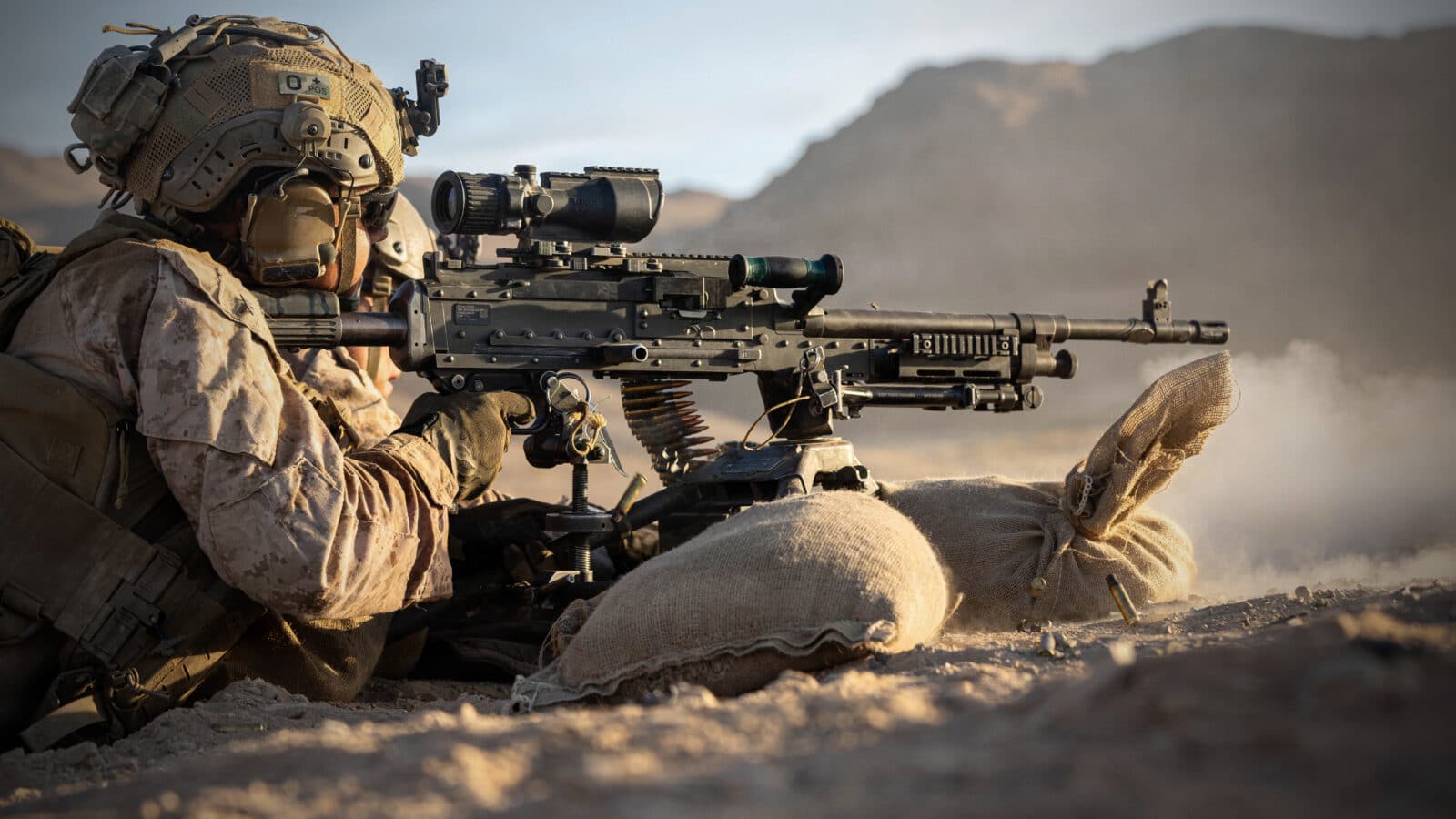
Some 650 to 950 rounds per minute. That is the exact mathematical formula required to turn an enemy formation’s fighting spirit into a desperate desire to simply survive. The United States military has spent decades crafting and perfecting this formula and has ensured its fighting men and women are well versed in its many uses and applications.
The official U.S. Army Technical Manual describes the M240 as “a belt-fed, air-cooled, gas-operated, fully automatic machine gun that fires from the open bolt position.” While that definition is technically accurate, it fails to capture what the weapon actually is. It is the heartbeat of American fire superiority, and the defining sound of that heartbeat over the last four decades has been the steady, rhythmic, unstoppable chugging of the M240.

It’s heavy, brutal to carry, and it is the undisputed heavyweight champion of medium machine guns because it does the one thing a machine gun absolutely must do without fail, no matter what: it never stops firing. Many people forget that the M240 didn’t start its legendary U.S. military career in the hands of the infantry. Long before ground troops were humping this 27-lb. behemoth up the mountains of Afghanistan or through the streets of Baghdad, it was doing dirty work inside the steel carapace of American armored vehicles.

This is the story of how a tank’s coaxial machine gun proved so ridiculously reliable that the infantry had no choice but to steal it for themselves.
Retiring “The Pig”
To understand the M240, you first have to look at the weapons it was brought in to replace, starting with the legendary M60 machine gun. The M60 was one of the most iconic faces of the Vietnam War. It served with distinction in the hands of infantry squads and as the premier weapon for helicopter door gunners who specialized in hurling lead at the enemy while raining brass from the sky. It is an icon of American might, a Hollywood favorite, and an all-around pleasure to shoot.

However, even though it has its strengths, it is important to be honest about its faults and weaknesses. Troops affectionately (and sometimes aggressively) referred to it as “The Pig.” It was a maintenance-heavy weapon, requiring constant upkeep and cleaning to ensure reliability in the field. Changing a red-hot barrel in the middle of a firefight required clumsy asbestos gloves, and as parts wore down in harsh environments, it became notorious for jamming at the worst possible moments. This was unacceptable and resulted in the loss of American lives, losses that the military hoped to prevent when searching for The Pig’s replacement.

While the infantry was struggling with the quirks of the M60, the armored community was dealing with an entirely different nightmare: the M73 and M219 machine guns.

Those weapons were used as the coaxial machine guns in early armored vehicles like the M48 and M60 Patton tanks, and their reliability was absolutely abysmal. A coax lives an incredibly unforgiving life. It is mounted inside a steel box that violently bounces across the earth at 40 miles per hour, surrounded by extreme heat, carbon and dust. When you are buttoned up in a tank during a mechanized assault, you cannot easily reach over to clear a complicated malfunction. The military desperately needed a coax that was functionally indestructible without sacrificing lethality and reliability.

The Army looked outward for a solution and found it in the Belgian-designed FN MAG. In the late 1970’s, the military put the weapon through a grueling series of evaluations against its competitors. The results were undeniable. The new weapon’s Mean Rounds Between Stoppages (MRBS) absolutely embarrassed the competition and proved it could run filthy and hot without skipping a beat.

Live The Armory Life. The latest content straight to your inbox plus an automatic entry to each of our monthly gun giveaways!
The Army officially adopted it in 1977 as the M240, specifically to serve as the coaxial machine gun for armored vehicles like the incoming M1 Abrams and Bradley Fighting Vehicle. For nearly two decades, this ultra-reliable powerhouse was the armored community’s best-kept secret, running flawlessly in the turrets while the infantry continued to slog it out with the M60.
Under the Hood: M240 Reliability
To understand why the M240 dominated those reliability trials, you have to look at the mechanics driving the gun. The secret behind its sustained suppression capability comes down to three critical design features: the open-bolt operating system, the adjustable gas regulator and the quick-change barrel mechanism.
Open-Bolt Operating System
The M240 fires from the open-bolt position. For the uninitiated, this means that when the gunner releases the trigger to stop firing, the bolt assembly travels backward and physically locks to the rear. The chamber is left empty and completely exposed to the open air. This is a vital safety and reliability feature for a weapon designed for high volumes of fire.

When a machine gun sends hundreds of rounds downrange in a matter of minutes, the chamber temperature skyrockets. If a live round were left sitting inside that white-hot chamber, the ambient heat would eventually cause the gunpowder to ignite on its own. This dangerous malfunction is known as a “cook-off” and can result in serious injury to the operator or those nearby. Locking the bolt to the rear allows the weapon to vent that massive heat buildup and keeps the ammunition safe.
Adjustable Gas Regulator
The cyclic fire rate of an AK-47 is around 600 rounds per minute. The M3 Grease Gun shoots 450 rounds per minute. The fire rate of the M240 isn’t a single static number like many other weapons systems. In fact, the technical manual officially lists it as a sliding scale from 650 to 950 rounds per minute.
This variance is entirely by design, courtesy of an adjustable gas regulator located at the front of the gas cylinder. Under normal conditions with a clean weapon, the gun is fired on the first setting, churning out around 650 to 750 rounds per minute. However, as you may know, combat is notoriously dirty.

When the weapon gets choked with carbon, sand, and grime after sustained firefights, the gunner can physically adjust the gas plug to the second or third setting. This forces a higher volume of expanding gas into the system, violently driving the piston backward to punch through the filth and keep the gun cycling.
Quick-Change Barrels
Unlike the cumbersome barrel changes of the M60 era, swapping a barrel on the M240 is executed with a simple push-button release on the left side of the receiver. It should be noted that the physical reality of executing that swap depends entirely on where the gun is mounted and which variant you are operating. For the infantry variants (like the M240B or the Marine Corps M240G), the barrel features a built-in carrying handle. The gunner simply depresses the release, lifts the handle to strip the hot barrel out, and slams a fresh one in.

For an armor crewman, it is a completely different story. The M240 used as the coaxial machine gun in the Abrams strips away the heat shield and the carrying handle entirely to fit inside the tight confines of the gun mantlet. There is no handle to grab. When a loader has to swap a red-hot coax barrel in the middle of an engagement, they are grabbing raw steel using a heavy heat mitten in the cramped interior of the turret, relying on pure muscle memory to get the tank back in the fight.

Compared to the M73 and the M219 however, this was a cakewalk, as those weapons systems had archaic barrel change procedures involving the swiveling of the entire receiver, which was near impossible to do in a stressed environment.
M240 Family Tree: Tailoring the Heavyweight
Once the U.S. military realized they had an absolute masterpiece of reliability on their hands, they began tailoring the weapon to fit the specific needs of different combat units throughout the fighting force. Today, the M240 exists in several distinct configurations, but they all share the exact same rugged DNA.
The Armor Variants: M240, M240C, and M240D
As a tanker, these vehicle variants are my bread and butter. While they are fundamentally the same weapon, employing them feels entirely different based on where they sit. The standard M240 (with no letter designation) is the coaxial variant mounted directly next to the 120mm main gun in the Abrams.

Because of its placement in the mantlet, the loader feeds the ammo belts from the left side, over the cannon, and into the machine gun. It lacks a traditional trigger group or buttstock, firing instead via an electronic solenoid controlled by the gunner’s cadillacs. (To accommodate other platforms like the Bradley Fighting Vehicle that require a right-hand feed, the military utilizes the M240C).

The M240D is the brawler. This is the variant mounted on the skate mount at the loader’s hatch. It feeds from the standard left side and is operated manually using spade grips and a butterfly trigger. Additionally, the “Delta” model comes with an egress kit. If the tank is disabled and the crew has to abandon ship, pulling two retaining pins allows the loader to rip the gun off the mount, slap on a traditional buttstock and trigger assembly, and take it to the ground as a highly effective infantry weapon.
Marine Corps Pivot: The M240G
By the mid-1990s, the Marine Corps had finally had enough of the M60. Being naturally resourceful (read: broke), they looked at the incredibly reliable M240’s already mounted in their LAVs and tanks and realized the solution to their infantry problem was already in the armory.

They pulled the weapons out of the vehicles, slapped on a buttstock, bipod and iron sights, and fielded it to the infantry as the M240G (the “Golf”). It’s all about pure function and no nonsense. It lacks a heat shield, which saves weight, and retains the three-position adjustable gas plug from the vehicle variants, giving Marine machine gunners total control over their cyclic rate of fire
Army Infantry Standard: The M240B
Seeing the Marines successfully running the Golf model in the dirt, the Army finally retired the infantry’s M60’s in 1997, adopting the M240B (the “Bravo”). The Bravo is the heaviest of the ground variants, weighing in at roughly 27 lbs. The Army added a heat shield, a modernized front sight, and Picatinny rails for mounting optics and lasers.

Most importantly, the Bravo features a hydraulic buffer system integrated into the buttstock. This buffer absorbs a massive amount of the weapon’s recoil, making it incredibly controllable during sustained bursts. It is a grueling piece of equipment to ruck up a mountain, but the second the bipod hits the dirt, it becomes the uncontested base of fire for the Army infantry squad.
Death from Above: The M240H
The aviation community couldn’t let the ground guys have all the fun. The M240H (the “Hotel”) was developed to replace the M60D as the standard door gun on helicopters like the UH-60 Black Hawk and CH-47 Chinook. Like the tank’s Delta model, it features spade grips and a butterfly trigger, and it can be rapidly dismounted with an egress kit if a bird goes down and the crew needs to fight their way out.

The Maritime Solution: The M240N
The Navy needed a piece of this reliability for their own operations, leading to the M240N (the “November”). Designed specifically for waterborne environments, the November model lives its life on pintle mounts aboard small patrol crafts, rigid-hull inflatable boats (RHIBs), and ship decks. Because it isn’t meant to be humped through the mountains or fired from the dirt, it completely strips away the integral bipod found on the infantry variants.

Maritime environments present the unique hurdles of constant exposure to saltwater, sea spray, and corrosive ocean air. This can be notoriously brutal on weapon systems, but the exact same rugged mechanics that keep the gun cycling through the sand and carbon of a battlefield keep the November model chewing through belts on the open water.
The Operator’s Perspective of the M240 Machine Gun
Regardless of your job or in which capacity it’s used, operating the M240 is intensive and grueling work. If you are an infantryman humping a 27-lb. Bravo model plus heavy belts of 7.62 up the side of a mountain, your knees and back will absolutely hate you. If you are an armor crewman wrestling a jammed, red-hot coax in the pitch-black turret of an Abrams moving at 40 miles per hour, your knuckles will be busted and your hands WILL inevitably get burned (ask me how I know). The weapon demands a steep physical toll from anyone who is tasked with wielding it.

However, the second you make contact and need to establish immediate fire superiority, every ounce of that weight, every scorch mark, and every drop of sweat is instantly forgiven.
As the military continues to modernize and looks toward the future with lighter, Next Generation Squad Weapons like the XM250, some might wonder if the M240’s days are numbered. The truth is, you can’t easily replace a masterpiece of reliability.
For almost 50 years, from the turrets of armored dreadnoughts to the trenches of the infantry, the M240 has done exactly what it was designed to do — never stop firing. As long as there is a need to lay down an unbreakable wall of lead to dominate the battlefield, the undisputed heavyweight champion isn’t going anywhere.
Editor’s Note: Please be sure to check out The Armory Life Forum, where you can comment about our daily articles, as well as just talk guns and gear. Click the “Go To Forum Thread” link below to jump in and discuss this article and much more!
Join the Discussion
Read the full article here