

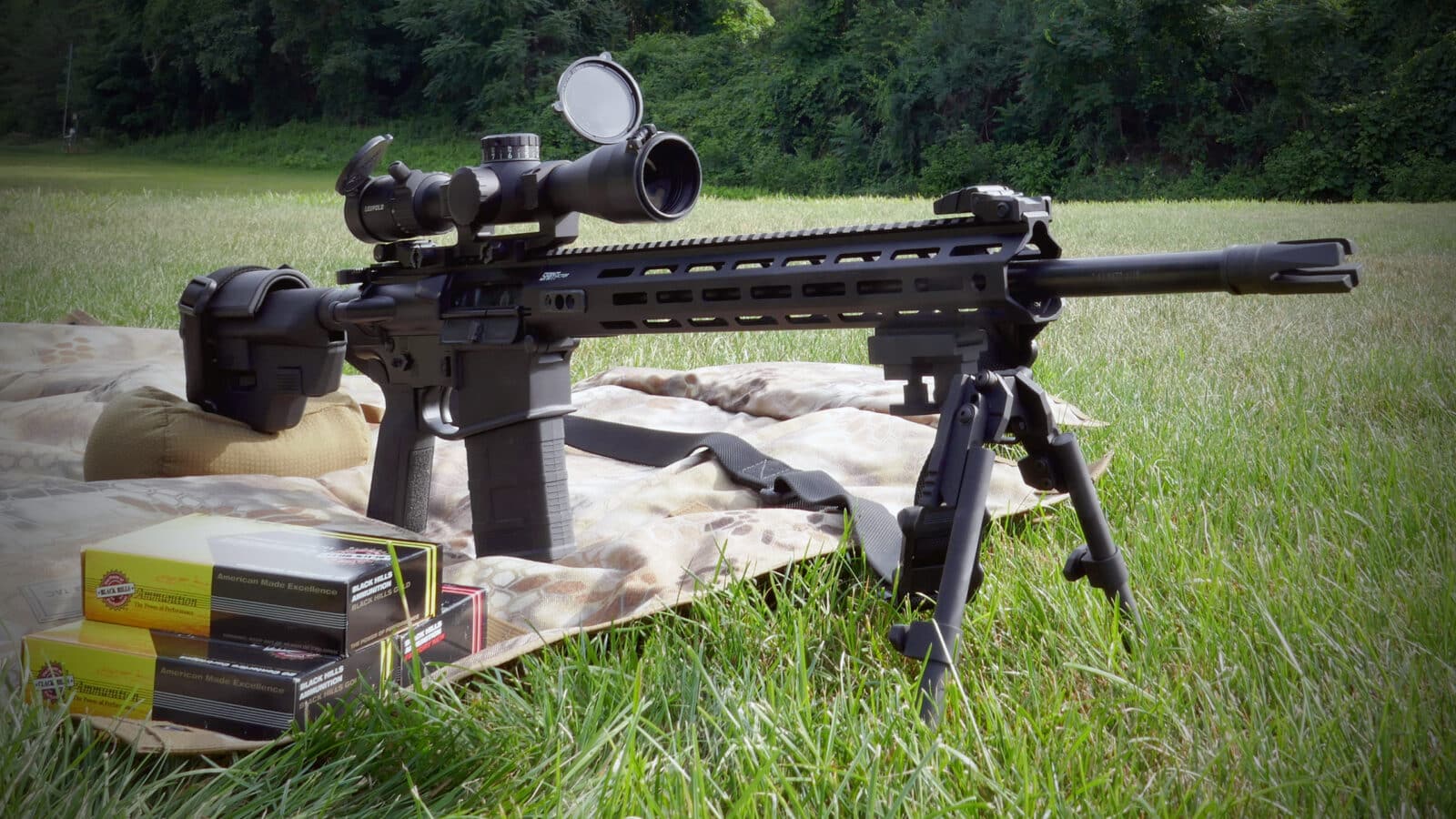
Editor’s Note: Be sure to employ the services of a qualified gunsmith if you are incapable of installing these parts on your rifle. The SAINT rifle used in this article was originally loaned to the author by Springfield Armory, but it was subsequently purchased by the author.
Springfield Armory’s SAINT Victor rifles include many factory-installed enhancements that place them solidly in the “premium” category of rifles. Among these features are forged upper and lower receivers, a free-float aluminum handguard, a quality barrel finished in black salt nitride, a nickel boron-coated flat single stage trigger, a solid set of folding and adjustable iron sights, and more.
Springfield Armory is an industry leading manufacturer that can produce an affordable rifle with the most-wanted factory upgrades. However, what if you wanted to further tweak the design for your personal needs? No problem, as AR-pattern rifles are modular and can be easily upgraded.
The Distant Path
While modifying your rifle can be as simple as swapping a few parts for aesthetics, you can also undertake a more in-depth approach for a specific goal. This happened for with the SAINT Victor 7.62 20” rifle I have been recently testing.
A practice that is often used to determine a rifle’s accuracy is to measure the “group size” on a paper target. A good way to obtain the smallest possible group is to place the rifle on solid rest such as a GG&G XDS bipod, which in turn can be placed on a stable shooting bench. The rifle is then fired at a target such as an Action Target Rifle Sighting Target which enables a shooter who is using a scope to easily maintain a consistent point of aim.

This method helps to remove many variables and creates near-ideal conditions. I say “near-ideal” conditions, because results from a rifle and ammunition combination can still vary due to temperature and humidity changes or wind. This is why those who develop reloading data test on indoor ranges.
Be sure to read the author’s article on how companies develop loads here.
When it comes to AR mods, two easy changes are the trigger and the stock. These easily installed upgrades do not require significant gunsmithing skills — just the ability to read and follow instructions. While the factory-installed nickel boron-coated flat trigger is very nice, I prefer single stage triggers for a rifle that will be used in a CQB role. However, in my opinion, a two-stage trigger is superior for precision shooting.

When I reviewed this SAINT Victor 20″ AR-10 Rifle for use in rural defense or police patrol role, I found that with quality ammunition the rifle consistently shot about 1.5” groups or, roughly translated, 1.5 MOA at 100 yards. Dropping a fired case into a Wilson Gage confirmed that Springfield uses quality barrels that are machined to the minimum chamber dimensions. This made me very confident that a two-stage trigger could help me shrink those groups even more.
A quality trigger will not make a poor-quality barrel shoot better. However, a quality two-stage trigger, such as a Geissele Super Semi-Automatic (SSA) helps me squeeze every last fraction of a minute of accuracy out of a quality rifle barrel like the one that was factory installed on this rifle.
I decided to install an SSA trigger that Geissele describes as follows:
“The SSA’s two-stage design allows the trigger to be light enough for accurate and precise shots, but forgiving enough for frenetic close in work. The SSA is safety certified by Crane Naval Surface Warfare Center. It is recommended for demanding applications such as Law Enforcement use, dynamic environments, and mid-range carbine work.”

The SSA is not adjustable. However, its total pull weight is not more than 4.75 lbs. Geissele says that the first stage pull is 2.75 to 3 lbs. and the second stage is between 1.5 and 1.75 lbs. Because of its crisp pull, the Geissele SSA helps me keep the scope perfectly aligned with the target while pressing the trigger to the rear.
Contact Points
A long-range optic on an AR requires a very specific cheekweld for maximum performance. An incorrect cheekweld can prevent a shooter from properly mounting the rifle and squeezing the most accuracy out of a rifle. Most SAINT Victor rifles ship with a B5 Systems Enhanced SOPMOD buttstock that for a tactical rifle is an excellent choice.
A B5 Collapsible Precision Stock is a good option for those who intend to use the 20”-barreled .308 SAINT Victor as a precision rifle and shoot at longer distances. The Precision Stock has adjustments for length of pull and comb height. It attaches to the factory-installed receiver extension with no gunsmithing.

First, confirm that the chamber is empty and the magazine has been removed from the receiver. Remove the Enhanced SOPMOD stock. Pull all the way down on the adjustment lever and then pull the stock completely off the receiver extension. The B5 Collapsible Precision Stock can then be installed: pull down on its adjustment lever and slide it onto the receiver extension.
Once attached, the length of pull can be adjusted by use of the lever. The lever can be locked to prevent the stock from being removed from the receiver extension while still allowing the length of pull to be adjusted. For a finer adjustment, use the thumb screw on the rear of the stock. Use the other thumb screw to adjust the comb height.

Live The Armory Life. The latest content straight to your inbox plus an automatic entry to each of our monthly gun giveaways!
Installation of the Geissele SSA trigger is a bit more involved. However, for readers who are willing to read and follow instructions, it should not bedifficult to install. As was done for the stock installation, confirm the rifle is unloaded. Once the rifle is cleared and safe, close the action, place the selector on SAFE, and push out the pivot and takedown pins to separate the upper and lower receivers. Set the upper aside. The job will be easier if you insert a vise block into the magazine well and secure the lower receiver in a sturdy bench vise, such as the Brownell’s Gunsmith Vise.
Once the receiver has been secured, push the hammer pin out first while cupping a hand over the receiver to prevent the hammer from flying out. Then, press the trigger pin out and remove the trigger and disconnector. It’s a good idea to look into the receiver before pressing the pins out. Each pin has a groove in the center and groove on one side. Press them out so that the groove on the side exits the receiver first.

Clean any dirt out of the receiver and then read and follow the instructions provided by Geissele to install the SSA trigger. It is important to pay particular attention to the lubrication points. The Geissele Trigger Fitting Pin is another useful tool to have on hand. Unlike punches, this pin is the proper size and so helps to allign the trigger and hammer to ease the insertion of the pins with only finger pressure. Do not use a hammer to install the pins. If they do not go in easily, stop and determine what is out of alignment.
Once the trigger has been installed, re-attach the upper receiver to the lower receiver and perform all the safety checks listed in the instructions. After I performed the required safety checks, I used a Lyman Digital Trigger Pull Gauge to test the total pull weight and it came in at a crisp 4.25 lbs. Once all checks were completed it was time to head to the range.
Range Time
Jeff Hoffman at Black Hils Ammunition kindly sent me a few different .308 loads for this article. It being early spring in New Hampshire, I had to await a day when the on-range temperature was at least 35° with no rain.
For use of the SAINT Victor for patrol and rural defense, I zeroed the Leupold Mark 4 HD at 50 yards. That zero performed well for shooting five-round groups at 100 yards. All of the Black Hills Ammunition Jeff sent did extremely well in the Saint Victor 20”. Here’s the data for the three best performers:
| Accuracy | Velocity | |
|---|---|---|
| Black Hills Gold 155-grain ELD Match | 0.91″ | 2,741 fps |
| Black Hills 168-grain Boat-Tail Hollow Point | 0.95″ | 2,514 fps |
| Black Hills Gold 150-grain Hornady CX | 1.3″ | 2,724 fps |
All of the loads yielded consistent velocities and low standard deviations. However, the Black Hills Gold loaded with a Hornady 155-gr. ELD Match bullet stood out for the smallest group size. This makes sense as the standard deviation, or the consistency from cartridge to cartridge, was an amazing 4.9!

I’m looking forward to experimenting with handloads, but I think that 0.910” will be hard to beat.
I track every cartridge fired through each of my rifles. For a rifle that is equipped with a Nitride barrel, I’ve found about 1,000-1,500 rounds can be fired before there is enough copper build-up to affect group sizes. Fortunately, Nitride barrels are very easy to clean. Once the copper is removed, group sizes will shrink.
Conclusion
AR type rifles are modular and easy to upgrade. Investing in a quality rifle such as a SAINT® Victor 20″ AR-10 Rifle provides shooters with a solid platform to build on later when skills improve and funds become available. This is a terrific rifle and I have decided to purchase the sample that was sent for review.
Editor’s Note: Please be sure to check out The Armory Life Forum, where you can comment about our daily articles, as well as just talk guns and gear. Click the “Go To Forum Thread” link below to jump in and discuss this article and much more!
Join the Discussion
Featured in this article


Read the full article here