

Back in the 1990s, it was widely predicted that laser sights might very well be the next “big thing” in handguns utilized for personal defense.
The first successful laser sight was invented by Dr. John Matthews — founder of famed SureFire — some years before, but it wasn’t quite ready for prime time. Matthews was able to design a helium-neon laser and mount it on a revolver and, while it did indeed work, cost and size of such a unit made it impractical.
Over time, laser sights became smaller, lighter, and cost effective, and firms would eventually succeed in building robust laser sights that could be affixed to handguns commonly used for defensive applications. Unlike earlier offerings, these new laser sight systems did not change the external dimensions of the gun, allowing it to be carried in readily available holsters.
The Details
A laser sight projects either a visible or invisible beam, allowing the user to align the muzzle of the gun with the target without taking a conventional sight picture. For civilian applications, visible lasers that project either a red or green visible beam are utilized.
However, a major limitation of laser sights is the fact that they are only visible in certain light conditions. In bright sunlight, they are pretty much useless; as light conditions fall, the laser becomes visible.

The beam of a laser sight can be picked up indoors, on dark, overcast days and at dusk or dawn. During the hours of darkness, a visible laser may very well be the ultimate night sight. Most violent crimes happen at night, so a handgun with a laser sight can offer a significant advantage for personal defense.
In 1997, Insight Technology introduced the M-3, a small practical weapon-mounted light (WML) that could be easily affixed or removed from a pistol with an accessory rail. Without question, the M-3 was a game changer. Until that time, WML’s were bulky and required a semi-permanent attachment to the pistol, making them impractical for anyone other than SWAT cops or military operators.
The Insight Technology M-3 proved to be an instant hit, and other companies soon followed with their own spin on a compact weapon mounted light. But Insight Technology took it one step further and crossed the diamond with the pearl to create the M-6.

The M-6 used the same white light as the original M-3, but added a visible red laser to the package. This gave the end-user a white light to reliably identify a target as well as a means of getting an index in a low-light environment. Might they have been on to something?
An Epiphany
I tend to take a very conservative view toward the guns and related gear used for personal defense. To persuade me that a new pistol, holster or technique is superior, it must outperform previous options that have served me well in the past. I could wrap my head around the concept of a weapon-mounted light, but I wasn’t entirely sold on white light/laser concept of the M-6 when it first appeared.

However, while I was considering what advantage a light/laser combo might afford, I was able to try my hand with an M-6 on a Rogers Range. The range randomly displayed reactive steel plates between 7 and 17 yards, with decreasing exposure time during the drill. You never knew where the next plate would appear, and the fact that we were running it in the dark only added to the challenge.
Initially, I ran the drill with my duty pistol equipped with tritium night sights and used a heavy, full-size police flashlight to spot the target. At first, I was hammering the plates without fail, but my success rate quickly diminished as exposure times of the plates were reduced. Maybe I wasn’t such a deadeye after all!
Transitioning to the M-6 and conducting the identical exercise yielded significantly enhanced results. No doubt, the fact that I only had to manipulate a single switch to activate the light and laser paid dividends. Plates that were only exposed for a very brief time frame were now easy pickings and my success rate was far better than what I could achieve with a handheld light and a pistol with three-dot night sights. I later enjoyed similar success engaging moving targets in the dark as well as shooting while moving.

Live The Armory Life. The latest content straight to your inbox plus an automatic entry to each of our monthly gun giveaways!
Based on that success, I thought both the commercial and law enforcement markets would eventually embrace white light/laser combos. Weapon-mounted lights had in fact caught on and the combination units offered even greater capabilities with little downside. But much to my surprise, this never happened.
One of the bigger stumbling blocks was lack of suitable holsters. Holster manufacturers were slow to bring out dedicated light-bearing holsters and slower yet to come up with rigs for the white light/laser combos which feature different external dimensions. The small, custom holster manufacturers could certainly make such as a scabbard but there was little interest from the firms turning out police duty holsters.
I do have a duty holster from Safariland that accommodates my Streamlight TLR-2 combo with a white light and laser, but by that time the die had already been cast. It seemed light/laser combo units were never going to be the hot ticket with law enforcement.
Still a Good Choice?
There is no doubt the red dot revolution is in high gear, and pistol-mounted optics bring a great deal to the table. The biggest advantage is the fact that the shooter is now using a single focal plane. This not only speeds up the learning process for new shooters, but can pay dividends in a highly stressful situation. If we accept the fact that a red dot optic can help the cause, might a laser offer similar benefits?

When exposed to a lethal danger in close quarters, there is a great deal of research that suggests your focus will be on the threat rather than the sights. Depending on any number of factors including training, mental conditioning, proximity or a spontaneous attack, use of iron sights may be problematic. Because body alarm reaction may cause you to look at the threat, the fact you merely place the red dot on target can result in better hit potential.
When you get down to it, a laser sight works on the exact same principle. Place the dot on what you need to shoot and press the trigger. Unlike a red dot optic, the learning curve for using a visible laser isn’t very steep at all. A laser sight system also provides users with additional benefits.
In less-than-optimum light, one can get a rock-solid index on a threat even if you can’t drive the gun to eye level. In armed combat, consider the fact that you may be injured before getting a shot off and are incapable of raising your pistol to eye level.
Firing from non-typical positions around cover or concealment while exposing as little of your body as possible is yet another advantage. In real life, threats are often moving and a laser can get you on target and help minimize the risk of tunnel vision in a rapidly evolving situation.

Left to my own designs, I prefer a compact-size pistol for personal defense. They are a little easier to hide than a full-size service pistol, and I can perform at a significantly higher level than with a sub-compact or micro pistol.
When worn on the belt, adding a weapon-mounted light does not make this package more difficult to hide — providing you select the right holster. Of late, I’ve upgraded to a white light/laser combo on a couple of my favorite pistols, which has provided me with even greater capabilities.
If you don’t feel put off by adding a WML to your pistol, going the extra yard with a white light/laser combo might be close to the ever-elusive free lunch and I see little downside. Most of these units have laser only, white light only, or laser/white light capability.
You may have to beat the bushes a little harder to find a suitable holster and I have obtained such rigs from Muddy River Tactical and Falco. A quick internet search will provide you with the names of other manufacturers who make such a holster.
Quality Matters
There are several different firms currently producing combination units, but like any other product you might be betting your life on this is not a place to cut corners. My current collection of combo units includes examples from SureFire and Streamlight, which have all proven to be solid performers.

SureFire’s X400 Ultra combination units feature a highly visible integrated red or green 5-milliwatt laser along with an illuminator that puts out 1,000 lumens of intense white light. They also offer the X400T-A with the specialized Turbo beam pattern to reach out to extended distance. As with all SureFire products, quality is top shelf. My original X400 is still going strong and will probably last longer than I do.
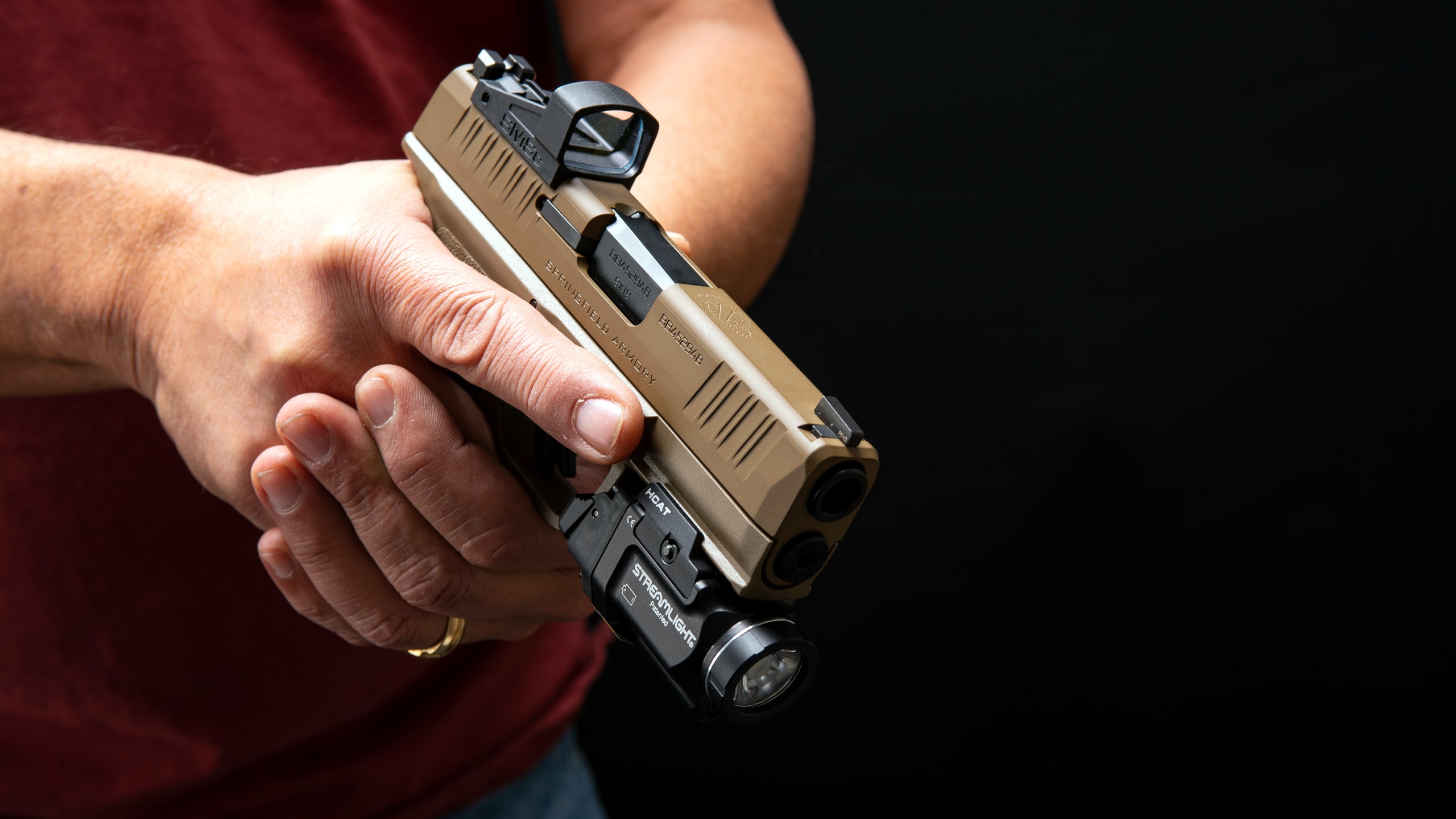
For many years, Streamlight has offered the TLR-2 family of combo units. I have examples of TLR-2 HL (high lumen) with both red and green lasers and have used them extensively without any issues. The current crop of TLR-2 HL illuminators projects 1,000 lumens of intense white light, and the visible laser will get you on target very fast in a low-light environment. On a service-size pistol, the TLR-2 remains an excellent choice.
On an EDC pistol, Streamlight’s TLR-8 family of light/laser tools is a tough act to follow. The dimensions are much more compact than those of the TLR-2, which is important when keeping a low profile is required. Best of all, the downsized TLR-8 is still a stellar performer, capable of putting out up to 500 lumens of light. For smaller sub-compact and micro pistols with rails, Streamlight offers the TLR-8 sub series which boasts the same features.
My Springfield Armory Echelon 4.0C is outfitted with a TLR-8 G, while my Hellcat sports the sub version. Both units feature a green laser, which is visible in a wider range of light conditions than red. Green laser units typically command a slightly higher price than red but, to my thinking, the greater capabilities make it worth the additional expense.
Alternative or Supplement?
As pistol-mounted optics move to the forefront, some might consider light/laser combinations to be something that never hit full stride and has limited applications.
For example, the use of a visible laser is pretty much limited to diminished lighting conditions while a red dot optic is useful in all levels of light. But what might the better tool be in a highly stressed, low-light scenario when your fingers have turned to flippers and your heart is beating through your chest?
A light/laser combo offers solid utility, especially for people focused on personal defense. Most armed conflict continues to occur at relatively close range and in less-than-optimum light. Do you really need a light and/or laser? It might be better to have those things and not need them than to need them and not have them.
If you prefer a weapon-mounted light, a combination unit with a built-in laser can increase your capabilities. Life is about choices and our job, lifestyle, where we live, and social environment all influence the sort of hardware we carry.
I use a pistol equipped with a white light/laser combo when teaching law enforcement officers or when going on the road. But for EDC, I still go with a naked gun sans optics or a light. Your needs may be very different. I would consider a pistol equipped with a light/laser combination unit to be a very formidable tool for home defense.
I might be going against the grain, but I feel white light/laser combinations still have much to offer. Unlike red dot optics, there isn’t much of a learning curve in getting comfortable with a light/laser combination. I set up my units so both the light and laser units come on simultaneously. That gives me the ability to quickly assess a potential threat, and if necessary to get a reliable index if there is a need to fire.
Since it’s dark about half the time, lacking a light source — hand-held or weapon-mounted — can be disadvantageous. In real life, threats can be partially exposed and may very well be moving. A laser sight combined with white light will give you better capability to get decisive hits on a threat and minimize risk to you as well as innocent bystanders.
While I don’t see white light/laser combos eclipsing pistol-mounted optics any time in the future, they do offer an interesting alternative and might even serve as a supplement for users whose primary concern is personal defense.
Editor’s Note: Please be sure to check out The Armory Life Forum, where you can comment about our daily articles, as well as just talk guns and gear. Click the “Go To Forum Thread” link below to jump in!
Join the Discussion
Featured in this article

Read the full article here