

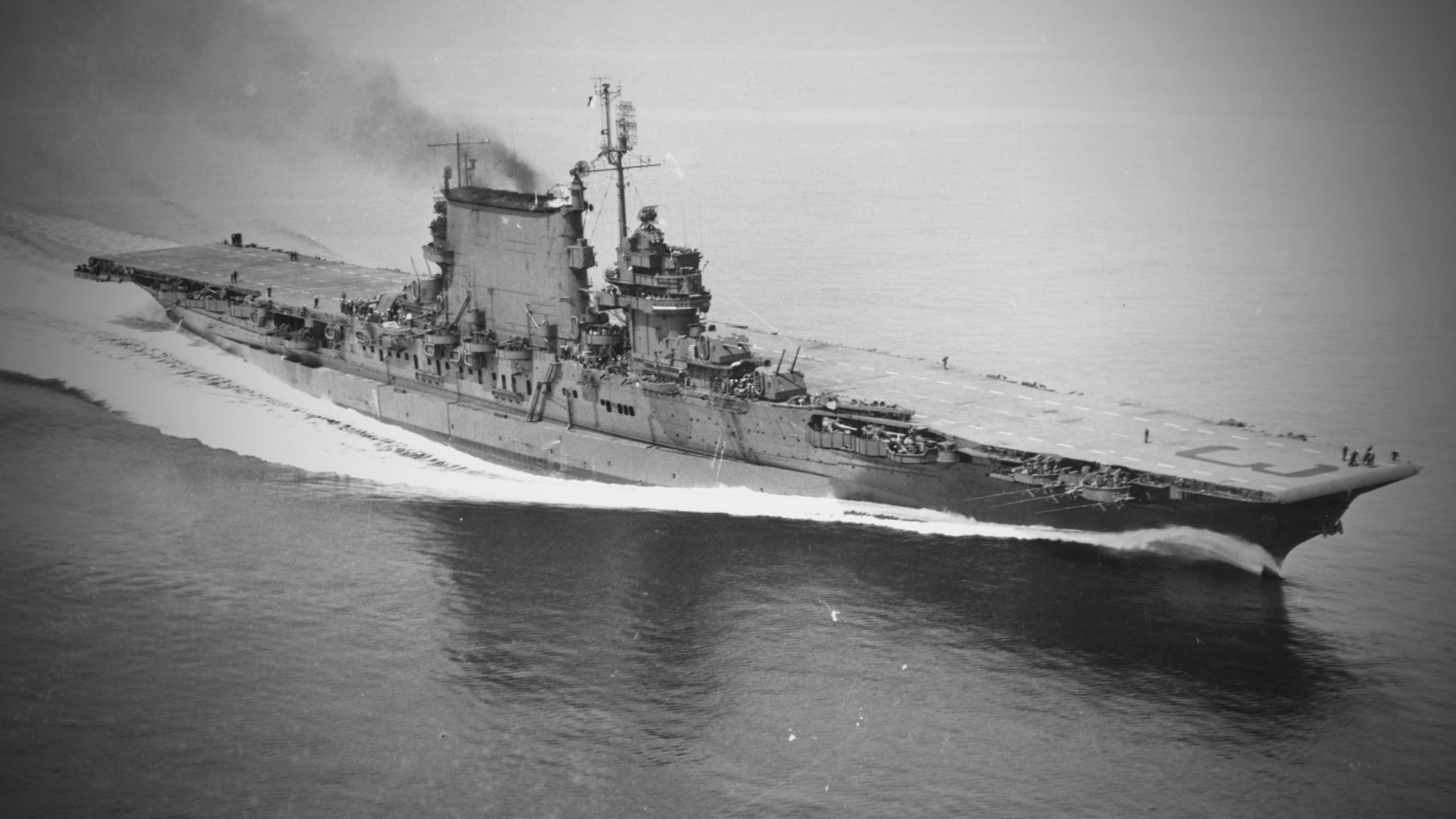
The USS Saratoga (CV-3) was one of just three United States Navy aircraft carriers — along with USS Ranger (CV-4) and USS Enterprise (CV-6) — to survive the entirety of the Second World War. Although outdated by 1943, as the newer and more capable Essex-class entered service, CV-3 was one of the American flattops that fought for time in the early stages of the conflict, and continued to find a role until victory was finally achieved.
After the war ended, USS Saratoga was among the warships that helped return United States military personnel from distant posts in the Pacific, and met her end as a target for nuclear weapon tests during Operation Crossroads.
An Important Name
USS Saratoga is fittingly remembered for her role during the Second World War, yet she has historic ties to the founding of the nation. In addition, she was ordered as the United States sought to avoid entry into the First World War, and was originally authorized as a Lexington-class battlecruiser.

The famed American flattop was also the fifth of six U.S. Navy warships named for the Revolutionary War’s Battle of Saratoga, which actually consisted of two battles fought in September and October 1777. The second was a decisive American victory, which persuaded France to enter the conflict as an American ally.

The World War II carrier was preceded by an 18-gun sloop-of-war lost in a gale during the Revolution and was itself followed by a 26-gun corvette that saw service during the War of 1812 on Lake Champlain. The third USS Saratoga was a 22-gun sloop-of-war that served with the U.S. Navy for more than 40 years. The fourth USS Saratoga (ACR-2) was the former armored cruiser USS New York, which also ended her service with the name USS Rochester.
The most recent and final to date USS Saratoga (CV-60) was a Forrestal-class supercarrier that saw service during the Cold War.
From Battlecruiser to Carrier
As noted, the Lexington-class was originally to have consisted of six battlecruisers. Construction of what was to become CV-3 was put on hold during the First World War because there was a greater need for anti-submarine vessels to counter Germany’s U-boat campaign, which led to America’s entry into the conflict. That was almost certainly for the best, as it allowed the design to be improved, including increased armor protection based on experience gained by the UK’s Royal Navy during the conflict. That likely contributed to her survival during the Second World War.

When she was finally laid down at the New York Shipbuilding Corporation at Camden, New Jersey, in 1920, the warship received the hull number CC-3. USS Saratoga was on track to be the second of the six Lexington-class battlecruisers.
However, the Washington Naval Conference resulted in the construction of USS Saratoga being suspended when she was around 28 percent completed. Work was also halted on USS Lexington, and rather than scrap the vessel, it was converted into a carrier. CC-3 was subsequently given the hull number CV-3 on July 1, 1922.

Following the conversion, the USS Lexington (CV-2) and CV-3 were the largest aircraft carriers in the world, with flight decks 901 feet long and 100 feet wide. Each was fitted with lowerable crash barriers, a simple yet innovative feature that enabled the two American flattops to quadruple the landing rate of aircraft. That allowed USS Lexington and USS Saratoga to operate with 86 planes, double the number of the Royal Navy’s HMS Courageous.

Powered by diesel-fueled turbines with electric motors, the U.S. carriers could reach speeds of 34 knots. As naval aviation was still considered experimental in nature, the warships, which displaced 36,000 tons, were armed with four twin 8-inch (203mm) guns.
Readying for War
CV-3 was commissioned on November 16, 1927, nearly a month ahead of USS Lexington, giving USS Saratoga the distinction of being the first “fast carrier” to enter service. She sailed from Philadelphia in early January 1928 for a shakedown cruise, and it was on January 11 that Marc Andrew “Pete” Mitscher, the ship’s air officer, made the first landing on the flight deck. Mitscher, a pioneer in naval aviation, would go on to become an admiral in the United States Navy, leading a Fast Carrier Task Force in the Pacific War.

On January 27, 1928, USS Saratoga carried out a unique experiment with the rigid airship USS Los Angeles (ZR-3), which moored to the flattop’s stern to take on fuel and stores.
Two years later, CV-3 took part in Fleet Problem IX, her first fleet exercise. The drills included a simulated attack on the Panama Canal, during which USS Saratoga launched a strike that could have destroyed the locks. However, as the carrier had been spotted by defending vessels, she was also “sunk” by aircraft from USS Lexington. Those drills served as an augury to the future conflict in which both carriers would fight, and sadly, the Lexington wouldn’t survive.
Over the next decade, the United States Navy continued to develop its carrier tactics. During the subsequent Fleet Problem X in the Caribbean in 1930, CV-3 was again sunk, along with USS Langley (CV-1), in a surprise attack carried out by CV-2. USS Saratoga managed to gain the upper hand in the following Fleet Problem XI, where CV-3 came out on top.
Live The Armory Life. The latest content straight to your inbox plus an automatic entry to each of our monthly gun giveaways!
Fleet Problem XIX in 1938 may have been the most significant of the exercises, as CV-3’s new squadron of Douglas TBD Devastators, the first torpedo bombers to serve on a flattop, was used in a “sneak attack” on Pearl Harbor, catching the base largely off-guard!
At that point, Japanese and American tactics were mainly the same: to provide an air umbrella for a strike force of battleships. That exercise clearly demonstrated a more effective use of aircraft carriers, where air power could strike far deeper and harder into enemy territory than any warship.

Japan soon began building two 30,000-ton carriers, along with aircraft ideally suited for such operations. Then, three years after the Fleet Problem XIX, the Imperial Japanese Navy (IJN) attacked Pearl Harbor for real. At that point, the IJN operated 10 carriers to the United States Navy’s eight, of which only three were in the Pacific.
USS Saratoga in December 1941
CV-3 wasn’t at sea when the IJN attack on Pearl Harbor occurred, as the carrier had only recently completed a modernization at Bremerton Navy Yard, Washington, which saw the widening of the flight deck at the bow, and additional aircraft guns installed.

Work was only completed in late November 1941, and on December 7, the USS Saratoga arrived in San Diego to embark her air group. Just a day later, the warship was dispatched to carry United States Marine aircraft to reinforce the garrison at Wake Island.
She arrived at Pearl Harbor on December 15, quickly refueled, and then rendezvoused with the cargo ship USS Tangier (AV-8), which carried relief troops and supplies. USS Lexington (CV-2) and USS Enterprise (CV-6) provide distant cover, but when reports came that Wake Island was under attack, the relief force was recalled. Wake Island, the “Alamo of the Pacific,” fell to Japanese forces on December 23. Military historians have debated whether the right call was made to pull back the American carriers, but the U.S. was still fighting for time at that point.
USS Saratoga carried out operations near the Hawaiian Islands as the year ended.

Just days into 1942, south of Oahu, CV-3 was hit by a deep-running torpedo fired by the IJN submarine I-16. It could have been a disaster for the United States Navy to lose a carrier, but the added armor likely helped save the ship. Six crew members were killed and three firerooms were flooded, yet the aircraft carrier limped back to Pearl Harbor under her own power. Temporary repairs were made, and the ship then headed back to Bremerton Navy Yard for permanent repairs and upgrades to her anti-aircraft batteries.
Returned to Service
USS Saratoga was sidelined until May, undergoing repairs. After then traveling again to San Diego, CV-3 conducted intensive training with her air group before heading back into action. Although the United States Navy expected a major assault on Midway in early June 1942, the carrier first needed to load aircraft, stores, and rendezvous with escorts.

She only arrived at Pearl Harbor on June 6, missing the showdown at the Battle of Midway.
Joined by USS Enterprise and USS Hornet (CV-8), the carrier was deployed to the Aleutian Islands, where the Japanese had landed its forces. However, the operation was canceled due to the slow speed of the fleet, and just a month later, CV-3 was steaming again to the South Pacific.
USS Saratoga served as the flagship for Rear Admiral Frank J. Fletcher during the landings on Guadalcanal, and the flattop had completed training flights at the Fiji Islands just weeks earlier. For two days, aircraft from the carrier provided cover, and afterwards, CV-3 continued to operate east of the Solomons to protect the sea lanes.

Finally, on August 24, contact was made, and USS Saratoga saw her first major combat operations, launching her aircraft at the IJN’s light carrier Ryūjō. Commander H. D. “Don” Felt led the Air Group 3 (AG-3), equipped with the Grumman TBF Avenger torpedo bomber, in the attack. A 1,000-pound armor-piercing bomb dropped by Felt’s aircraft struck the flight deck of the IJN’s light carrier, setting it afire.
Three more bombs found their target, and five torpedo-armed Avengers also targeted the Ryūjō at the starboard bow, with one torpedo striking the carrier. Ryūjō listed to the starboard, dead in the water. By that evening, she was at the bottom of the Pacific. Aviators from USS Saratoga had scored their first significant victory of the war.
Then just a week later, another Japanese torpedo, fired by the IJN submarine I-26, struck CV-3. Although no one was killed, a dozen sailors were wounded, and an engine room was flooded. She was temporarily dead in the water, but the New Orleans-class heavy cruiser USS Minneapolis (CA-36) was able to tow the carrier back to Tongatabu for temporary repairs. USS Saratoga arrived at Pearl Harbor on September 21.

Repairs were completed by early November 1942, and she was deployed back to the Eastern Solomons. She spent a year providing air cover for some minor Allied operations, and it wasn’t until a year later, in November 1943, that she took part in any significant combat, when the carrier helped neutralize the Japanese airfields on Buka.
On November 5, 1943, aircraft from USS Saratoga and the Independence-class light aircraft carrier USS Princeton (CV/CVL-23) conducted a raid on the occupied port of Rabaul to destroy the IJN fleet. The port was one of the most heavily defended Japanese bases in the Pacific, with anti-aircraft guns ringing the harbor, as well as six airfields from which fighter aircraft could launch.
The Japanese assumed the defensive shield couldn’t be penetrated, but they were wrong.
CV-3’s aircraft were able to break through the heavily defended port and damage multiple Japanese heavy cruisers, including the Atago, Chikuma, Maya, Mogami, and Takao, as well as the light cruiser Agano. The Avengers succeeded in torpedoing the light cruiser Noshiro and the destroyer Fujinami. The carrier-based assault was followed by 27 Consolidated B-24 Liberators, but the American bombers — which sought to target Japanese aircraft on the ground — found no targets of opportunity and hit the shore installations instead.

The strike, although costly with every carrier-based plane taking some damage, crippled operations at Rabaul and stopped a major Japanese naval offensive. Having spent a year at sea, USS Saratoga was overdue for repairs and returned to the United States.
From the Marshall Islands to Iwo Jima
In January 1944, USS Saratoga once again returned to Pearl Harbor, joined by USS Langley (CVL-27) and USS Princeton, as the warships were deployed to support the U.S. Navy’s Gilbert and Marshall Islands Campaign. Aircraft from CV-3 took part in attacks on Japanese-held Wotje and Taroa, then on the Engebi and Eniwetok atolls, and provided air cover for American ground forces during the landings.
Following the campaign, in March 1944, USS Saratoga was dispatched to the Indian Ocean, where she trained with the Royal Navy carrier HMS Illustrious, and then took part in Operation Cockpit, the raids on Japanese-occupied Java and Sumatra. The operation was notable as the Allied force included the Free French battleship Richelieu, the Dutch cruiser HNLMS Tromp, the New Zealand cruiser HMNZS Gambia, and four Australian destroyers.

The air wing of the British flattop included Vought F4U Corsairs and Fairey Barracuda torpedo/dive bombers, while the air group of CV-3 consisted of Grumman F6F Hellcats, Douglas SBD Dauntless dive bombers, and Grumman TBF Avenger torpedo bombers. The engagement was largely inconclusive, but it provided the Royal Navy with much-needed insight into carrier operations. Following the brief battle in the Indian Ocean, USS Saratoga was recalled to the United States for another refit. However, on the return journey, most of the Allied force also took part in Operation Transom, against the occupied city of Surabaya on Java, another raid that has been deemed inconclusive.
USS Saratoga completed her refit and spent the remainder of 1944 carrying out training for night fighter squadrons. Then, in January 1945, she was ordered to rejoin the fleet at Iwo Jima. As the carrier arrived in the area of operations, she came under a Japanese kamikaze attack.
Three bombs and two kamikaze aircraft struck the aging flattop. She was struck again as night fell. The carrier’s forward flight deck was destroyed, there were holes on her starboard side, and a large fire broke out on the hangar deck. The attack killed 123 men and also destroyed 36 planes.
Miraculously, USS Saratoga survived.

She didn’t meet the same fate as USS Lexington, which had been lost following the Battle of Coral Sea in May 1942. By evening, the fires on USS Saratoga were under control, and she was even able to recover aircraft. She was again forced to return to Bremerton for repairs. CV-3 then spent the final months of the war as a training platform at Pearl Harbor.
When the war ended with Japan’s surrender, USS Saratoga was among the many warships assigned to “Magic Carpet” duty. She helped bring home more than 29,000 Pacific War veterans, more than any other vessel. For her actions in the Second World War, she received four campaign decorations, eight battle stars, the American Campaign Medal, the Asiatic-Pacific Campaign Medal, the American Defense Service Medal, and the World War II Victory Medal.
Impressively, USS Saratoga recorded a lifetime total of 98,549 landings during her 17 years in service.
Operations Crossroads
USS Saratoga wasn’t just one of the three United States Navy carriers in service before the war to survive until victory was achieved; she was also the oldest. It was already evident there would be no place for the flattop in the post-war world.

Sadly, no consideration was given to preserving the vessel as a floating museum. Instead, the decision was made to employ the carrier in the Operation Crossroads atomic bomb tests on naval vessels at Bikini Atoll. USS Saratoga proved as tough and determined against an atomic bomb as she did against the torpedoes and kamikazes.

She survived the initial bomb, Test Able, which was an air burst over the site. However, she was fatally damaged during the subsequent Test Baker, an underwater detonation carried out on July 25, 1946. USS Saratoga sank approximately eight hours after the underwater blast. She was struck from the U.S. Navy list on August 15, 1946, marking the official end of her service.
Editor’s Note: Be sure to check out The Armory Life Forum, where you can comment about our daily articles, as well as just talk guns and gear. Click the “Go To Forum Thread” link below to jump in!
Join the Discussion
Read the full article here