

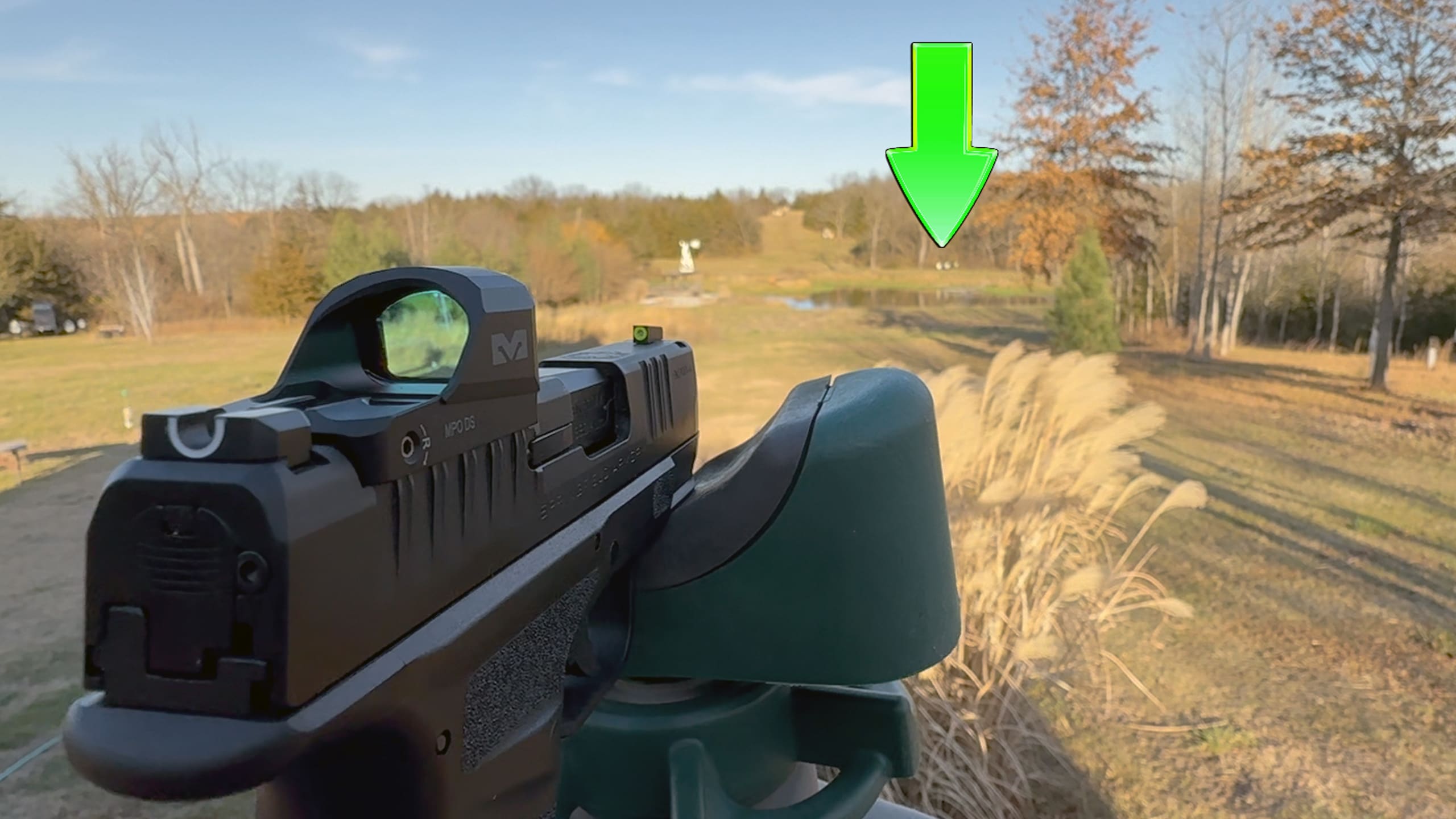
Before we begin, let’s just address the elephant in the room. What is “long-range” with a pistol, especially in a caliber like .380? That is a fair question, so let’s just start with the simple fact it is FUN to see how far we can go, to push our skills and develop our technique for shooting accurate/tight groups at appropriate distances.
While we all have different definitions of what “fun” is, for me it’s not mag dumping at five yards, even if that is an appropriate target-engagement distance backed by statistical data. I can lunge forward and engage a target in seconds at that distance — not to mention put all rounds center mass as fast as I can pull the trigger. Most folks that practice at all can do the same.
The Question
The farther back we go, the more difficult it becomes. Those that want to argue about what is too far to engage a target usually fail to ask “why” it becomes exponentially more difficult the farther back we go.
The farther back you go, the more your mistakes, training gaps and bad habits get magnified — exponentially. Doing what is easy is not going to improve your skills compared to really testing and pushing yourself. I train on the simple premises, push my training to the limits, challenge myself and my skills, and try to develop a growth mindset.

If I can mag dump accurately at 25 yards or even 50 yards, what are my groups and speed going to look like at 5, 10, or 15 yards? I have been asked a lot over the years how you can get to be a good shot. For me, it was not practicing point-blank.
There are a couple other things worth mentioning regarding training at longer distances. The statistics show that majority of shootings for self-defense or even law enforcement happen under 15 yards. I did my own test measuring distances out in public. Most all store aisles are 15-25 yards long and, in the big box stores, they can be 100 yards long. I’m not saying one should engage targets at this distance, but it does give pause regarding only training at five to 15 yards.

Training at distance will quickly show you what you are doing wrong, from “flinching” to jerking the trigger, as well as your reset of the trigger, aiming, stance, etc. It will do all the same for the ammo you are using along with gun and optic. If they are not of good quality, distance-shooting can become impossible. I want to know the gun, ammo, optic are capable of shooting better than me if my life depends on it. I hope this gives you some insight as to why I like to take my pistols the distance. With that said, this brings us to the Hellcat .380 ACP.
The Platform
In my opinion, too many folks underestimate the effectiveness of a .380 ACP for self-defense. We are not talking about law enforcement or military and needing to penetrate barriers, here. The .380 is for self-defense, and typically for concealed carry. It does not have the speed and energy of a 9mm, but it does have less recoil, and is often smaller, lighter and easier to conceal. Many prefer the .380 because they either lack the necessary hand strength to manage a small 9mm’s recoil, or simply the strength to rack the slide.

When it comes to concealed carry, Springfield’s Hellcat series has an outstanding reputation for accuracy. Does the .380 Hellcat align with the reputation of the 9mm?
Let’s check out the .380 Hellcat, see what we can get for accuracy at “normal” distances using a variety of ammo, and then have some fun. Let’s see what we can do at 25 yards standing and benched, then 50, 100, and if can we hit the steel at 200 yards. Seriously? Hitting the target at 200 yards with a .380 ACP concealed carry gun? It will be fun to try, either way.
I will be using Meprolight’s MPO DS micro red dot optic for this review. Using iron sights are perfect and often preferred for those close-distance, quicker-target-acquisition shots in my opinion. However, as I move back in distance, it does get harder because the front sight post gets larger and larger over the target.

Live The Armory Life. The latest content straight to your inbox plus an automatic entry to each of our monthly gun giveaways!
At 50 yards, the font post covers about half my full-size IDPA steel target. At 100 yards, it extends beyond both sides of the target and, if I have to adjust elevation, can completely obscure the target — which it does at 200 yards. This is why I prefer red dots outside of really close distances.
With that said, when I first received the gun, I did test it literally straight out of the box with iron sights and was able to hit the steel easily at 25 yards with the iron sights, hitting 10/10 in 4.21 seconds (see video). It did get much more difficult at 50 yards, only hitting 2/10 at 100 yards standing. I didn’t even try at 200 as I can’t see the target behind the front sight post.

I put the MPO DS red dot and got it zeroed at 25 yards. I was able to get really tight groups at 25 yards benching it with a variety of ammo. Take a look at the groups and see what you think; I know I was really impressed. I did a companion piece for The Armory Life where I tested my picks for the top .380 ACP self-defense rounds with this gun, and you can see it here.
The Foundation
Before I started really pushing the distance after checking its accuracy benched at 25 yards, I wanted to quickly test it out back at the CQB range and make sure it functions flawlessly at more acceptable engagement distances like 10-15 yards on various targets and out to 25 yards. I had no problems consistently engaging targets (see video), rapidly and quickly transitioning between them.

Now that we know it is more than capable of doing what it was designed for, let’s see just how far we can go. Can we consistently hit the steel at 100 or even 200 yards? As you can see in the images, the targets get really small at those distances and even the dot is covering a large portion of the target. In the images, you can see the problem with using the iron sights as they completely obscure the target at those distances.
Before going to longer distances, I wanted to see what I could get at 50 yards, standing. With AAC’s FMJ range ammo, I was able to get 6/10 hits in 10.5 seconds. I wanted to see if I could do better with Hornady’s American Gunner and, much to my surprise, I was able to get 8/12 in 11.6 seconds.

I started off benching it at 100 yards. After a couple of mags with limited success, I found the needed adjustments due to distance and was able to hit 6/10 from the bench. Typically, once you find where you need to aim, you get pretty consistent results. It does take some patience and time at that distance, but it’s worth it in my opinion. It is a lot of fun being able to do that. I was really surprised how well I was able to do standing at 100. You will have to see the video and decide for yourself.
Then it was time to see how well I could do at 200 yards from the bench. After finding the adjustments I need to make for holdover and wind, I was able to get five hits in a row at 200. It was challenging to say the least, but five in a row demonstrates it was more than just luck. Was it FUN? Heck yes!

I truly believe your skills improve the most when you push yourself, and nothing pushes you more than shooting at distance. It also saves you a lot of ammo! That’s right, when you shoot at distance, you have to take your time, concentrate, and you end up going through a lot less ammo than doing mag dumps at five to 10 yards. Of course, you want to make sure you are good to go at those distances, but why not try something different if you don’t shoot at distance?
Conclusion
The Hellcat .380 ACP is exceptionally accurate at normal engagement distances, so much so that you can push the distance to the limits. For many of you reading this, this gun will perform better than you can shoot. It certainly did for me.
Editor’s Note: Please be sure to check out The Armory Life Forum, where you can comment about our daily articles, as well as just talk guns and gear. Click the “Go To Forum Thread” link below to jump in!
Join the Discussion
Featured in this video



Read the full article here