


Samuel Riner may only be in his mid-20s, but he already has more than a decade of knifemaking experience under his belt – and his goal this year is to showcase his work to its widest audience yet.
Riner got his first taste of the craft as a kid. His father was actually in the handle material business, creating and selling Micarta slabs for knifemakers. “He showed me the basics, and then I taught myself from there,” Riner tells us. “I was fourteen when I first felt like making a knife – and I had some equipment, so I made my first knife out of O1.” Some business owners will keep the first dollar they ever earned, but in the knife world we do things a little different: Riner still has that first knife and, while it’s retired from active duty, he keeps it around as a reminder of the long art of knifemaking. “I made about 50 knives before I turned out anything that was any good,” he says – a real grind. “Everything takes more time than you imagine.”
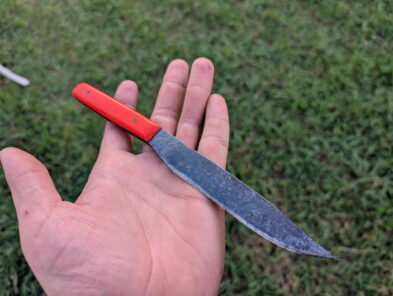
But those dozens of practice pieces firmed up Riner’s understanding and allowed him to get where he is today, turning out handmade bushcraft and EDC fixed blade knives in his Tennessee-based shop for a growing and loyal group of fans. “Most of my customers are return customers,” says Riner. “Most have bought at least five, but I have one guy who’s bought more than 60. He gives them out as gifts. [editor’s note: we’d like to be on that gift list]”.
Riner says his reputation rests on his focus on performance. He won’t add a model to his portfolio without a prolonged period of testing. “Before I make any of a model to sell, I do a pretty thorough test on it. I baton stuff, make feather sticks, chop through nails…it’s several hours of extreme torture.” Another important element of this grueling testing regime is the penny test. “I also do a penny cut: a put a penny on a stump and baton through it, then see if the knife can still cut paper.” Riner says a knife is ready to sell when it can pass this exam. “I’ve probably cut through fifty dollars worth of pennies.”
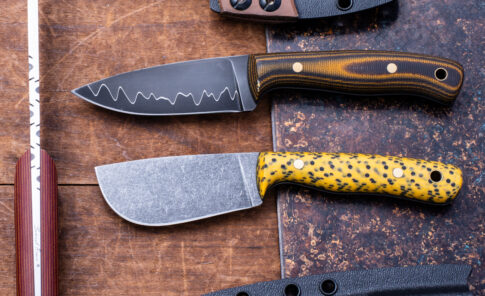
Having a craftsman father gave Riner an intimate understanding of the machinery and processes of handmade tools, and the amount of custom-made implements in his shop imbue his work with its particular character. “We’ve actually made most of our equipment: forge press, grinder, rolling mill,” Riner tells us. And yes, all of his handle scales are produced by Riner, who scours local outlets for suitable cloth and then works it into 14×14 slabs of usable composite. “I make the Micarta here too. All my handle materials are made in-house from whatever cloth I can find.”
In the past, Riner made knives full time, and he says he wants to get back to that point. He has partnered with KnivesShipFree to bring a selection of his pieces to new users, growing his reputation for reliable, handmade tools. “Right now, I’m working with KSF to develop a line that people like.” Most importantly, he wants to continue to grow the skillset he has been cultivating since he was a kid. “I just try to make the best knives I can. I’m hoping to get back to doing it full time and taking care of everyone.”
Knife in Featured Image: Samuel Riner Knives Slim Defender
The information provided by KnifeNews.com (the “Site”) is for general recreational purposes only. The views and opinions expressed on the Site are those of the author or those quoted and do not necessarily reflect the views of any entities they represent. All information on the Site is provided in good faith, however, we make no representation or warranty of any kind, express or implied, regarding the accuracy, adequacy, validity, reliability, availability, or completeness of the information on the Site. Under no circumstance shall we have any liability to you for any loss or damage as the result of the use of the Site or reliance on any information provided. Your use of the Site and your reliance on any information on the Site is solely at your own risk.
Read the full article here