

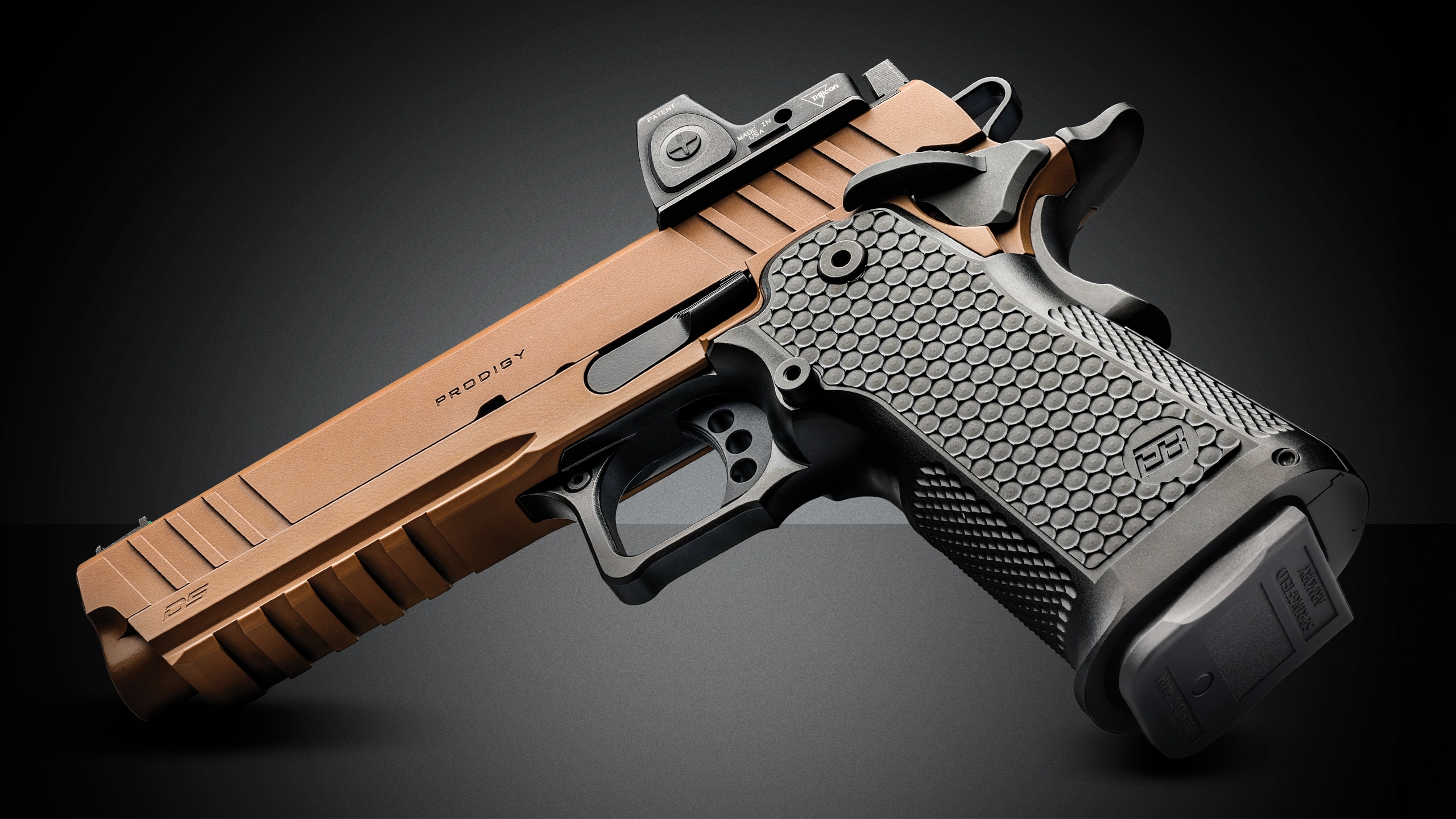
Editor’s Note: The Ed Brown Metal Grip Module reviewed in this article was provided to the author by Ed Brown Products. The 1911 DS Prodigy used for testing the Metal Grip Module was loaned to the author for this review by Springfield Armory.
For the history of the 1911, you might find pistols with two slides, but virtually never with more than one frame. It’s the serialized part specifically fitted to the slide and barrel, containing the fire control parts.
Enter the 9mm 1911 DS Prodigy from Springfield Armory. At first glance, what the pistol brings to the table is double-stack capacity (that’s what the “DS” in the name stands for) to the classic 1911 design. However, a closer look reveals more.
At its core, the Prodigy features a modular design to its frame. Rather than being one piece, the “frame” is a metal receiver (billet aluminum on the compact models, steel on others) that incorporates the slide rails and contains all the fire control parts save the trigger. Attaching to that receiver is a separate, polymer grip module that offers slim dimensions and light weight. It also is replaceable and can be swapped at will.
As a result of this design, the 1911 DS Prodigy takes the classic “old fashioned” 1911 platform into the 21st century with modular adaptability — as well the increased capacity of a double-stack magazine. This opens up a whole new world of possibilities, which brings us to the Ed Brown Products Metal Grip Module we are considering here today.
The Foundation
But first, let’s discuss Ed Brown Products. When a company has been around for nearly six decades, there’s a lot of history there. Ed Brown, the founder of the company, became a part-time gunsmith in 1968 while working full-time as a tool and die maker. For those who aren’t clear on what the job title means, machinists make things while tool and die makers make the things that make the things. It’s a demanding profession where any deviation affects not only what you’re making, but anything it touches.

From that standpoint, it’s unsurprising that Brown (also a successful competitive shooter) was dissatisfied with the quality of aftermarket 1911 parts available at the time, which were of variably quality. Brown launched his own line of gun parts in 1988, was honored as Pistolsmith of the Year in 1991 by the Pistolsmiths Guild, and later began producing his own complete pistols. While Ed himself has passed on, the company he founded continues under the capable guidance of his sons Travis and Wade.
As someone who has been filing on his own guns for the past three decades, I know that Ed Brown parts were always among the best — and still are. I fit my first Ed Brown beavertail in 1996, and he was one of the first pistolsmiths I met when I joined the firearms industry in 2000. I’m installing one of the company’s barrels in a project 1911 right now.
A New Direction
Which brings us back to the topic at hand — the Metal Grip Module for the 1911 DS Prodigy. When my editor at The Armory Life reached out to me about this project, I excitedly accepted. I’ve been very impressed by the Prodigy and, as a fan of Ed Brown products, was excited try out this new accessory for it.

The Ed Brown full-size grip module retails for $599 and is machined from high-grade aluminum and coated with a “Black Gen4” finish. It weighs in at 5.5 oz. You might wonder what the module brings to the table apart from simply being a different material. While the polymer material of the Prodigy’s factory grip module has numerous benefits, an aluminum one allows for more intensive and deep texturing — a concept that Ed Brown definitely ran with on their module.
The Ed Brown Metal Grip Module features a texturing that seeks to balance aggressive grip with comfortable handling characteristics. The sides of the module feature circular-pattern cuts with raised edges that is both eye-catching and highly “grippable.” The frontstrap, rear contours of the frame and the matching (included) mainspring housing have a chainlink texture made of small, overlapping ovals that create peaks and valleys without checkering’s sharp corners, which can cut up hands and jacket linings with equal aplomb. The base of the triggerguard is deeply undercut with a scallop that flows down into the top of the frontstrap, creating a restrained “finger-groove” effect.
Needless to say, I was excited to try this out. So, I put in a request for a test sample Prodigy as well as the Ed Brown Metal Grip Module for the project.
Step-by-Step Instructions for Installing the Metal Grip Module
Swapping the grip module from the Prodigy’s receiver is not difficult if you know your way around the gun bench, and does require some specific steps. First, after clearing the gun, pull the slide back until you can push the slide stop out, then run the slide assembly off the receiver. The full-length guide rod will keep everything in place.

Next, drive out the mainspring housing pin with a punch. Two things. First, the pin has a divot in one side, and I suggest you use it. The other side is domed and, while that may not be a big deal on a steel-framed gun, on the Prodigy that dome can push the punch to one side. If you are not cautious, you can put a mark in the polymer. Second, use a roll pin punch, which has a small, rounded tip that will fit into the divot, and make sure it’s long enough to pass through the extra width of the grip frame. I used a set from Brownells, and they worked perfectly.
Next, slide the mainspring housing down and out, then remove the safety lever by cocking the hammer and rotating the safety up towards the “safe” position until it can be pulled out. Take care when doing this step to avoid scratches. Ambi safeties usually have a mortise joint where the two halves of the cross shaft come together in their passage through the grip safety. You want these to be tight so the two sides don’t flop around.
My solution was to wrap the safety’s contact pad with a piece of leather top and bottom to avoid damaging the serrations, then clamp the safety in a vise and pull the gun away until the safety came out. Just remember to make sure it’s rotated into the correct position, and be ready to catch the plunger tube spring, which will exit the gun the second it can clear the safety.
The right-side lever is held in place by the extended, dovetailed head of the hammer pin, which fit into a blind hole in the back of the safety. A neat arrangement, you simply rotate the safety until it can be pulled straight out to the right. Remove the grip safety and sear spring, then push out the sear and hammer pins to remove the lockwork.

Live The Armory Life. The latest content straight to your inbox plus an automatic entry to each of our monthly gun giveaways!
Normally, this is when you’d remove the mag catch to free the trigger, but not here. On the Prodigy, the trigger is captured until the grip frame and receiver are separated, which starts with removing three screws: one where the front of the trigger guard meets the frame, and the two that looks like upper grip screws. Each of those two screws interface into a narrow plate that will come out when you remove the screws.
For reassembly, the plate should be oriented where the upper flat will bear against a ledge inside the module, and with the beveled side downwards. The smaller screw in the guard is more closely analogous to a Chicago screw, where one side screws into the other, so you’ll need a hex key for either side. Pull the grip frame down at the same angle at which it meets the receiver, and the two will separate. Remove the mag catch and transfer the trigger to the new frame.
You’ll also need to transfer the mainspring housing, cap, pin and retainer over to the machined aluminum housing that comes with the frame. The pin that holds the mainspring cap in place has a flange and installs from the rear into a countersunk hole. Reassembly is in the reverse order.
The Project
As noted, the Ed Brown Metal Grip Module is a full-size unit, which means it is designed to work with the Prodigy pistol’s 17-round (and extended 20- or 26-round) magazines. I decided to top off the module with a 4.25” Prodigy receiver and slide assembly as I prefer that configuration for an EDC/CCW pistol. However, you can just as easily fit out with a 5” full-size assembly.

The lockwork — hammer, sear, disconnect — are all contained in the receiver proper, but since the trigger is housed in the module, I was curious to see if pull weight would change when it’s swapped. With the Ed Brown module, it averaged a crisp 3-lbs., 15.1 oz. on my Lyman scale, a half ounce lighter than with the factory polymer unit.
I’m a sucker for iron sights, but there’s no denying the advantages of a dot. This brings us to an element of the core Prodigy I want to mention — the Agency Optic System (AOS) cut on the slides. Developed in collaboration with Agency Arms, AOS employs plates designed exclusively for the 1911 DS. Machined from billet steel, each plate is designed specifically to deliver proper optic height for intuitive sight picture and instant target acquisition and features an integral rear sight. While I tried out the pistol with Trijicon’s RMR HD 2 on an A14B plate, there’s a plate for just about every popular optic out there.
If you’ve not used the Agency Optic System (AOS) plate system before, first, remove the factory plate with a T10 Torx wrench, lifting from the front, then slip whatever plate you need into place, being careful to slide the rear under the lip that holds it in place.
Testing the Metal Grip Module on the Shooting Range
Now, off to the range, where I shot the Ed Brown-equipped pistol alongside a factory polymer grip frame model for a total of 200 rounds. This is the third 191 DS I’ve shot, and all have been quite accurate. Although most of my handheld groups were in the 3” range at 25 yards (which is quite good), my best measured group came just under .75”, fired standing unsupported. Yes, you read that right. That was with Hornady’s 124 +P American Gunner JHP, which is a consistently great performer in my experience.

I didn’t put a shot timer on it, but I should have: double-taps were effortless, with both casings seeming to exit the gun as a single unit. And this is where the Ed Brown frame really shone. Shot to shot, I found that I could easily run the gun very fast. It’s texturing was aggressive, but still comfortable. It really seemed to strike a sound balance between comfort and shootability.
Conclusion
The 1911 is renowned for many things — but modularity is not usually one of them. However, the 1911 DS Prodigy has helped shift that paradigm. With the swappable grip module design, it has opened up an opportunity for users to try out some exciting options for the popular pistol.
That’s where the Ed Brown Metal Grip Module steps in. If you want the modern modularity of the double-stack 9mm 1911 DS Prodigy, but are looking for a more “traditional” metal material — along with some excellent ergonomics and texturing — the Metal Grip Module from Ed Brown definitely deserves a close look.
Editor’s Note: Please be sure to check out The Armory Life Forum, where you can comment about our daily articles, as well as just talk guns and gear. Click the “Go To Forum Thread” link below to jump in!
Join the Discussion
Featured in this article


Read the full article here