

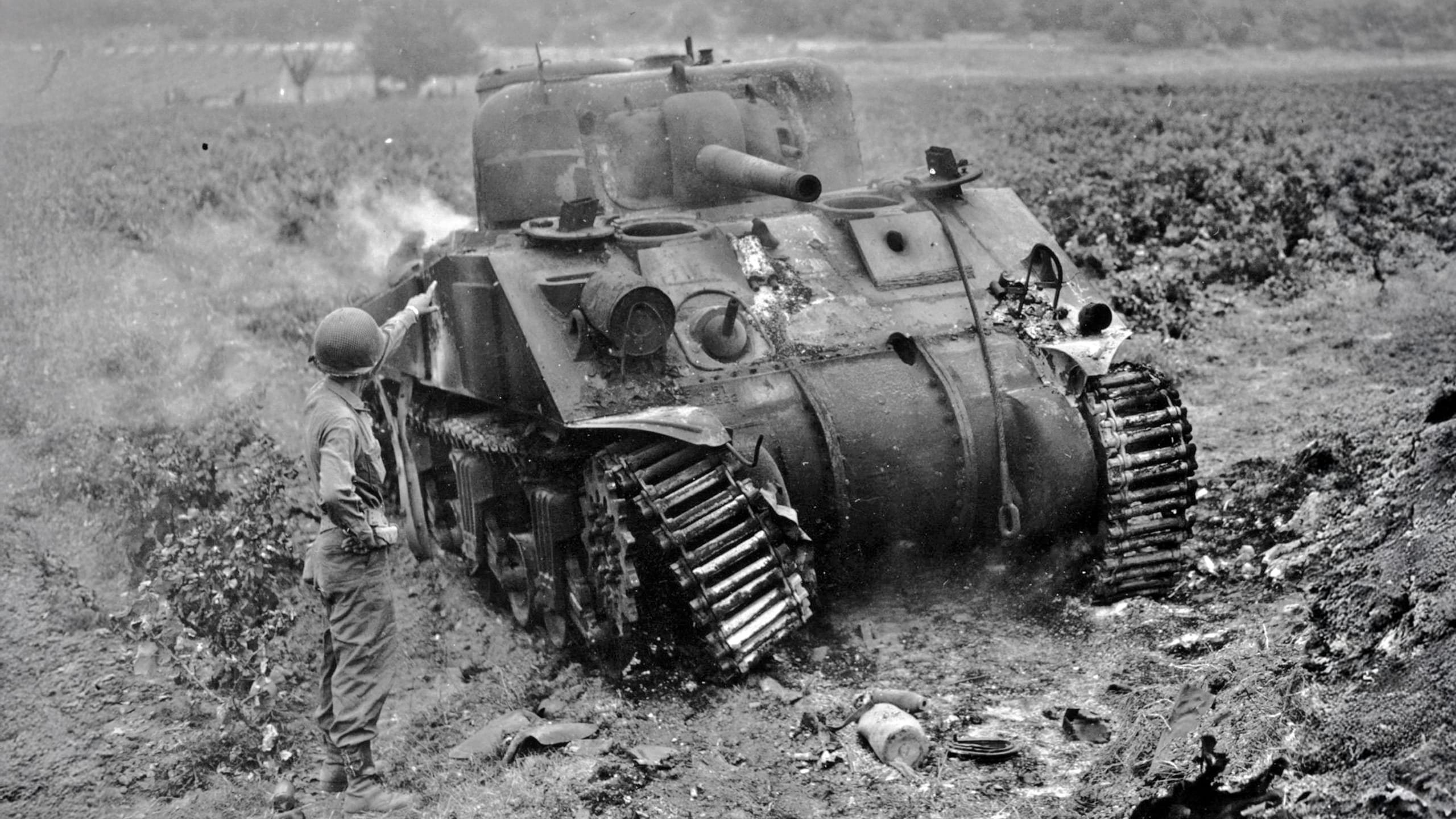
Since World War II, arguments have raged over the abilities of German tanks compared to those of the Western Allies. AFV enthusiasts and armchair generals have debated the merits of the thick armor protection and big gun armament of German armored vehicles versus the less protected and under-gunned, but mechanically reliable and numerically superior British and American tanks — particularly the Sherman. Sometimes, these arguments can make you wonder how the Allies ever won the war in Europe.
There are many who deride the Sherman tank, both then and now. Many believe they have good reasons for their negative views of the M4 Medium Tank. Large numbers of Sherman tanks were lost in Western Europe, and casualties among their American, British, and French crews were frighteningly high.
Often overlooked in these debates is the fact that the M4 Sherman was designed as an infantry support tank, with little attention paid at first to tank-fighting. During the fighting in North Africa, the Sherman was the equal of most German tanks. In Italy, a disparity in tank armor and armament became apparent due to the appearance of the German MK V Panther, believed by American intelligence to be a heavy tank, and expected to be seen only in small numbers. In truth, the Panther was a medium tank, and large amounts of these dangerous vehicles were waiting in France.

Even as late as April 1944, the U.S. Army’s New Weapons Board reached this rather naive conclusion about advancing the Sherman tank’s armament:
“Although it is quite unlikely that tank units will be assigned specific missions of combating enemy tanks and anti-tank guns, tank-vs.-tank and tank-vs.-anti tank combat is often brought about by enemy counterattacks and defense installations. Owing to this fact and the fact that an increasing number of armored pillboxes and fortifications are being encountered, more powerful tank armament is indicated.”
With D-Day just two months away, the process of up-gunning the Sherman was well behind schedule. Even so, a little more than 100 of the 76mm gun armed M4A1(76) tanks were available by the start of Operation Cobra, the breakout from Normandy in late July 1944. The up-gunned Sherman performed well in some ways, but not as well as expected in others.
A Deadly Foe?
One of the American 76mm gun’s primary hobgoblins was the Panther’s front hull armor, 80mm thick and sharply angled at 55 degrees. The Panther’s frontal protection proved difficult for American anti-tank weapons (less than 90mm) to handle at reasonable combat ranges. And by mid-1944, the Panther was showing up in ever-increasing numbers. While Sherman crews were discouraged about their tank-fighting abilities, several U.S. combat leaders were increasingly worried.

General Eisenhower was furious when he got the news about the new 76mm gun, and Ike raged:
“You mean our 76 won’t knock these Panthers out? Why, I thought it was going to be the wonder gun of the war. Why is it that I’m the last to hear about this stuff? Ordnance told me this 76 would take care of anything the Germans had. Now I find you can’t knock out a damn thing with it.”
The “76mm Gun, M1” wasn’t useless, but it certainly wasn’t as useful American tankers needed it to be. Meanwhile, the Sherman tanks really were providing infantry support much more frequently than they were fighting German tanks — but when they did face enemy tanks, they believed they were under-protected as well as out-gunned.
More powerful ammunition was part of the anti-tank solution, and when the 76 mm T4 (M93) High-Velocity, Armor-Piercing Tracer (HVAP-T) rounds became available, some hope was restored. But there were never enough T4 rounds to meet the need, and despite the HVAP ammo’s tremendous muzzle velocity (3,400 fps) it still couldn’t penetrate the Panther’s frontal armor at 900 yards.

Ultimately, the answer came in a brutal equation of sacrificing men and machines. American troops and their M4 tanks were on the offensive. The armored numbers game required overwhelming the Panzers with an abundance of very good (but never truly great) Sherman tanks.
American tankers faced this significant challenge and literally fought their way through German panzer divisions with the tools they had at hand, coupled with tremendous courage and incredible skill. There were no easy answers in the armored war of 1944-45, but American tankers maintained their momentum and aggressiveness, and the highly reliable, mass-produced Sherman tanks proved good enough to roll on to victory.
In Their Words
I spent some time researching the wartime comments of American Sherman commanders and crews about their vehicles and the German armor they faced.

One of the first things to come up was the infamous German 88mm gun. A tank commander from the 745th Tank Battalion provided this advice in the December 1944 edition of “Battle Experiences”:
88 Fever: “Replacements should be taught the advantages of our tanks over those of the enemy, instead of constantly being told of the effect of the German 88mm gun. Although our tank guns will not always penetrate the frontal armor of enemy medium tanks, our Sherman tank is faster, more maneuverable and has faster turret action than any tank the Germans have. Their slower turret makes it difficult for them to track our tanks.”

Live The Armory Life. The latest content straight to your inbox plus an automatic entry to each of our monthly gun giveaways!
A U.S. intelligence report from April 1945 features comments from American armored commanders about their vehicles and their ability to compete with German tanks. It certainly doesn’t sugarcoat anything, but it does not take an “all-is-lost” attitude either. The report was originally classified as “Secret”.
To: CG, Com Z
Thru: G-4
From: AFV&W Section
Date: 9 April, 1945
- The statement, “It is said that it takes three of our Shermans to knock out a “Tiger”, is an unfortunate generalization that cannot be proved or disproved by facts.
- There are instances of infantrymen destroying a “Tiger” by small arms fire, or a light tank destroying one at point blank range.
- There are instances of a “Tiger” tank accounting for three or four Sherman tanks.
- There are no figures available on the total number of Sherman tanks destroyed by “Tiger” tanks, and the total of “Tiger” tanks destroyed by Shermans.
- From D-Day to 20 March 1945, Ordnance records indicate the following total losses in combat vehicles have been sustained by Sixth and Twelfth US Army Groups:
Medium tanks: 3,757
Light tanks: 1,205
Tank Destroyers (SP): 739
TOTAL: 5,701

There is no accurate compilation of German tanks and self-propelled guns destroyed by US forces available at this time. The Enemy Logistics Section, G-2, SHAEF, estimates that the Germans have sustained the following losses on the Sixth and Twelfth Army Group fronts from D-Day to 1 April 1945, as a result of ground action:
Tanks: 2,200
Self-propelled guns: 2,500
TOTAL: 4,700
(This section is initiating a study on German combat vehicle losses from records compiled by the respective Army Artillery and Armored Officers.)
- A majority of American tank losses have been caused by German infantry hollow charge weapons, emplaced anti-tank guns, and self-propelled anti-tank guns. It is estimated that less than 200 “Tiger II” tanks (the original Tiger tank is obsolete), and less than 1,500 Panther tanks have been encountered by US forces.
- In breaching a defensive line it is necessary to place tanks well forward to give the infantry the close support desired. In a breakthrough operation, tanks spearheading the advance are bound to encounter concealed tanks and anti-tank guns overlooked by the cavalry screen. Therefore, tank losses are relatively high for any offensive army.
- In a frontal encounter with a “Panther” or “Tiger” versus a Sherman, the American tank is at a distinct disadvantage because of the superior armor protection and the superior armor penetration performance of the principal armament of the German tanks. The American tank, if armed with a 76mm gun, can risk a lucky hit on the front plate of a “Panther” with special high velocity ammunition (“HVAP”); otherwise the tank has to maneuver to the flank of the German tank where he can destroy it by attack against thinner armor plate. (Approximately 40% of Shermans in the hands of our troops are equipped with the 76mm gun — as opposed to the 75mm gun.)
- American tanks are equipped with a turret power traverse mechanism superior to the one installed in German tanks. This permits the Sherman to get in the all-important “first shot” in most instances.
- It should be remembered that it was not intended tactically that American tanks would have to “slug it out toe-to-toe with other tanks”, and they were not designed to meet this requirement. It is believed that the Heavy Tank T26E3, now being received in increasing quantities (April — 200) provides a tank better able to withstand enemy attack, and to destroy German armor with a minimum of US tank losses.
- There is attached as Incl No. 4, extracts from correspondence from combat commanders received by the undersigned, relative to the merits of our tanks.
J.A. Holly
Brig Gen, USA,
Chief, AFV&W Section.

In “Extracts from correspondence from combat commanders as to the relative merits of American and German tanks”
- Major General Edward H. Brooks, CG, VI Corps, (then CO, 2nd Armored Division), 23 June 1944:
I quote a statement by a British Armored Division Commander:
“The outstanding point about the tanks is that the German TIGER and PANTHER is an infinitely superior tank to the CROMWELL or SHERMAN. That is a fact and a disturbing fact, as again we have fallen a long way behind the German in tank design.”
“I agree with this statement wholeheartedly. I feel that we can take the Germans with the stuff we have, in the country we are fighting now, but a few weeks hence when the county opens up the great value of armor will be lost unless we have a gun that can shoot it out on more even terms with the German PANTHER and TIGER tanks.”
- Colonel Peter O. Hains, III, Armored Officer, First U. S. Army, (Formerly CO 1st Armored Regiment, 1st Armored Division):
- 28 July 1944:
“In our recent operation we have met and defeated a large number of PANTHERS. I have some officers making a survey to determine how they were knocked out. A preliminary survey indicates that proper technical employment i.e. flanking fire, guns in depth, guns mutually supporting, obtained our successes. There can be no question about the effectiveness of the 75 mm or 3-inch gun when employed in this manner. Unfortunately, sometimes they have to meet head on and as you know, we are on the wrong end of the stick when that happens.’
“As a result of our recent operations it is more apparent than ever that the 75mm gun M4 Tank is obsolete. That is, it cannot be employed successfully where German armor is present in any quantity. I recently visited several of our armored units, particularly the 2nd Armored Division, and they are very specific and firm in their feeling that the 75mm gun in the medium tank is unsuited for their operations. They state that the crews have suffered from German gunfire at 3000 yards to such an extent that they have lost confidence in these tanks because they feel that they are unable to fight back and can only stand for the kill or run away. They have confidence in the 76mm gun tank because they have at least a sporting chance of fighting back. This condition has become critical and I feel that we must increase our efforts to obtain the 76mm and speed up the delivery of the 90mm. Unless you have seen the Royal Tiger, you can have no conception of the terrific size and power of this tank. When Panthers and Tigers are present on the battlefield, as they have been lately, it is a serious strain on the morale of our units to fight them with 75mm gun tanks.

- Colonel W.P. Withers, CO, 17th Armored Group, 20 February 1945, (relative to superiority of U.S. turret power traverse mechanism):
“The number of seconds it takes to turn those Kraut turrets is a matter of win or lose in a battle sometimes. We have definitely had instances where for some reason, the Tiger or Panther did not swing their guns on our tanks, thus allowing us to destroy them at 900 yards.”
- Colonel H.A. Sears, Commanding CCA, 4th Armored Division, (then CO, 17th Armored Group), 18 December 1944:
“One of our gunners complained the other day that it was a bit discouraging to bounce eleven shots off a German tank and have it keep on going. He was shooting a 75. 75s bounce off the new “Royal” job. On the other hand it is interesting to note that the German PW’s have complained that it takes three minutes for them to traverse 360 degrees while our power traverse whips around in nothing flat, so I guess we all have good features on our vehicles but you just hear more about the gripes.”
Conclusion
Brigadier General Holly makes several interesting points in his notes. He reminds that the Sherman was never conceived or designed to be a tank-fighting vehicle. He also notes that any attacking army is likely to take higher casualties to achieve their objectives. Given the date that this report was written, with victory within sight, the time to rethink American tank development and doctrine had long passed.
The incredible bravery and ingenuity of American tank crews, coupled with the adaptability and overall quality of their vehicles, had ultimately beaten the best the Germans had to offer.
Editor’s Note: Be sure to check out The Armory Life Forum, where you can comment about our daily articles, as well as just talk guns and gear. Click the “Go To Forum Thread” link below to jump in!
Join the Discussion
Read the full article here