

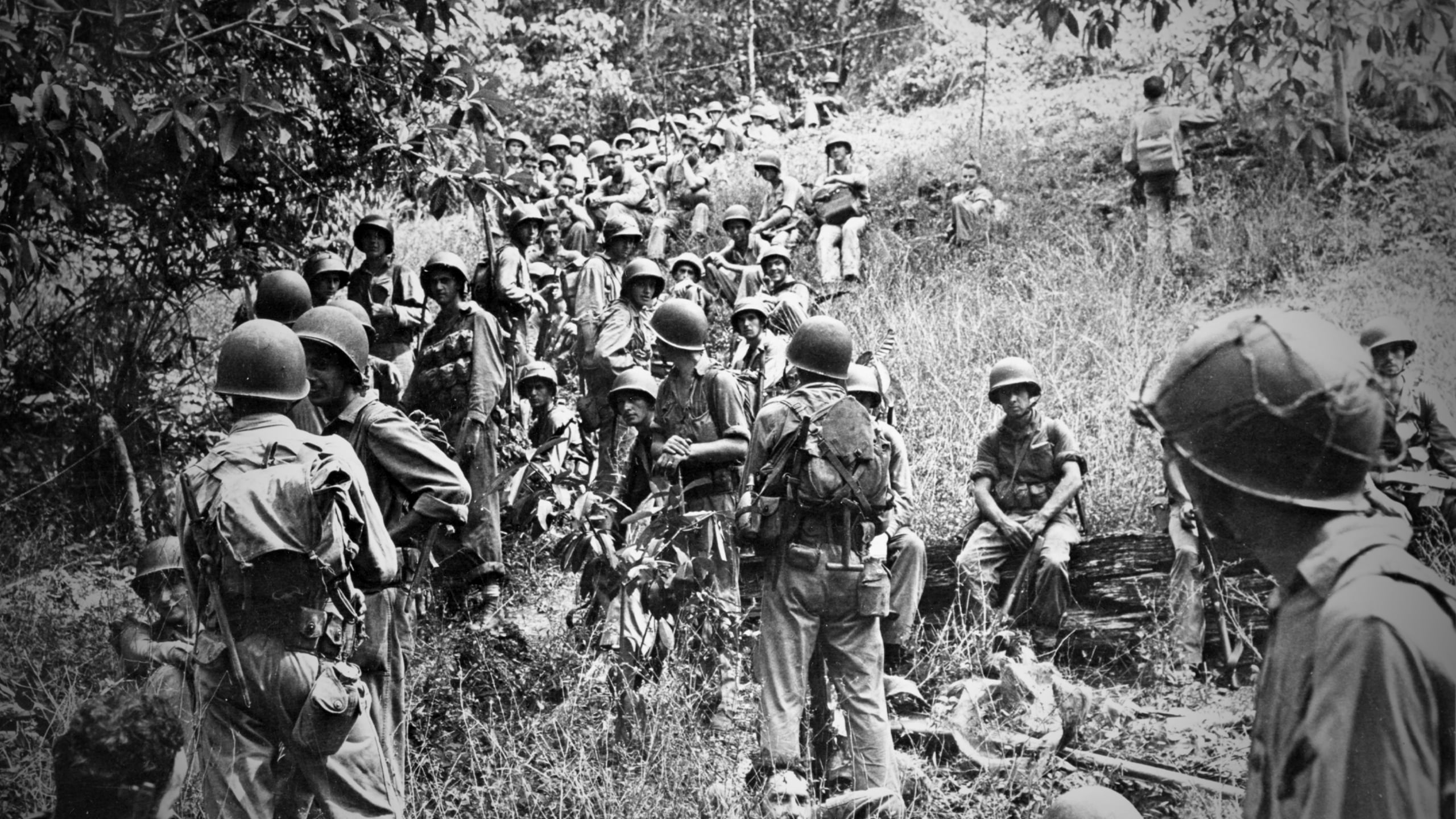
“It was scary, you know? The damnedest thing…” The old Marine flicked at a bright yellow tie he was wearing. “We were ordered to take Atabrine to prevent malaria. Most of us did that but it tended to turn our eyes and skin a bright yellow. And then a rumor started that the stuff would make you sterile. As if the jungle and Japs weren’t bad enough … .”
A few other aging veterans of the 1st Marine Division during World War II had lots more to say as they reminisced about service in the South Pacific, but each time the Battle of Guadalcanal was mentioned, the atmosphere got dense and stories mostly turned morose. “The Japs had it right,” another vet added. “They called Guadalcanal the island of death.”

Very few remain with first-hand experience of combat on that island in the southern Solomons, but every Marine knows from the history lessons drummed into their psyche at boot camp that Guadalcanal was the first American offensive action following the Japanese attack on Pearl Harbor.

That brutal campaign stands out in military history for a number of reasons. One of those is the sheer sustained violence of the fighting in the Guadalcanal Campaign that took place in all three dimensions: sea, land and air. And in no other campaign of World War II did the outcome of a battle hang in a precarious balance for an extended period with one side and then the other gaining the upper hand.
A New Era
Beginning on August 7, 1942, and continuing for six bloody months, the Guadalcanal campaign was marked by seven major naval engagements, 20 or more ground combat engagements, plus daily clashes in the air over the Solomon Islands that frequently morphed into brutal battles between ships and attacking aircraft. Guadalcanal gave all participants an early and shocking look at what war in the Pacific Theater of Operations would involve. It was not pretty.

The Pacific War, which began for the U.S. on the 7th of December, 1941, caught the American forces flat-footed and staggering like a dizzied boxer after a standing eight-count. The normally resilient American self-confidence was shaken to its core. The United States armed forces needed to come out swinging against a Japanese military armada, an experienced air, land and sea force that had carved a bloody path through China and Indonesia and had conquered American outposts at Guam, Wake, Bataan and Corregidor in the Philippines.

While as a result of continuing pressure on the United Kingdom from Nazi Germany the U.S. had agreed with allies on a Europe-first agenda for the war, it was clear that the Japanese juggernaut on the other side of the world had to be stopped. That would, by nature of the Pacific battlefield with its vast stretches of open ocean and island strongpoints, make it primarily a naval and amphibious exercise. And that would, by nature of their training and experience, make it a job for which the U.S. Marine Corps was ideally suited.

What planners in Washington and Hawaii needed most desperately in efforts to stymie Japanese conquests in the South Pacific were locations that featured both space for an airfield and a deepwater anchorage to support warships. The Solomons had both, and orders were cut for Operation Watchtower. It was designed to seize Tulagi, Santa Cruz, and then Guadalcanal where the Japanese were already in the process of building an airfield.
Fighting for a Foothold on Guadalcanal
Enter the understrength 1st Marine Division, commanded by Maj. Gen. Alexander A. Vandegrift. He would lead his forces ashore in the Solomons on August 7th.

As usual under U.S. doctrine for amphibious operations, the Navy exercised overall command until Marines hit the beach. Command then shifted to the senior Marine officer in the landing force. For Watchtower, Vice Adm. Frank Fletcher commanded the Allied expedition, with Rear Adm. Richmond K. Turner in command of the amphibious force. That mixed command issue was nothing new to the Marines, but it caused significant problems early in the Guadalcanal campaign.

Gen. Vandegrift’s division was short one full regiment, with only the 1st and 5th Marines scheduled to hit the beaches for Operation Watchtower. The division’s third infantry regiment, the 7th Marines, had been detached earlier in the year to serve as garrison security on American Samoa to guard vital Pacific supply lines.

Vandegrift’s grunts landed in the Solomons with legacy rifles — the revered M1903 bolt-action Springfield — as well as an admixture of experimental weapons. Some units tried out the Harrington & Richardson M50 Reising submachine gun to supplement their M1928 Thompsons, and the attached Parachute Battalion of the division made a surface landing with some M1941 Johnson rifles. Neither of these experiments proved very successful in subsequent fighting.

For the most part, infantry fire support on Guadalcanal — other than what was provided by artillery from the 11th Marines (75mm and 105mm cannon and howitzers) — was provided by water- and air-cooled .30-cal. machine guns, organic mortars (81mm and 60mm) and the well-respected M1917 BAR.

While some of his forces were still mopping up after a stiff fight on Tulagi and adjacent small islands, Vandegrift led his Marines ashore between Koli and Lunga Points on the north side of Guadalcanal proper. To everyone’s surprise — and the infantrymen’s delight — they met almost no opposition.

By the afternoon of D-Day for Watchtower, the partially built Japanese airfield was in Marine hands. That prompted an immediate reaction from Japanese forces on Rabaul, which launched the first of what would become regular airstrikes and heavy bombing raids on the Marines spreading out on Guadalcanal.
Marines On Their Own
The next night (8 August), while Marines searched for stronger enemy presence on Guadalcanal, the U.S. Navy encountered a major Japanese task force and got badly pummeled in a chaotic surface engagement in full darkness that became known as the Battle of Savo Island.

As a result, Admirals Fletcher and Turner decided the risk to their remaining task force warships was too great and steamed away from the southern Solomons. They left with half of the Marine division’s allotted supplies, which would create critical, painful shortages in future actions, not to mention some significant bad feelings about the Navy among the Marines who felt like abandoned orphans on Guadalcanal.

Marines would have to make do with only what was delivered at Lunga Point before the Navy left. Regardless, Vandegrift knew priority one was to get that airfield completed, so all hands went to work using mostly captured Japanese equipment and lots of sweat in the jungle heat.

They had it ready to launch and recover aircraft by August 12th and promptly christened the shabby facility Henderson Field. This was done to honor Marine aviator Maj. Lofton R. Henderson, who was killed in action during the Battle of Midway. What the Marines did not have at this point was aircraft.

That situation was resolved on August 20th when a U.S. Navy carrier arrived to deliver Marine squadrons of Grumman F4F Wildcat fighters and Douglas SBD Dauntless dive bombers. Two days later, the U.S. Army Air Force got into the fight, landing five Bell P-400 Airacobras.

This aviation element was promptly dubbed the “Cactus Air Force” after the allied codename for Guadalcanal. Marine and Army aviators began launching sorties almost immediately and prompted what would turn out to be almost daily enemy air attacks on Henderson Field. This airfield became the center of the Marine perimeter as well as a high-profile target for later Japanese ground attacks.
Mounting Costs of the Battle of Guadalcanal
The Marines were in some serious logistical jeopardy on Guadalcanal. Only five days of rations had been landed from their transport ships before the Navy left. Cobbling that together with captured Japanese provisions gave the Marines only a two week food supply.

To conserve, Marines were limited to two meals each day. That not only sapped strength, but also combined with the heat and humidity and the constant labor on the airfield and defensive positions surrounding the Marine perimeter to create a very dire situation. Very soon a severe strain of dysentery swept through division units and, by mid-August, one in five Marines were afflicted.

Live The Armory Life. The latest content straight to your inbox plus an automatic entry to each of our monthly gun giveaways!
Malaria also started to take a toll to the point where it became a sort of campaign symbol. As a matter of course, if you served on Guadalcanal you had dysentery, malaria or both. Atabrine was issued and Marines gobbled it up until some rumormonger spread the word it caused men to become sterile. That put a crimp in things and unit Hospital Corpsmen began to inspect mouths to insure the Atabrine was swallowed as directed. The entire Guadalcanal force was taking on a distinct yellow tinge to skin and eyeballs.

Ground combat skirmishes continued at various spots in the thin perimeter around Henderson Field and Lunga Point. In late August, Japanese forces made the first of many major attempts to recapture Henderson Field. It took the form of a night attack by the newly landed Imperial Japanese Army (IJA) 28 Infantry, which hit positions near Alligator Creek, a swampy tributary of the Ilu River.
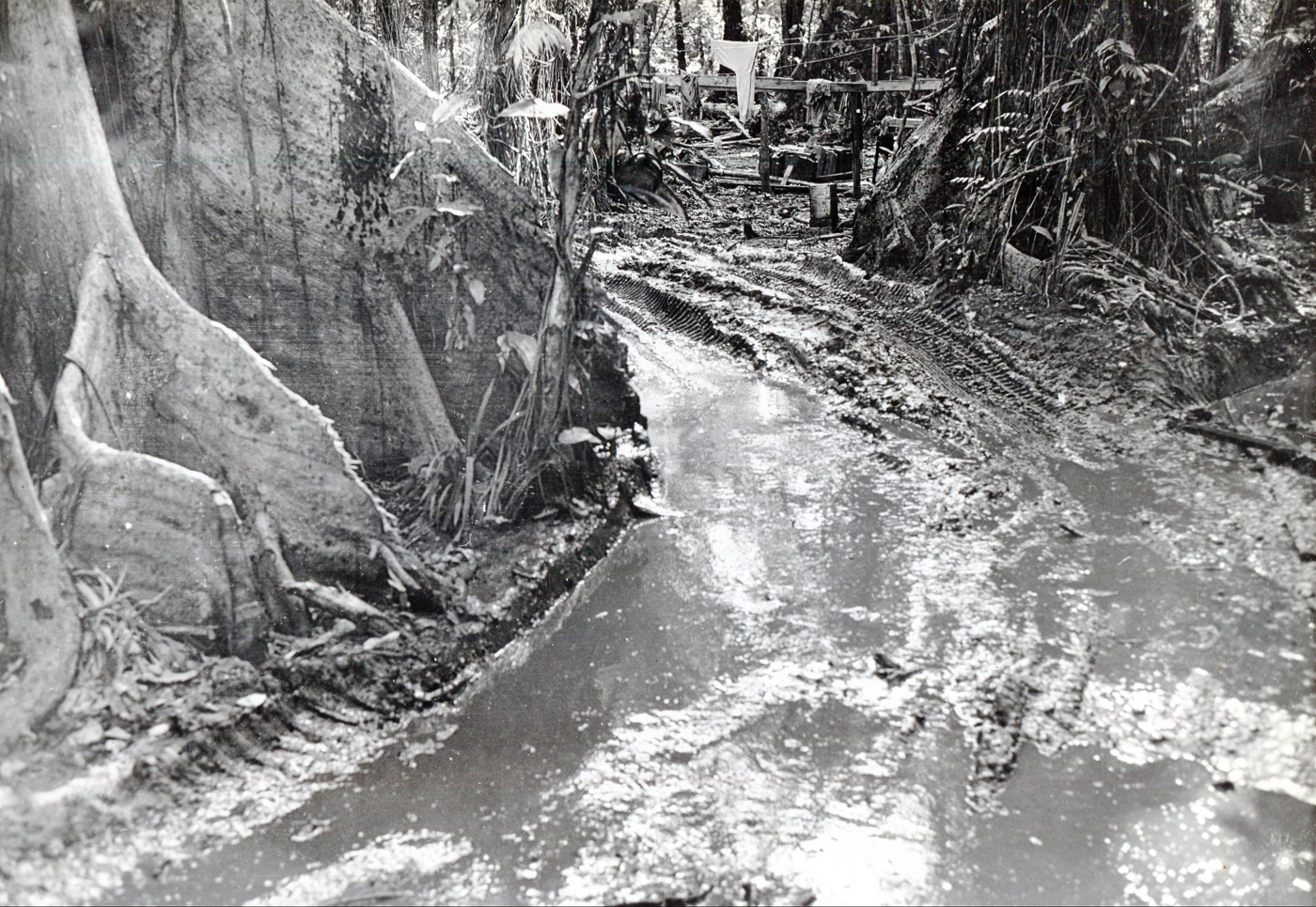
Tipped off by a local islander scout named Jacob Vouza, the Marines were ready for the fight. Crossing the creek and a nearby sandbar was a disaster for the Japanese, who lost more than 700 KIA — mostly to converging machine gun, AT cannon, mortar and rifle fire from elements of the 1st Marines. Only about 30 men of the assaulting units survived to crawl back into the jungle.
The Return
Earlier in the campaign, Allied naval forces had taken a serious pounding in the Battle of Savo Island, a night action in which they lost four heavy cruisers. Payback came in late August. In a furious carrier-based fight, Allied sailors and aviators pummeled the Japanese, forcing them to withdraw from the eastern Solomons. While Japanese warships steamed away to refit and repair battle damages, enemy efforts to reinforce and resupply their troops on Guadalcanal continued.

Japanese logistical efforts using slow transports was just offering fat targets to U.S. aircraft and warships. As a result, the Japanese employed what became known to the Marines as the “Tokyo Express.” It involved stealthy nighttime sorties using fast vessels such as destroyers and light cruisers sneaking down The Slot (New Georgia Sound) to deliver troops, ammunition and supplies. It worked for a while and, by the end of August 1942, the Japanese were able to land their entire 35th Infantry Division and parts of their 2nd Infantry Division staging at Rabaul.

Of course, this large number of men had to be fed and resupplied with ammo. By this time in the campaign the Navy’s PT boats and the Cactus Air Force had gotten wise to the Tokyo Express and started hammering away at anything afloat near the island, day or night. Now the logistics worm had turned and the Japanese forces began to suffer from lack of food. They began to refer to Guadalcanal as “Starvation Island” or the “Island of Death.”
Unrelenting Pressure
Enemy forces on Guadalcanal now included at least two full infantry divisions and supporting arms. Throughout most of early September, the Japanese command on Guadalcanal launched a series of rabid attacks on the Marine perimeter while continuing to pound Henderson Field with daily air raids. One of the most memorable of these ground actions was the attack on what became known as Edson’s Ridge by a brigade of the IJA 35th Infantry Division.

Col. Merritt Edson (known throughout the Corps as Red Mike for his complexion and the fiery beard he sported during service in Nicaragua) commanded the 1st Raider Battalion in a bloody fight for Tulagi in the earliest phases of Operation Watchtower. Transferred to Vandegrift’s command on Guadalcanal, he was in command of a force including his own Raiders, two companies of the 1st Marine Parachute Battalion and 2nd Battalion, 5th Marines, sent to a ridgeline south of the airfield to get a short rest. The Japanese had other ideas and launched a dusk assault with more than 3,000 men. This nearly spelled disaster for the Marines.

Throughout the night the Marines, supported by a battery of howitzers brought up from Lunga Point, turned back wave after wave of frontal attacks, including several episodes of hand-to-hand combat. Defenders were pushed back to the edge of Henderson Field until the attack finally stalled and the Japanese survivors began to melt back into the jungle.

The butcher’s bill was steep, especially for the Japanese brigade that lost 850 killed in the Edson Ridge action versus slightly more than 100 Marines KIA. The fight at Edson’s Ridge was typical of increasing Japanese pressure on Guadalcanal Marines, but help was inbound.

Vandegrift, fully aware that American morale and prestige would suffer if the Guadalcanal campaign failed and, under constant enemy pressure, had appeared to suffer in stoic silence while continuing to ask the chain of command for help in a deteriorating situation.

His prayers were answered in September when a convoy arrived carrying nearly 5,000 men from the 3rd Provisional Marine Brigade. That brought the missing 7th Marines and another battalion of artillerymen from 11th Marines. Also arriving with the reinforcements were vital stores of tents, aviation fuel, ammo and rations. All of this plus some additional heavy construction equipment allowed Vandegrift to strengthen and consolidate a solid defensive perimeter around Lunga point and the jungle environs.

The costs were still high, though, with the carrier USS Wasp (CV-7) being sunk while escorting that convoy, leaving just one operational carrier — the USS Hornet (CV-8) — in the Pacific at the point.
Tipping Point
By the first week of September, Tokyo Express runs continually delivered troops from the Japanese 2nd Infantry Division to Guadalcanal. Vandegrift and his Marines maintained an offensive mindset despite having to hold vital defensive positions to safeguard Henderson Field.

When he deemed pressure on his perimeter had to be relieved, the commanding general sent a large combat team across the Matanikau River where they successfully attacked newly landed Japanese forces. This did severe damage to the IJA 4th Infantry Regiment and forced the Japanese command on Guadalcanal to surrender positions east of the Matanikau. More importantly, it delayed and disrupted their plans for a final, all-out assault to shatter Marine defenses and retake the airfield.

Then came the night of the battleships. Frustrated by the see-saw nature of the situation on Guadalcanal, the Japanese Navy steamed close to Guadalcanal on the night of October 14th with a huge force built around two battleships bristling with long-range 14-inch guns.

From 10 miles offshore, the big ships and escorts opened fire on Henderson Field. It was a frightening and crushing naval gunfire assault that sent everyone on the island running for cover. The Japanese gunners kept up a steady barrage, firing 973 14-inch rounds over an hour and a half. Most of that high-explosive fell on Henderson Field.

“That was the night of the battleships,” a Marine survivor said. “Never seen anything like it. Tore us up something awful…” It was a devastating blow to Allied air power on Guadalcanal, heavily damaging runways, burning nearly all available aviation fuel, and destroying 48 of the Cactus Air Force’s 90 aircraft. Only about a dozen aircraft were flyable by dawn the next day.

While troops were trying to rebuild at Henderson, pressure on perimeter positions steadily increased. In the last days of October, Japanese infantry staged another large-scale, bloody and brutal attack designed to crack the Marine perimeter.

It failed, but Marine defenders took a beating. All Allied eyes in the South Pacific were focused on Guadalcanal by this time, and many observers questioned the ability of the beleaguered Marine force to hang on in the face of tenacious Japanese forces that seemed to magically multiply.

Lt. Gen. Millard F. Harmon, commanding U.S. Army Forces in the South Pacific, convinced higher headquarters that Guadalcanal was becoming a battle of attrition that could end in an embarrassing stalemate. He wanted some of his soldiers to land on Guadalcanal, relieve the exhausted Marines and conduct an offensive out beyond the beleaguered perimeter designed to sweep all Japanese forces from the island.
Hard-Earned Support
In mid-October, the 164th Infantry of the Army’s Americal Division, landed on Guadalcanal, becoming the first U.S. Army unit to enter combat in the South Pacific. The floodgates were opened as Army units relieved Marines, taking up positions in the eastern sector of the Lunga perimeter.

The soldiers got a quick and bloody taste of combat against fanatical Japanese troops almost immediately when elements of the IJA 2nd Infantry Division staged a multi-prong assault on the fresh troops.

The soldiers, fighting alongside Marines, got a quick and continuous lesson in jungle combat in the last week of October 1942. They helped fight off at least three more major enemy attempts to poke holes in the Lunga perimeter defense, accounting for some 1,500 Japanese killed in close combat.

While enemy losses in ground engagements continued to mount, the war at sea in the Solomons also reached a critical juncture. In mid-November, the U.S. Navy smashed a Japanese troop convoy and most of its escort vessels. The Japanese command now realized it was impossible for them to reinforce units remaining on Guadalcanal. They were forced to abandon the fight for Lunga Point and Henderson Field in the face of staggering losses and a shaky logistics pipeline.

Japanese troops remaining on the island would slip away to regroup in jungle lairs west of the Matanikau and move toward high ground and defensive bastions in other parts of Guadalcanal, such as those marked on tactical maps as Mount Austen and the Galloping Horse.

Toward the end of 1942, the rest of the Americal Division (182nd and 132nd Infantry) arrived and the tight Lunga perimeter began to expand rapidly, with soldiers relieving exhausted Marines and conducting longer-range patrols. A new command was established on Guadalcanal.

Army Maj. Gen. Alexander Patch was placed in charge of the XIV Corps, that was composed of the Americal Division, the 25th Infantry Division (Tropic Lightning) and the 2nd Marine Division.
Turning the Tide
In January 1943, as the ragged remnants of the 1st Marine Division boarded ships to leave Guadalcanal where they had held virtually unassisted for nearly six bloody months, they left behind a huge, multi-service command. Gen. Patch’s corps numbered more than 50,000 men. They promptly went to work chasing down what was left of a large enemy force now holding out in jungle redoubts.

In the first two months of 1943, soldiers plus 2nd Division Marines went after Japanese remnants stubbornly holding high-ground positions. Major assaults on jungle terrain features such as Mount Austen, the Sea Horse and Galloping Horse ridgelines turned out to be tough, bloody fights.

The shattered and tattered enemy survivors were caught in a bloody vice. That was the last gasp for the Japanese remaining on Guadalcanal. Those that survived the crucible on the island of death escaped by sea in a reverse version of the Tokyo Express, evacuating only a third of the more than 30,000 men that Japan committed to combat on Guadalcanal. Gen. Patch declared the island secure on 9 February 1943.

By the end of the January offensive on these jungle redoubts, the American command had tallied another 3,000 Japanese killed in action. Gen. Patch next coordinated a final offensive with 2nd Division Marines advancing along the northern coastline of Guadalcanal, while Army troops from Tropic Lightning pushed from the opposite direction.

Operation Watchtower and the fight for the Solomons had been a long, costly, debilitating struggle, especially for the 1st Marine Division, but the tide was turned. Japanese expansion was halted and the momentum shifted to the allies. Because of Guadalcanal and the men who fought for that island, the worm of war had turned in the South Pacific.
Editor’s Note: Be sure to check out The Armory Life Forum, where you can comment about our daily articles, as well as just talk guns and gear. Click the “Go To Forum Thread” link below to jump in!
Join the Discussion
Read the full article here