

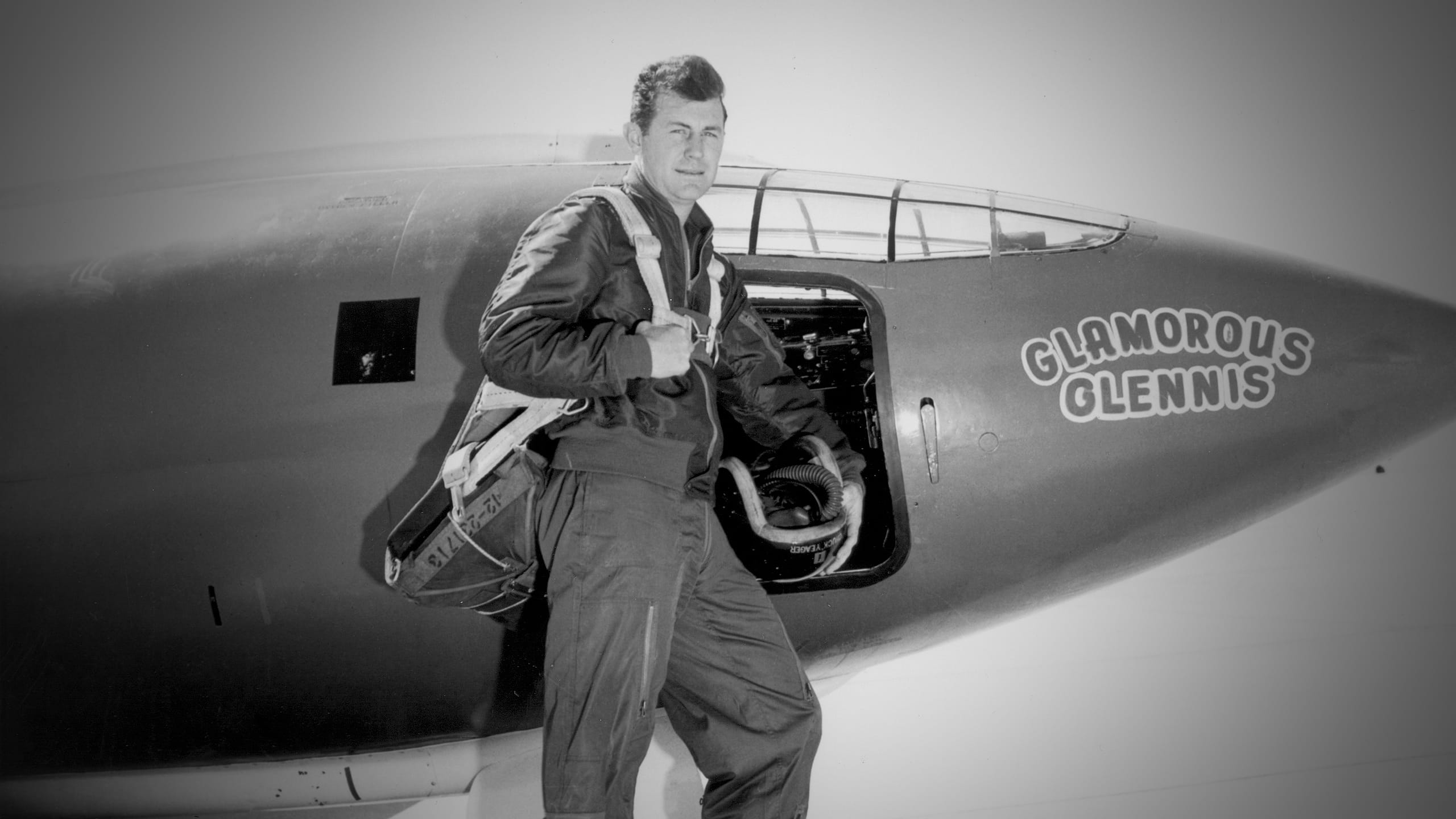
Born into poverty in the woods of West Virginia, Charles E. “Chuck” Yeager was a World War II aircraft mechanic, fighter pilot, double ace, military commander, and a test pilot who broke the sound barrier. His journey from Army private to USAF Brigadier General is an inspiration to all.
Yeager began his Air Force career in September 1941 as a private in the U.S. Army Air Corps, serving as an aircraft mechanic. While he wanted to be a pilot, that career path was initially closed to him due to his age and lack of education, as the Air Corps required two years of college and a minimum age of 20.
After Pearl Harbor, however, the standards were revised due to the urgent need for pilots, and Yeager was accepted into the flight officer program. While Yeager had excellent eyesight and other attributes for flight training, his first few flights were memorable for another reason: Yeager vomiting in the cockpit.
With time, the queasiness went away, and Yeager excelled at flying. He graduated from pilot training at Luke A.F.B. in March 1943. He then transferred to the 363rd Fighter Squadron at Tonopah, NV, and was trained with the Bell P-39 Airacobra. Once while he was showboating, he clipped a farmer’s tree during a training mission and was grounded for a week.

In November 1943, the unit shipped out to RAF Leiston and began training with the P-51 Mustang.
Shot Down
On his eighth mission, Yeager, who had one aerial victory so far when he took out a Me-109 on the way to Berlin, was shot down over occupied France. He bailed out and hit the ground running for the tree line, evading the Nazis.

Initially, he trained the French Resistance (Maquis) in the use of explosives and timers, which he learned from his father, who worked in the gas fields. He escaped to Spain with the help of the resistance while helping another wounded aviator over the Pyrenees. He then spent time in Malta before returning to England.
A Talk With Eisenhower
After his downing, Yeager’s days of combat were over. Or were they? At that time, there was a regulation that prohibited downed pilots (evaders) from flying over enemy territory again. This was to prevent the resistance groups from being compromised if the pilot was captured and interrogated.
Yeager’s desire to fly again was so intense that he spoke with Supreme Allied Commander General Dwight D. Eisenhower to request a return to combat status. Actually, Yeager wrote in his memoir that “I raised so much hell that General Eisenhower finally let me go back to my squadron.”

When they met, “Eisenhower said, ‘I’ve got guys shooting themselves in the foot to go home. What is the matter with you?” Yeager replied, “General, I haven’t done my job. I don’t want to leave my buddies after only eight missions. It just isn’t right. I’ve got a lot of fightin’ left to do.”
Eisenhower told him that it was the War Department’s policy, but he would ask for permission to send Yeager back. While waiting, Yeager was limited to short-range missions, but managed to bag a Junkers Ju-88 bomber flying over the English Channel for his second kill.
Live The Armory Life. The latest content straight to your inbox plus an automatic entry to each of our monthly gun giveaways!
In August 1944, Yeager returned to combat status and was issued a P-51C Mustang with a Malcom Hood canopy and, almost immediately, a P-51D, which he christened Glamorous Glen III, after his future wife, Glennis Dickhouse. On Oct 12, 1944, Yeager made squadron history when he became their first “Ace in a Day” with five kills of Luftwaffe Me-109’s.
On November 27, 1944, Yeager continued his hot streak, downing four Fw-190 fighters. He would also score one of the first victories of a Me 262 jet fighter and end the war with 13 kills. On January 15, 1945, he flew his last mission and returned to the U.S., having completed 61 missions in total.

Due to his status as an Evader, Yeager was given his choice of assignments and chose to be a functional test pilot of repaired aircraft at Wright Field.
Test Pilot
With the war now over, Yeager graduated from the Flight Performance School and landed a dream job as a test pilot at Muroc Army Airfield (Edwards A.F.B.)
After a Bell Aircraft Test pilot demanded $150,000 to break the sound barrier with their new rocket-powered X-1, Col. Albert Boyd, the chief of the Flight Test Division, successfully lobbied to get the X-1 project under his command. Boyd had already assembled a team of the best test pilots around. Now, Yeager was selected to be the first to break the sound barrier.

Two days before the record-breaking flight attempt of the X-1, Yeager was out horseback riding with Glennis and broke two ribs. Yeager, certain the injury would get him scrubbed from the mission, found a civilian doctor in nearby Rosamond to patch him up.
Now comes the hard part. In order to close the hatch on the X-1, Yeager had to hold it down and slam down a lever to seal it. This was not going to happen with two broken ribs. He asked his pilot/flight engineer friend, Jack Ridley, to help him come up with a solution.
Ridley chopped off a section of broom handle, and the pair tested it on the ground. The next day, the broomstick hatch tool worked perfectly, and Yeager was on his way to the history books. Yeager broke the sound barrier with a speed of Mach 1.05 at an altitude of 45,000 feet.
The 50’s
Yeager was the first American pilot to fly a MIG-15 due to the defection of a North Korean Pilot. In 1953, Yeager was a part of the X-1A team in search of breaking the Mach 2 barrier. Yeager set a new speed record in December 1953 when he flew the X-1A to Mach 2.44, breaking a recent Navy record and spoiling their planned celebration of the event.

The new flight record, however, almost killed Yeager. Just before reaching Mach 2.44, the X-1A became uncontrollable when it experienced “inertia coupling,” a condition that caused the aircraft to pitch, roll and yaw simultaneously. The X-1A dropped from 51,000 feet to 29,000 feet in less than a minute before Yeager regained control of the plane.
The 60’s
In 1962, Yeager, now a full colonel, became the first commandant of the USAF Aerospace Research Pilot School. The school was the first stop for pilots wishing to become astronauts. While Yeager was arguably the best pilot at the time, his lack of a college degree kept him from serving as an astronaut.

In December 1963, Yeager began test flights of the M2F1 “Lifting body, also known as the “Bathtub”. You may recognize this aircraft from the opening crash scene of the “Six Million Dollar Man” television series. It was here that Yeager suffered his most serious injury.
Another program in the works at the time was the NF-104, which was a rocket-assisted Lockheed F-104 Starfighter. It was one of the first programs created to train pilots for astronaut duties.
Yeager took off and reached nearly 100,000 feet when the aircraft became unresponsive and entered a flat spin. The Starfighter lost approximately 95,000 feet of altitude with Yeager attempting to gain control all the way down. At one point, Yeager deployed the Starfighter’s drag chute in hopes of straightening the aircraft and restarting the engine.

With only a few seconds left, Yeager ejected from the Starfighter. During the ejection sequence, the ejection seat base struck him in the head, and the hot rocket motor broke his faceplate, which caused the oxygen supply to catch fire and severely burn his face. Yeager suffered through numerous operations for his facial burns. This was the end of his test flight career.
Vietnam, Retirement and Beyond
In 1966, Yeager assumed command of the 405th Fighter Wing at Clark Air Base, Philippines, which rotated throughout Southeast Asia and South Vietnam, flying 127 missions.
In the early 1970’s, Yeager was assigned as the air attaché to the Pakistani Air Force, assisting them with integrating the AIM-9 Sidewinder missile onto their fighter aircraft.

In March 1975, Yeager finally retired with 34 years of service. Not one to sit around, Yeager kept busy with a variety of projects. He made a cameo appearance as Fred the bartender in the movie “The Right Stuff,” which, in part, told his story of breaking the sound barrier. He drove a Corvette pace car at the Indianapolis 500. He flew an F-15D Eagle in celebration of the 50th anniversary of his record-breaking flight. He was a spokesman for AC Delco auto parts and a consultant to Northrop Grumman for the F-20 Tigershark.
Yeager passed away on Pearl Harbor Day, 2020, at the age of 97.
Legacy
His military decorations and awards include the Distinguished Service Medal, Silver Star with oak leaf cluster, Legion of Merit with oak leaf cluster, Distinguished Flying Cross with two oak leaf clusters, Bronze Star Medal with “V” device, Air Medal with 10 oak leaf clusters, Air Force Commendation Medal, Purple Heart, Distinguished Unit Citation Emblem with oak leaf cluster, Air Force Outstanding Unit Award Ribbon, and the Congressional Medal of Freedom.

Yeager was a command pilot and had flown more than 12,000 hours in 361 different makes and models of military aircraft in service to his country.
Editor’s Note: Please be sure to check out The Armory Life Forum, where you can comment about our daily articles, as well as just talk guns and gear. Click the “Go To Forum Thread” link below to jump in and discuss this article and much more!
Join the Discussion
Read the full article here