

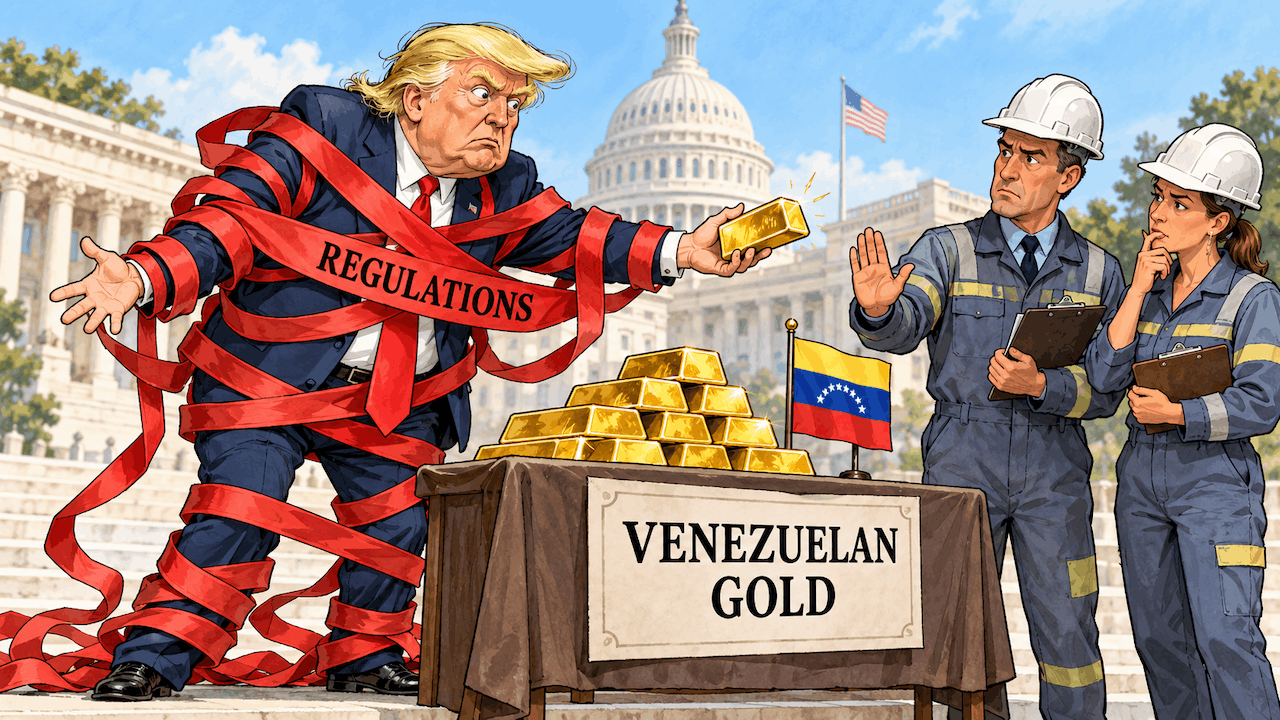
Last March, President Donald Trump sat in the Roosevelt Room admiring 10 Venezuelan gold bars. White House officials said they joked about keeping the gold as aides snapped photos. (They weren’t exactly kidding, by the way.)
Meanwhile, hundreds of millions of dollars in Venezuelan gold sits untouched in warehouses.
As it turns out, getting the gold was the easy part.
Getting it processed and sold is a different matter.
Due to a tangle of regulations intended to deem some gold “bad” and other gold “good,” U.S. refiners don’t want to touch the Venezuelan gold. They worry they will run afoul of rules designed to trace and track gold sources and ensure it meets “industry standards.”
After the U.S. deposed Nicolás Maduro, it granted Trafigura the right to sell Venezuelan oil. The company ranks among the world’s largest trading houses.
But Trafigura wanted more. According to the New York Times, company executives argued that Venezuelan gold was a national security issue, telling the Trump administration that it could “wrest control of a lawless industry and put Venezuela’s minerals in the hands of the U.S. government and its partners.”
In March, the administration lifted sanctions, allowing the import of Venezuelan gold. Trafigura stepped up to the plate in what the White House called “a historic deal.”
Six months later, the gold remains in storage “under Trafigura control,” according to a company statement issued to the “Organized Crime and Corruption Reporting Project (OCCRP).
OCCRP reported that the company refused to comment on why it hasn’t sold the gold in the U.S., but experts say it’s due to “supply chain issues.”
“Venezuelan gold is extracted from a lawless and violent region, and it may be difficult to meet U.S. requirements to show it has been produced ethically.”
After granting Trafigura the right to sell Venezuelan gold, the White House issued a statement, saying, “Trafigura had a viable and quick plan to legitimately market gold following years of corrupt Venezuelan practices.”
That’s all well and good, but once the gold reached the U.S., refiners didn’t want to touch it. As the Times put it, “Refiners would need to guarantee, under international rules, that the gold has not funded gangs, environmental destruction or corruption.”
That’s because the U.S. government, through the Treasury Department, has pushed draconian domestic and international sourcing rules that scare the heck out of refineries across the globe. These firms risk financial harm, investigations, and/or loss of accreditations if they fail to comply with constantly evolving government dictates declaring that this or that particular source of gold illegal, for whatever reason.
U.S. Treasury’s Rules Blow Up in Everyone’s Faces
In March 2018, the Trump administration issued an executive order authorizing sanctions against the Venezuelan gold sector. The gold license required reports identifying the parties, quantities, prices, transaction dates, government payments, and documentation of plans to establish the gold’s chain of custody. In March, the administration eased the sanctions, only requiring chain of custody.
But officials misjudged the impact of international regulations put in place at Washington’s behest. They treated Trump’s “authorization” to buy Venezuelan gold as if it could resolve a much larger compliance problem. While the U.S. government eased sanctions, it couldn’t eliminate the crushingly burdensome international regulatory framework it essentially built.
Refiners accredited by the London Bullion Market Association must independently meet so-called “responsible-sourcing standards,” including assessing risks involving armed groups, human rights abuses, and money laundering. U.S. permission to process Venezuelan gold does not waive those industry requirements.
In effect, the federal government made trading Venezuelan gold a compliance hazard and then encouraged companies to participate.
Simon Houghton-Dodd, a senior manager with Asahi Refining, reflects the views of many in the industry.
“Do we want to be the first refiner to publicly announce that we are receiving Venezuelan gold?”
According to the Times, refiners must establish that the gold they refine isn’t linked to criminality and environmental “abuse.” That’s easier said than done, especially given the situation in Venezuela. The Times said its investigation turned up gang-linked gold entering the supply chain.
In effect, the U.S. government weaponized rules against supposedly illicit gold sources as part of its global capital controls. Other countries followed the lead. Now, the administration wants to flip the script, but refineries can’t or won’t touch the gold because of the sourcing rules imposed on them. Violating the rules could incur significant penalties, up to and including losing certifications.
In other words, the U.S. shot itself in the foot with its own gun.
Now refiners must decide whether the potential return justifies the risk. Political enthusiasm in D.C. doesn’t eliminate that calculation.
The Broader Context
This raises a question: why were the U.S. and the international community so eager to impose strict controls on gold?
If you ask, they’ll say it’s to stop criminals and protect the environment. However, the part they don’t say out loud is that they want to maintain as much control over money as possible.
Gold is money, and governments hate it precisely because it’s hard to control.
Mind you, they don’t hate gold for themselves, as evidenced by the rapid expansion of central bank gold reserves. But they would prefer that you not have it. And they especially prefer that their enemies not have it.
They want everyone to rely on their fiat currencies that they can manipulate with ease.
Enter this complex tangle of rules and regulations designed to delegitimize gold based on who produces or uses it.
But at the proverbial end of the day, gold is gold. And regulating it can become tricky, as the Trump administration learned. It’s tough to impose regulations on thee and not on me.
So, the U.S. government finds itself in a position where it wants to use what it now suddenly views as “good gold” but can’t because it has pushed for a global regulatory regime to control “bad gold.”
Read the full article here