

Last week I spent a few days in Laredo, Texas, sweating my butt off in 108-degree heat and researching its geopolitics—specifically, how geography has long made it the “gateway” to Mexico and the wider Americas.
Laredo marks my second extended trip to US-Mexico border cities, after Brownsville and Matamoros last year. (I’m happy to share the 13-page essay I wrote on Matamoros—just reply and I’ll send it over.)
In both Brownsville and Matamoros, a sentiment shift struck me immediately: unbridled optimism, an almost giddy assurance that nearshoring was only just beginning and that prospects on both sides of the border were exceptional. Laredo had optimism, too, but it was cautious and caveated. That dreaded word—uncertainty—hung like a pall over every conversation.
THE SITUATION
Earlier this month, the Trump administration decided not to renew the United States-Mexico-Canada Agreement (USMCA). The US has not left the USMCA, but the agreement is now subject to annual reviews for the next 10 years, at which point it will expire.
There’s a good bit of “the art of the deal” happening here. The US could have triggered a USMCA withdrawal in six months but didn’t. Negotiations continue (albeit bilaterally between the US/Canada and the US/Mexico), and if all three reach an agreement, they can extend the deal beyond 2036. Even so, those negotiations aren’t going well.
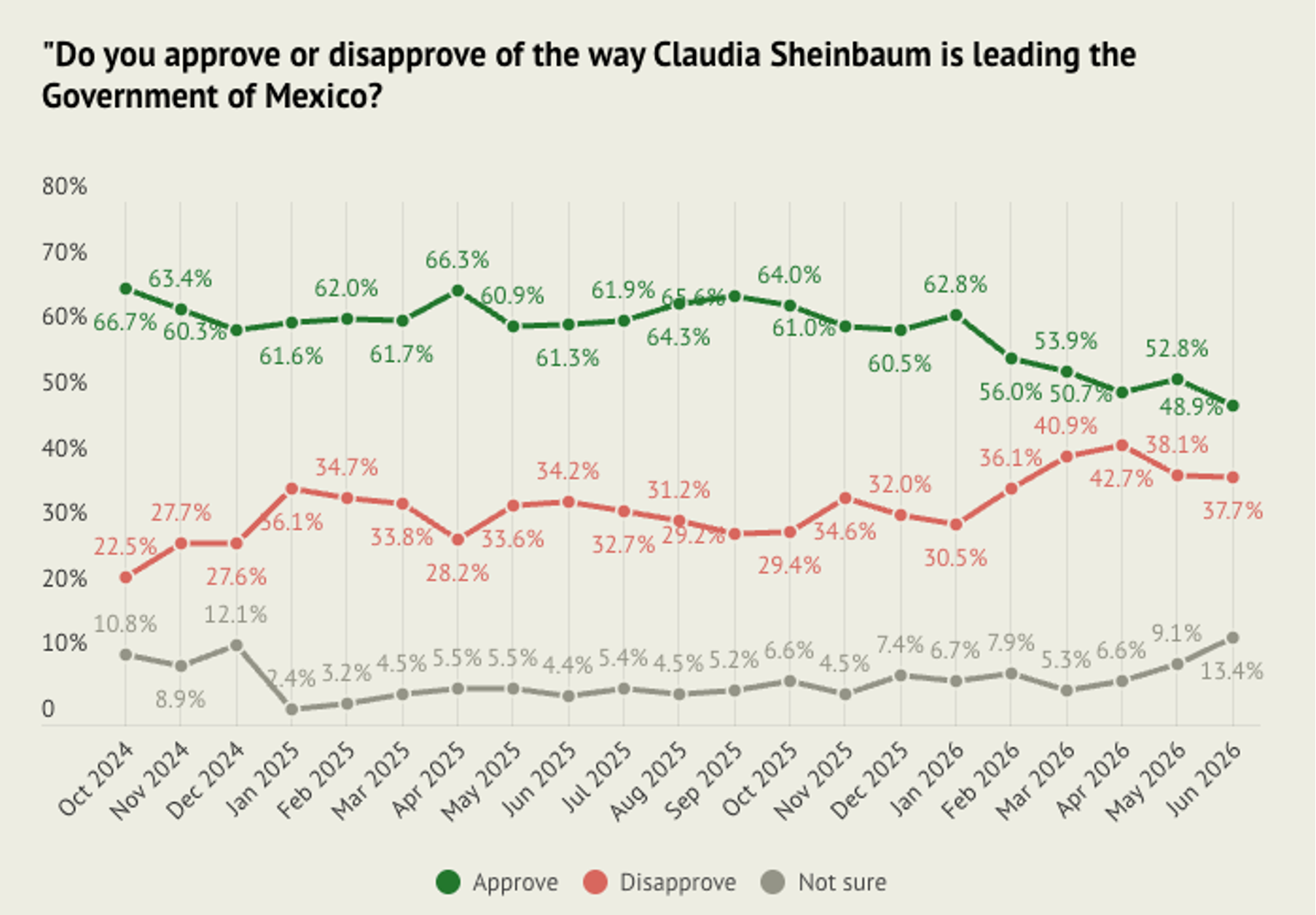
While I was in Laredo, the US invoked the Tariff Act of 1930 (aka Smoot-Hawley) to slap additional 50% tariffs on Canadian imports, “covering products ranging from wine to hockey sticks to cement.” And US-Mexico ties have been tense since April, when the US Justice Department indicted a sitting governor (Sinaloa’s Rubén Rocha Moya) and nine other Mexican officials for drug trafficking. That pressure has coincided with Mexican President Claudia Sheinbaum’s approval slipping below 50% and the signing of a new EU-Mexico trade agreement.

Source: AS/COA
Macro Prospects
The optimism was pierced on Liberation Day. It was not so much the tariffs themselves as the haphazard, volatile, and inconsistent way tariff policy has been rolled out that has slowed momentum. Tariffs can be effective if wielded properly… and disastrous if used incorrectly. Many of the tariffs the US imposed last April were struck down by the Supreme Court, and most of President Trump’s new ones will likely land there too.
Moreover, existing agreements and understandings haven’t tempered US behavior in tariff negotiations. The latest round against Canada covers goods “regardless of whether a good originates under the USMCA.” Until April, Sheinbaum had earned praise for ingratiating herself with Trump—largely by doing whatever he asked. More Mexican troops at the border? Yessir. More fentanyl seizures? No problem. Tariffs on Chinese goods entering Mexico? Just say how high.
When it came time to extend the USMCA or even get assurances that US-Mexico trade would not be affected by whatever problems Washington has with Ottawa, Mexico was met with indictments rather than assurances.
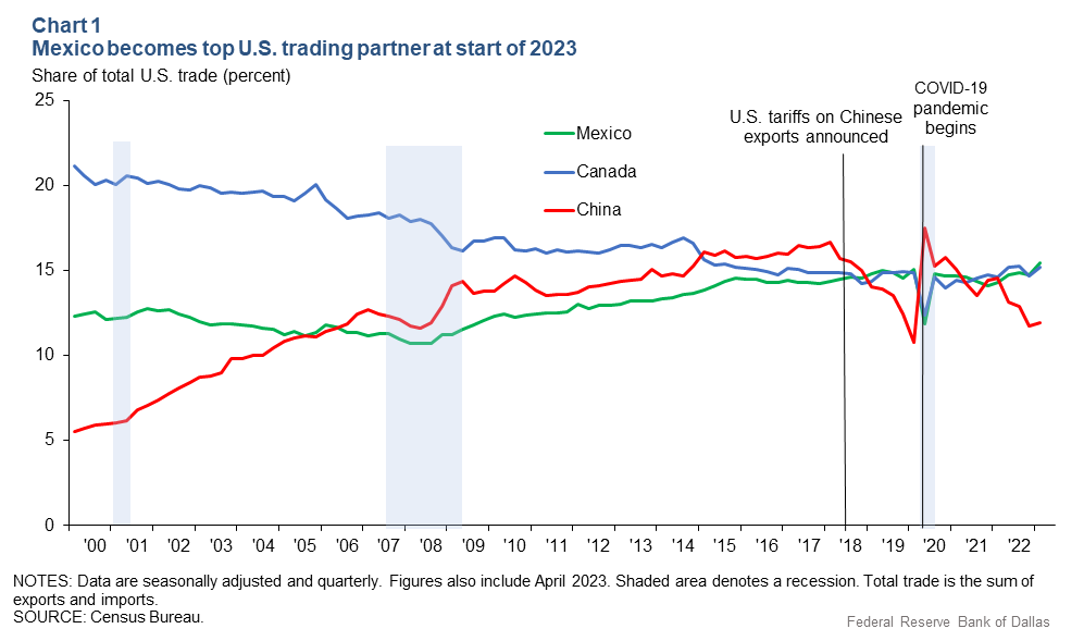
 At the macro level, nearshoring and the US-Mexico relationship is still a positive story. So far this year, bilateral trade between the US and Mexico is at a record $404.6 billion. Mexico became the top US trade partner in 2023 and hasn’t looked back, now accounting for 16.5% of all US trade.
 Source: Dallas Fed
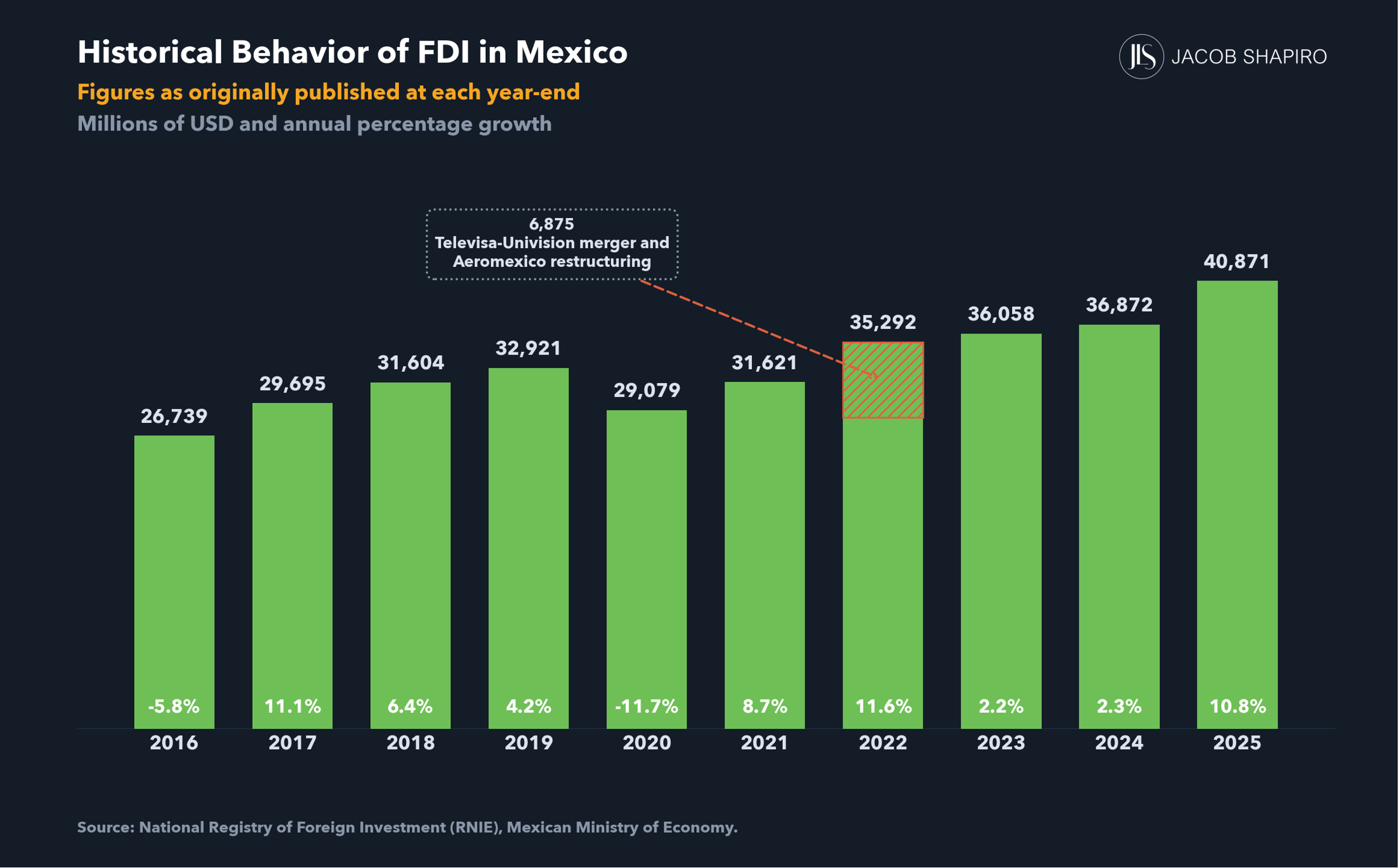
In April, bilateral trade was up over 23% year-on-year, a trend that is set to continue through the end of the year. Headline figures on foreign direct investment (FDI) are no less impressive, reaching a record $40.9 billion in 2025, nearly an 11% year-on-year jump and a fifth-straight annual increase.
The decoupling of US-China trade was never going to happen overnight and will likely take years, if not decades, to come to fruition. But the data is clear that the decoupling has started, and Mexico becomes the best option for relocating factories serving the North American market. In other words, nearshoring is real, it’s happening, and the macro prospects of border cities in both the US and Mexico are primed for explosive growth.
Nearshoring Without Growth
While the top-line data looks good, dig a little deeper and the picture is not nearly as rosy. The Trump administration’s mercurial and antiquated approach to trade is denting what should be an unmitigated growth story. While headline FDI figures are positive, most of that is not the arrival of new investment but reinvestment by companies already on the ground in Mexico.
Take Q1 2025: New investment accounted for just 7.4% of total FDI, below 2024’s 8.6% average. A record built on reinvestment signals a maturing installed base, not a fresh relocation wave. Moreover, the FDI numbers sit atop a weak overall investment picture. Total gross fixed investment declined 10% in 2025, with private investment down 2% and public investment down 26%.
Mexico’s GDP is sluggish, with projections for 2026 ranging between 0.6–1.5%. After a 2022–2024 border construction frenzy, the property market has turned. National industrial availability rose ~51% year-over-year in Q1 2026, and northern border markets like Ciudad Juárez and Reynosa saw vacancy “increase materially” as developers extend delivery timelines and get selective on new projects.
Leasing is still positive but well below the 2024 peak. In Laredo, I saw sparkling new warehouses dotting the landscape and heard that vacancy rates have been climbing. The official data says up 1.4 percentage points to 4.5% this year, but what I heard on the ground was much higher. BYD shelved its planned Mexican EV facility, and Tesla suspended the timeline on its Nuevo León gigafactory, both citing US tariff and trade uncertainty. This is, to steal from CSIS’s report, “nearshoring without growth.”
Good News, Bad News
The good news: The border is still primed for growth, and that expectation has led to significant infrastructure buildout. Laredo is the biggest port by dollar value in the US—bigger than the port of Los Angeles, Chicago O’Hare International Airport, and the Port of New Orleans. No city in the US can easily replicate Laredo’s unique geographic and infrastructural strengths, just like no city in the US can match Matamoros for competitive low-cost manufacturing prowess.
The bad news: Uncertainty around tariffs, the USMCA, and US-Mexico relations is capping that growth. Even with every trade issue resolved tomorrow, Mexico would still struggle to improve logistics, restore rule-of-law confidence after its controversial judicial reforms, and rein in both the cartels and cargo theft along key corridors. It’s led by a populist government largely because it has accumulated Latin America’s lowest GDP and GDP-per-capita growth over 35 years, excluding the basket case that is Venezuela.
It’s hard not to appreciate the self-sabotage the Trump administration has enabled. Had Trump 2.0 governed like Trump 1.0—non-interventionism, challenging Chinese trade practices, negotiating successful new trade deals for alternative US markets—the economy would be booming on a combined explosion of AI/data-center capex, cheap energy, and nearshoring.
Instead, the US is holding back the AI story by imposing restrictions on Anthropic and even considering taking national stakes in AI companies. It has driven the price of energy up due to a Sisyphean choice to try and foment regime change in Iran and is short-circuiting the US’s biggest ace in the hole: the combined economic power and potential of all North America.
Now, policy cannot completely sabotage macro. Laredo and other border cities will do well over the long haul, even if it doesn’t happen as fast as they hope, and even if policy limits the ceiling on that growth. But it absolutely can slow it down. And while the politicians argue and squabble, the real economy is champing at the bit. What it needs is not a specific policy; it needs clarity over what the future looks like. Until the US provides that, Laredo and the border in general will be stuck in 1st gear.
MAP/CHART OF THE WEEK
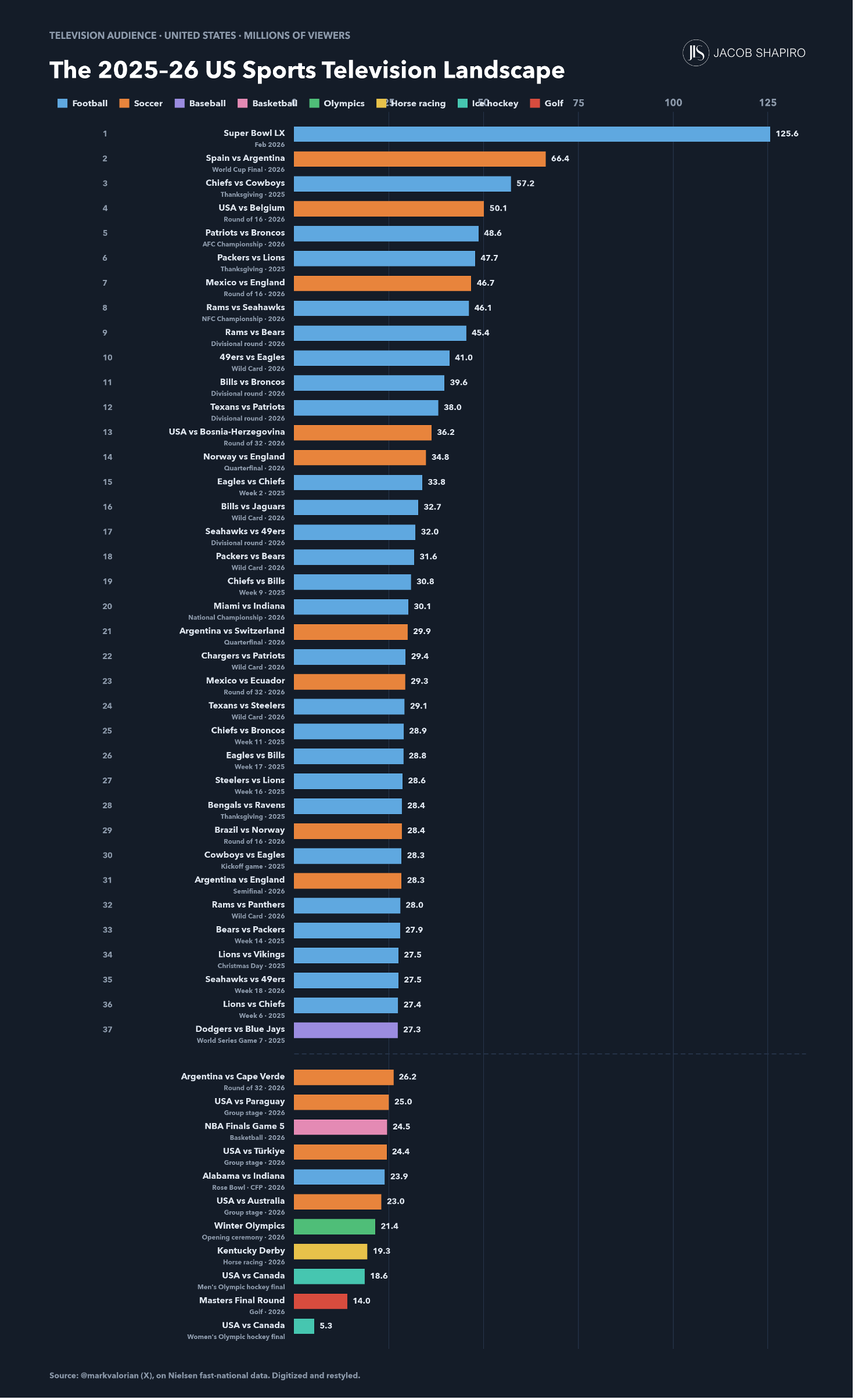
Maybe we are a soccer country after all!
 BLIND SPOT
Over the past two months, a wave of Gen Z protests has swept India—the “cockroach protests”—with tens of thousands marching in Delhi and a massive online following.
The English-language press runs them as one more challenge to Narendra Modi; the WSJ headline was literally “India’s ‘Cockroach’ Protesters Renew Challenge to Modi.” That framing is the blind spot. The protests began after a medical entrance exam drove some would-be test-takers to suicide—but that has nothing to do with the “cockroach” organizing principle.
In a separate, unrelated case, India’s Chief Justice called some jobless youth “cockroaches” in a ruling on fake-degree entrants to the legal field. Gen Z lifted the slur out of context into the Cockroach Janta Party, a jab at the ruling BJP that drew tens of millions of followers with no real manifesto.
The opposition has since latched on, but this is now about more than India. It’s yet another Gen Z protest built on educated discontent. India’s official unemployment is just 3.2%, and that number hides most of what matters: Only about a quarter of Indians hold a salaried job, graduate joblessness runs near 11%, and the ILO once put it at 29%. Only ~5% of medical-exam takers get a shot to attend undergraduate college in medicine.
In Nepal and Bangladesh, protests like these have toppled rulers. In Indonesia and Morocco, they’ve made headlines but little else. There’s a distinct echo of the Arab Spring, when jobless Egyptian graduates and engineers driving taxis joined the fight against the regime. Add AI coming for white-collar jobs, and you get India’s groundswell.
Read the full article here