

Metals Focus has released its Gold Focus 2026 report. It includes comprehensive historical supply and demand data for 2017-25 and its 2026 forecast.
Despite the recent selling pressure in the gold market, that 2026 forecast remains bullish.
Looking Back
Investment inflows drove gold to the strongest gain in decades in 2025. The yellow metal’s price rose 44 percent last year and topped $4,500 for the first time late in the year. It was the best year for gold since 1979.
“Central to this rally were exceptionally strong investment inflows, driven by the new U.S. administration’s marked divergence from established norms on trade and domestic and foreign policy, alongside its continued loose fiscal stance. Pressure on the U.S. dollar, coupled with concerns over its future role as a de facto reserve currency, also supported prices.”
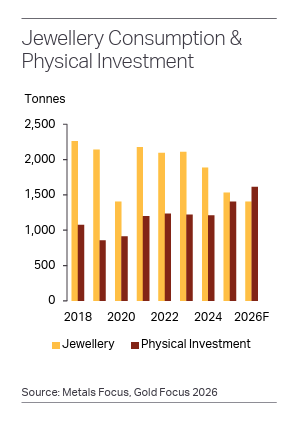
Physical gold investment rose by 16 percent to a 12-year high, reflecting bullish price expectations and heightened economic and geopolitical uncertainty. China (+28 percent) and India (+17 percent) led the surge in physical gold investment.
Concerns about the dollar drove central bank gold buying, another key dynamic supporting the gold bull market.
Many countries are worried about the weaponization of the dollar and the rapidly deteriorating fiscal situation in the U.S. This has driven a modest de-dollarization trend as these countries seek to minimize their dependence on the greenback.
The pace of central bank purchases moderated in 2025 but remained far above the recent historical average. Official net full-year buying came in at 863.3 tonnes. That was down 21 percent year-on-year, charting the lowest level since 2021.
However, while central bank gold purchases declined last year, they remained well above the 2010-2021 annual average of 473 tonnes.
To put that into context, central bank gold reserves increased by an average of just 473 tonnes annually between 2010 and 2021.
Strong investment demand and central bank buying mitigated a sharp drop in jewelry sales due to higher prices. Jewelry demand fell by 18 percent to a five-year low of 1,542 tonnes.
Despite higher gold prices, supply remained constrained last year.
Mine production rose by a modest 2 percent, supported by ramp-ups, project expansions, and stronger artisanal and small-scale mining. While the increase in gold production was small in percentage terms, it did set a record at
Meanwhile, recycling increased by a similar 2.8 percent but remained well below its 2012 peak.
Looking Ahead
The gold rally continued into the first weeks of 2026, with gold cracking $5,000 and approaching $5,500 before a sharp correction in late January.
Just a few weeks later, the U.S. and Israel launched a war on Iran, shaking up markets and putting further downward pressure on gold. The yellow metal has been rangebound between around $4,300 and $4,800, but there has been steady downward pressure.
According to the mainstream narrative, the Federal Reserve will have to keep interest rates higher for longer, or possibly raise rates, to deal with the price inflation driven by rising oil prices. Higher rates are considered a headwind for gold, a non-yielding asset.
However, Metals Focus remains bullish. Its analysts say they expect the bull run to resume in the second half of the year, once uncertainty surrounding the war is resolved.
“This view is premised on the assumption that the economic and political costs of a prolonged conflict will likely drive a relatively swift resolution, limiting the risk of a sustained oil crisis. While inflationary pressures are expected to persist, the consultancy does not subscribe to the growing consensus that U.S. rate hikes are likely over the next 12 months, as policymakers may tolerate higher inflation to avoid an economic slowdown.”
Metals Focus analysts are hinting at the Catch-22 the Fed finds itself in.
The central bankers at the Federal Reserve face a tough choice. They can either keep monetary policy tight – holding rates higher for longer or even raising rates – to tamp down price inflation, or they can ease monetary policy to take pressure off this debt-riddled bubble economy.
They can’t do both.
While the mainstream consensus seems to be that the Fed will keep rates higher, they seem to be ignoring the Debt Black Hole. If they do hike rates, they must know it will put additional strain on an economy buried in debt. Credit to Metals Focus analysts who seem to understand this conundrum and realize maintaining a higher interest rate environment isn’t the slam dunk many in the mainstream seem to think.
Metals Focus analysts said that despite the noise in the markets created by war headlines, the fundamentals that drove gold higher last year remain firmly in place.
“Crucially, the drivers from 2025 remain intact: ongoing U.S. policy uncertainty, persistent concerns about the dollar’s long-term outlook, elevated geopolitical risks, and stretched equity valuations. Together, these factors reinforce gold’s role as a safe haven and portfolio diversifier.”
Read the full article here