

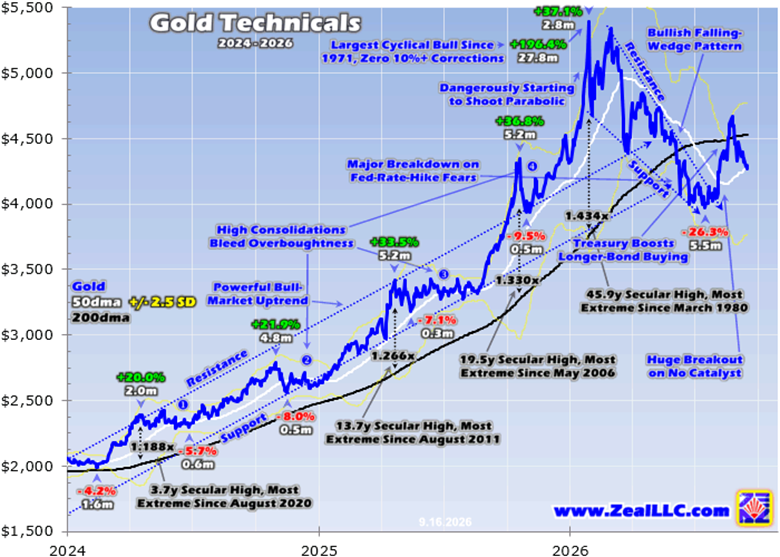
Gold has long been plagued by Fed hysteria. Vexingly, sharp kneejerk selloffs often erupt when traders see federal-funds-rate trajectories steepening. Yet history argues these bearish reactions are highly-irrational, as gold tends to thrive in Fed-rate-hike cycles. After a serious episode of gold selling on Fed-rate-hike fears in June, this week’s actual hike threatened another. But gold is reacting way-more favorably.
The theory behind dumping gold on higher rates ahead sounds logical. Gold is a sterile asset generating zero cashflows. So as general yields rise with interest rates, gold’s competitiveness with other assets weakens. With mounting opportunity costs for holding gold, traders shift capital out. That selling which is usually exacerbated by speculators’ super-leveraged gold-futures trading results in weaker gold prices.
Midweek each US 100-ounce gold-futures contract controlled $426,570 worth of gold. Yet specs are only required to maintain $21,732 cash margins in their accounts for each contract traded. That equates to extreme maximum leverage of 19.6x, which is actually on the lower side of the typical 20x-to-25x range! Running at 20x, a mere 5% gold move against speculators’ bets will wipe out 100% of their capital risked.
Such leverage enables speculators to punch way above their weights in bullying around gold prices. And specs’ primary trading cue is the fortunes of the US dollar. Its benchmark US Dollar Index rallies when the Fed’s Federal Open Market Committee, top Fed officials, or key US economic data they closely watch implies higher rates ahead. June’s episode of gold Fed fears flaring was a severe example of these dynamics.
The first FOMC meeting helmed by Trump’s new Fed chairman Kevin Warsh came on June 17th. In both its FOMC statement and his subsequent press conference, he emphatically emphasized the Fed fighting inflation. Despite no rate hike, that new price-stability focus implied a higher federal-funds-rate trajectory ahead. So the USDX surged and gold plunged for days, starting exactly on that 2pm FOMC decision.
Leading into it that day, gold had rallied 1.1% to $4,380. But within minutes of that statement’s release, gold had plunged 2.3% to $4,280! The FOMC concluded with “The Committee will deliver price stability.” Traders interpreted that as rate hikes coming led by the guy Trump hired to cut the FFR. Gold plunged 1.6% on close to $4,263 that day as the USDX surged 0.9%. Those post-Fed moves lasted five trading days.
Gold collapsed 7.8% during that short span partially driven by the USDX’s big-for-it parallel 2.0% rally! Thanks to that episode and an earlier plunge on a big upside surprise in monthly US jobs that was Fed-hawkish, gold cratered 11.6% in June for one of its worst months ever in dollar terms! Gold Fed hysteria has long flared on better-than-expected monthly US jobs and hotter-than-expected CPI, PCE, and PPI inflation.
That happened again in September, driving gold down 3.5% month-to-date on FOMC Eve. The monthly US jobs data for August tripled expectations at +162k actual versus +53k expected, besting early June’s May report doubling at +172k versus +80k. Both proved big four-standard-deviation beats to economists’ consensus. Gold’s MTD losses leading into Wednesday’s Fed decision were rivaling June’s 4.8% MTD ones.
Due to that latest monthly-US-jobs upside surprise and some warmer PPI and CPI metrics, Wednesday morning’s futures-implied Fed-rate-hike odds were running a near-certain 93%. Indeed the Warsh Fed dutifully followed the markets’ lead, with the FOMC’s dozen voting members unanimously deciding to hike its FFR by 25 basis points. That proved the Fed’s first rate hike since late July 2023, fully 3.1 years earlier!
During Fed Day’s final two hours between the FOMC statement and close, gold plunged about 2.3% from $4,350 to $4,250 exactly mirroring June’s late Fed-Day drop. Yet since gold rallied into the FOMC, it only closed 0.7% lower at $4,266. That was considerably better than its 1.6% loss on June’s FOMC decision. And midday Thursday as I pen this essay, gold has surged as much as 2.7% to $4,380 in that rate hike’s wake!
While we’re not yet through the same five-trading-day period after the FOMC, initially gold is faring way better now than back in June despite an actual rate hike. It looks like gold’s Fed hysteria is waning, and for good reason. Before we get into that, check out gold’s technicals over the past few years or so. The sharp breakdown after June’s FOMC meeting is readily evident, a big contrast to this week’s post-Fed resilience.
Five trading days after mid-June’s FOMC decision, gold had plunged to a major closing low of $3,993 on the new Fed chairman talking a big game on fighting inflation. Yet this Wednesday after that first hike in a few years, gold merely fell to $4,266 which was an impressive 6.8% higher. The FOMC proved more hawkish Wednesday than in mid-June. That was evident in the accompanying outlooks of top Fed officials.
With every-other FOMC decision, they release a Summary of Economic Projections which includes their collective outlook on the federal-funds rate called the dot plot. At the June meeting, those dots implied one rate hike in 2026. Yet this week that year-end outlook doubled to two total 25bp hikes in 2026 including this initial one! So traders worried about rate hikes had more reason to dump gold this time around.
Yet so far they are doing the opposite, aggressively buying on Thursday. Why should gold Fed hysteria be waning? I’d argue there are two primary reasons. First is how gold has fared during past Fed-rate-hike cycles, and second is how Warsh’s new approach to running the Fed ought to greatly reduce Fed-rate-hike fears. I’ve analyzed the former extensively for years, and outlined the case for the latter in mid-June.
Inarguably market extremes are driven by herd sentiment oscillating between popular greed and fear. That proves traders’ conventional wisdom is often wrong. Traders are most bullish at major toppings, and most bearish at major bottomings. Following those instincts will lead to buying high then selling low, the worst-possible outcome for trades. Irrational emotions also cloud traders’ perceptions of gold and rate hikes.
As the US dollar was pegged to gold before mid-August 1971, essentially the entire history of dollar gold started then. Since then the Fed has executed fully 13 rate-hike cycles, defined as 3+ consecutive hikes with no intervening cuts. If Fed-rate-hike cycles are indeed bearish for gold, that massive 55.1 years of historical data would prove it. Yet instead gold thrived during past Fed-rate-hike cycles, blasting higher.
I’ve extensively studied and analyzed gold’s, the US Dollar Index’s, and the S&P 500’s performances through all of them. My spreadsheets would support an essay on each, but for our purposes today here is gold’s summary. On average through the exact spans of all 13 Fed-rate-hike cycles in the dollar-gold era, gold averaged big 26.3% absolute gains! With their 14.1-month average duration, that’s +22.4% annualized.
Any 20%+ gains in a year are huge for gold, and indeed the stock markets. And gold fared better than that through all modern Fed-rate-hike cycles! So it’s stupidly-irrational to fear them, even for those super-leveraged gold-futures speculators. Those guys aren’t doing their homework. Gold rallied through all of the last four rate-hike cycles stretching way back to mid-1999, averaging excellent 18.7% gains during them!
Across all 13 since 1971, gold rallied through the majority 8 of them but indeed sold off in the other 5. In those 8 winners, gold’s average gains are a colossal 48.4%! And in the other 5 losers, gold’s average losses clocked in at an asymmetrically-small 9.0%. So this popular notion in recent years that Fed-rate-hike cycles are bearish for gold is total bullshit. Hopefully speculators and investors are finally learning that.
The idea that prevailing yields should affect gold investment demand is inherently flawed. Gold never yields anything, yet is an essential investment for other reasons including prudent portfolio diversification. Motivations for upping gold allocations are complex, shaped by gold, stock, and bond fortunes and key economic trends including inflation across major countries worldwide. Fixating on Fed rate hikes is way-simplistic.
Warsh’s wise new approach to running the Fed ought to really slash kneejerk gold selloffs on Fed-rate-hike fears. Big upside or downside surprises in monthly US-jobs data, key inflation measures including CPI, PCE, and PPI, and even sometimes quarterly GDP can really move Fed-rate-hike odds. That’s because traders are gaming that data based on how they expect the FOMC to react to it, which Warsh hates.
Futures-implied odds for a 25bp hike at this week’s FOMC meeting were running only 50% just before the latest August jobs report on September 4th. They surged to 67% immediately after on that +162k actual versus +53k expected. Before the August PPI wholesale inflation data on the 10th, they were running 60%. After two of its key metrics printed in-line, one 0.1% hotter, and one 0.1% cooler, those still surged to 76%.
The next morning on the 11th before the August CPI consumer inflation, futures were pricing in a 69% chance for a 25bp hike this week. That CPI was mixed, with three of its four key metrics matching their consensus forecasts and one just 0.1% hotter. Right after that, Fed-rate-hike odds soared again to 91%! This is all reflexive, traders bidding up Fed-rate-hike odds based on how they think the FOMC will react to data.
This sometimes leads to serious market distortions, a huge problem. So Warsh wants to eliminate the FOMC’s forward guidance on likely future federal-funds-rate moves. The Fed only started giving that in August 2003, and it has been problematic ever since. It creates a hall-of-mirrors effect, where traders gaming the Fed actually create market conditions forcing it to move. Forward guidance becomes self-fulfilling!
Back in mid-June at his first press conference as Fed chairman, Warsh articulately addressed this serious problem. That day Fox Business’s Fed reporter asked him, “So if you don’t give a lot of ongoing forward guidance won’t the markets have more volatility and shouldn’t Americans have more access into what you’re thinking going forward?” That’s self-serving, as a less-talkative Fed sure wouldn’t be good for Fed reporters!
Warsh’s inspired reply was one of the greatest things I’ve ever heard a Fed chairman utter! He said, “So I think financial markets perform best when they react to incoming data. I think the financial markets work less efficiently when they ask a question how will the Federal Reserve react to that incoming information.” While he wasn’t talking about gold, that describes countless kneejerk selloff days on key economic data.
“The more that markets are paying attention to what’s happening in the real economy, deciding what’s good data and what’s less-good data, the more financial markets can price what they believe is the most-likely and what are the tail risks. Financial-market prices are probably the most-important source of information to guide central bankers.” And inarguably the price of gold is one of the top critical market signals.
“But when all the financial markets are doing is reflecting back what we’ve said, then we’re taking the most-important source of information and we’re being blind to it. I’d like us to create a system where those blinders come off, where markets are following data that they efficiently think is reliable.” Gold always should’ve rallied on hotter inflation reports, which would’ve underscored their importance for the Fed.
“And they’ll be watching data, we’ll be watching data, they’ll come with better information through market prices to us, we can make more-informed decisions. But ultimately the goal that I set at the outset, deliver on the price-stability objective that Congress told us to do, that we’ve got to get in the business of doing.” Warsh knows traders’ Fed fixation distorting price moves has made markets way less useful for central bankers!
He is remedying that by eliminating forward guidance on the FFR, dramatically shortening the FOMC statements, already reducing the length of his post-FOMC press conferences and likely eventually limiting their number to after rare major Fed moves, and probably soon killing the dot-plot FFR projections by top Fed officials! Warsh wants every FOMC meeting to be live, dependent solely on the data since the last one.
Forward guidance of any kind seriously hems in top Fed officials, limiting how they can react to markets and economic data. And if those guys stop forecasting future FFR moves which traders game despite those predictions often proving notoriously wrong, gold should be liberated from its Fed shackles. If the Fed guys aren’t always publicly pontificating on what they might do next, kneejerk reactions to data will fade.
As Wednesday’s FOMC meeting was only Warsh’s third at the helm, it’s too early to know all the changes he will make and how those will affect traders’ views on likely FFR trajectories. But gold shrugging off the first Fed rate hike in several years after cratering under the mere threat of one just three months earlier is sure bullish! Gold should trade on its own fundamentals, technicals, and sentiment, mostly ignoring the Fed.
Successful trading demands always staying informed on markets, to understand opportunities as they arise. We can help! For decades we’ve published popular weekly and monthly newsletters focused on contrarian speculation and investment. They draw on my vast experience, knowledge, wisdom, and ongoing research to explain what’s going on in the markets, why, and how to trade them with specific stocks.
Our holistic integrated contrarian approach has proven very successful, and you can reap the benefits for only $12 an issue. We extensively research gold and silver miners to find cheap fundamentally-superior mid-tiers and juniors with outsized upside potential. Sign up for free e-mail notifications when we publish new content. Even better, subscribe today to our acclaimed newsletters and start growing smarter and richer!
The bottom line is gold Fed hysteria looks to be waning. Not long ago in mid-June, gold was slammed on the mere threat of Fed rate hikes. Yet this week after the first one in several years, gold proved resilient immediately after then surged the next day. That’s a heck of a show of strength after long years of being slaved to traders trying to game future rate trajectories. Gold selling off on Fed-rate-hike fears is highly-irrational.
Gold has thrived on average through the exact spans of all modern Fed-rate-hike cycles over the last half-century-plus. It enjoyed massive gains in the majority winners, and only saw modest losses during the rest. And this new Fed chairman hates market distortions caused by traders trying to game Fed reactions, so he is slashing all rate projections. That ought to liberate gold from kneejerk selloffs on Fed-hawkish data.
Adam Hamilton, CPA
September 18, 2026
Copyright 2000 – 2026 Zeal LLC (www.ZealLLC.com)
Read the full article here