

Gold demand was up 2 percent year-on-year in the first quarter, setting a record in value terms.
Including over-the-counter (OTC) selling, gold demand came in at 1,231 tonnes. Volume growth, coupled with the surging gold price, drove a 74 percent jump in the value of Q1 demand to a record of $193 billion.
Investment demand and central bank gold buying supported the market even as jewelry sales continue to face headwinds due to the higher gold price.
Gold Investment Demand
Please enable JS and disable any ad blocker
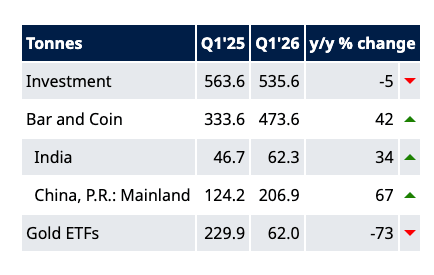
Gold bar and coin demand surged by 42 percent to 474 tonnes. It was the second-highest quarter on record behind Q2 2013 (602 tonnes).
As the World Gold Council put it, Chinese investors “hoovered up” physical investment gold. Chinese bar and coin demand surged 67 percent year-on-year to 207 tonnes, smashing the 2013 record of 155 tonnes.
According to the World Gold Council, the elevated gold price and its performance relative to other local assets drove demand, “with further impetus coming from heightened trade risks and global geopolitical tensions.”
Indian investors also gobbled up gold bars and coins, with demand climbing 34 percent to 62 tonnes. It was the strongest first quarter since 2013.
European bar and coin demand was up 50 percent year-on-year, coming in at 41 tonnes.
The World Gold Council called the U.S. bar and coin market “a hive of activity” in the first quarter. Net demand was up 14 percent year on year, but down 20 percent from Q4. Buying slowed in February and early March before picking up late in the quarter when the price correction offered a buying opportunity.
ETF demand was also up in Q1. Metal inflows into gold-backed funds rose a net 62 tonnes. Significant outflows in March mitigated the surge of gold into ETFs in January and February.
Asia was the only region to generate consistent monthly gains throughout Q1, with funds in the region adding 84 tonnes. That was just shy of Q4’s 91-tonne record.
European funds reported net outflows of 8 tonnes.
Meanwhile, North American funds reported heavy outflows in March, leading to a 16-tonne net decrease in gold holdings in Q1.
With the decrease in ETF holdings, overall investment demand dipped modestly by 5 percent year-on-year.
Central Banks Add Gold Despite Some Selling
Central banks globally added a net 244 tonnes of gold to their reserves in the first quarter. That was up 17 percent from the last quarter and 3 percent year-on-year.
The surge in central bank gold buying happened despite record prices early in the quarter and significant selling from Turkey and Russia in March. World Gold Council analysts said that continued buying in this environment “underscores the broadly strategic nature of their purchases and continued confidence in gold’s role as a store of value during periods of uncertainty.”
Despite rumors that it might sell gold to fund defense spending, Poland was the biggest buyer in Q1, adding 31 tonnes to its holdings. Uzbekistan was also in a buying mood, increasing its gold reserves by 25 tonnes. Other buyers included China, Kazakhstan, the Czech Republic, Malaysia, Guatemala, Cambodia, Indonesia, Serbia, and the UAE.
The World Gold Council said unreported buying was also elevated in the first quarter.
“This points to continued sizeable activity that has yet to be disclosed, a trend that has been in place since 2022.”
This unreported buying often remains undisclosed.
As Jan Nieuwenhuijs has reported, the People’s Bank of China secretly buys large amounts of gold off the books. According to data parsed by the renowned Money Metals researcher, the Chinese central bank is currently sitting on more than 5,000 tonnes of monetary gold located in Beijing – more than TWICE what has been publicly admitted.
Jewelry Demand Down, Tech Offtake Up
Please enable JS and disable any ad blocker
Higher prices continue to create significant headwinds for gold jewelry sales globally.
At just under 300 tonnes, global jewelry demand fell 23 percent year-on-year. A 19 percent dip in Indian demand and a 32 percent crash in Chinese sales pushed overall jewelry demand lower.
It was the lowest quarter for gold jewelry demand since COVID.
However, factoring in higher gold prices, the value of Q1 demand was up 31 percent year-on-year to $47 billion, a record first-quarter jewelry spending.
Gold used in industry and tech rose modestly by 1 percent year-on-year to 82 tonnes.
Gold offtake in the electronics sector rose by 3 percent to 69.3 tonnes.
The World Gold Council described gold use in the electronics sector as on a “two-speed setting.”
“Rapidly expanding AI infrastructure boosted demand for high-reliability and high-performance chips – technical specifications override cost considerations in these applications. Meanwhile, manufacturers in the price-sensitive consumer electronics market continued their efforts to reduce or replace gold in the face of record-breaking prices.”
Gold demand in other industrial sectors and dentistry declined by 8 percent to 10 tonnes, weighed down by the higher price. Gold used in dentistry dropped below 2 tonnes for the first time since the World Gold Council started tracking the data.
Looking ahead, the World Gold Council expects the fundamentals that have driven the gold bull market over the last couple of years to remain in place.
“Geopolitical factors are expected to remain front and center in driving gold demand for 2026 and beyond. This supports continued central bank net buying, broad global gold ETF inflows, and bar and coin accumulation. Recycling is expected to see a restrained increase in 2026. High prices are likely to continue taking their toll on jewelry.”
Read the full article here