

Our latest article on bank safety: “The Fed Is Warning Us About Bank Failures”
The Fed has recently published a study examining a core question in banking: do banks fail because of runs, or because they become insolvent?
Many analysts and banking experts still argue that runs, essentially large deposit outflows, are the main cause of bank failures. In that view, bank fundamentals matter less. Others believe the opposite: that fundamentals are what really matter, and that careful research can identify banks likely to run into serious trouble in a crisis. It is a longstanding debate that returns after every banking crisis.
If you follow our banking work, you already know where we stand. We strongly believe that the underlying health of a bank is what matters most. That is why we use rating scores based on 20 key fundamental metrics and conduct thorough research to identify red flags in banks’ balance sheets, P&L, and capital positions.
Yet, there are times when we also have experienced how runs can significantly affect a bank that generally has healthy fundamentals, which is what occurred with First Republic Bank of California. This is the type of situation which is the most unpredictable. Therefore, we focus on what is most predictable.
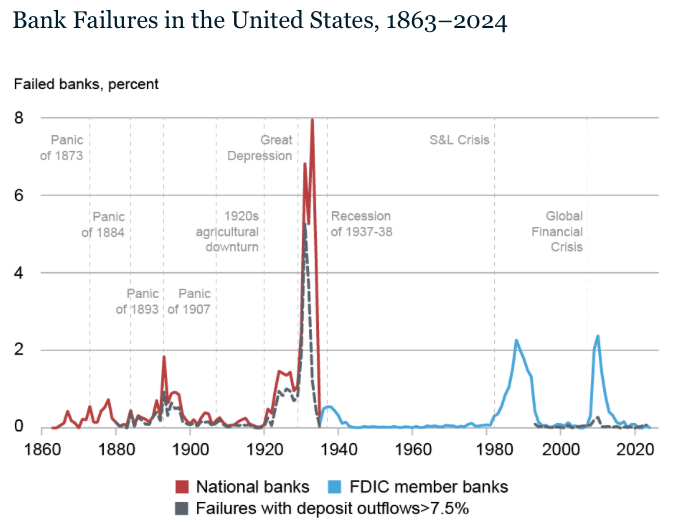
Now, back to the Fed study. As shown below, the Fed used a long-term data set covering more than 5,000 bank failures.
Source: The Fed
The key takeaway is clear: bank failures are generally linked to weak fundamentals. According to the study, banks that eventually fail tend to show the same warning signs years in advance: declining income and capitalization, rising asset losses, and increasing reliance on expensive funding. Another common precursor is rapid asset growth, often driven by aggressive lending. Importantly, these patterns hold for failures both with and without runs.
As a result, the Fed arrives at a very important conclusion:
“Bank failures are substantially predictable based on weak bank fundamentals. More broadly, crises in which many banks fail are often a predictable consequence of deteriorating fundamentals.”
If you follow our work, this should not be surprising. Still, this may be the first time a regulator has stated so explicitly that weak fundamentals, not runs alone, are at the core of bank failures. That is a bold conclusion, and one that may effectively settle a long-running debate.
Notably, many large U.S. banks are now showing exactly the issues the Fed highlights: rising asset losses, a growing reliance on expensive wholesale funding, and lending growth concentrated in just three areas: shadow banking, credit cards, and commercial real estate.
Another important takeaway is that liquidity support cannot solve insolvency. According to the Fed, international evidence shows that even banking distress, without runs, can lead to severe contractions in credit and output. Likewise, targeted liquidity interventions in the 21st century have never resolved bank distress on their own. Balance-sheet restructuring has always been necessary. That point should be especially relevant for those who still believe the Fed can prevent a banking crisis simply by injecting liquidity. Yet we doubt the masses will recognize this fact.
By publishing this study, the Fed may also be sending an indirect message: depositors have a responsibility to understand the condition of the banks holding their savings. If a crisis occurs, the Fed may argue that the warning signs were already visible, and that depositors ignored them. And, they would be right!
Bottom line
Believe it or not, there are more major issues on the larger bank balance sheets as compared to smaller banks, which we have covered in past articles. Moreover, consider that there was one major issue which caused the GFC back in 2008, whereas today, we currently have many more large issues on bank balance sheets. These risk factors include major issues in commercial real estate, rising risks in consumer debt (approaching 2007 levels), underwater long-term securities, over-the-counter derivatives, high-risk shadow banking (the lending for which has exploded), and elevated default risk in commercial and industrial (C&I) lending. So, in our opinion, the current banking environment presents even greater risks than what we have seen during the 2008 GFC.
Almost all the banks that we have recommended to our clients are community banks, which do not have any of the issues we have been outlining over the last several years. Of course, we’re not saying that all community banks are good. There are a lot of small community banks that are much weaker than larger banks. That’s why it’s absolutely imperative to engage in a thorough due diligence to find a safer bank for your hard-earned money. And what we have found is that there are still some very solid and safe community banks with conservative business models.
So, I want to take this opportunity to remind you that we have reviewed many larger banks in our public articles. But I must warn you: The substance of that analysis is not looking too good for the future of the larger banks in the United States, and you can read about them in the prior articles we have written.
Moreover, if you believe that the banking issues have been addressed, I think that New York Community Bank is reminding us that we have likely only seen the tip of the iceberg. We were also able to identify the exact reasons in a public article which caused SVB to fail. And I can assure you that they have not been resolved. It’s now only a matter of time before the rest of the market begins to take notice. By then, it will likely be too late for many bank deposit holders.
At the end of the day, we’re speaking of protecting your hard-earned money. Therefore, it behooves you to engage in due diligence regarding the banks which currently house your money.
You have a responsibility to yourself and your family to make sure your money resides in only the safest of institutions. And if you’re relying on the FDIC, I suggest you read our prior articles, which outline why such reliance will not be as prudent as you may believe in the coming years, with one of the main reasons being the banking industry’s desired move towards bail-ins. (And, if you do not know what a bail-in is, I suggest you read our prior articles.)
It’s time for you to do a deep dive on the banks that house your hard-earned money in order to determine whether your bank is truly solid or not. You can feel free to review our due diligence methodology here.
Read the full article here