

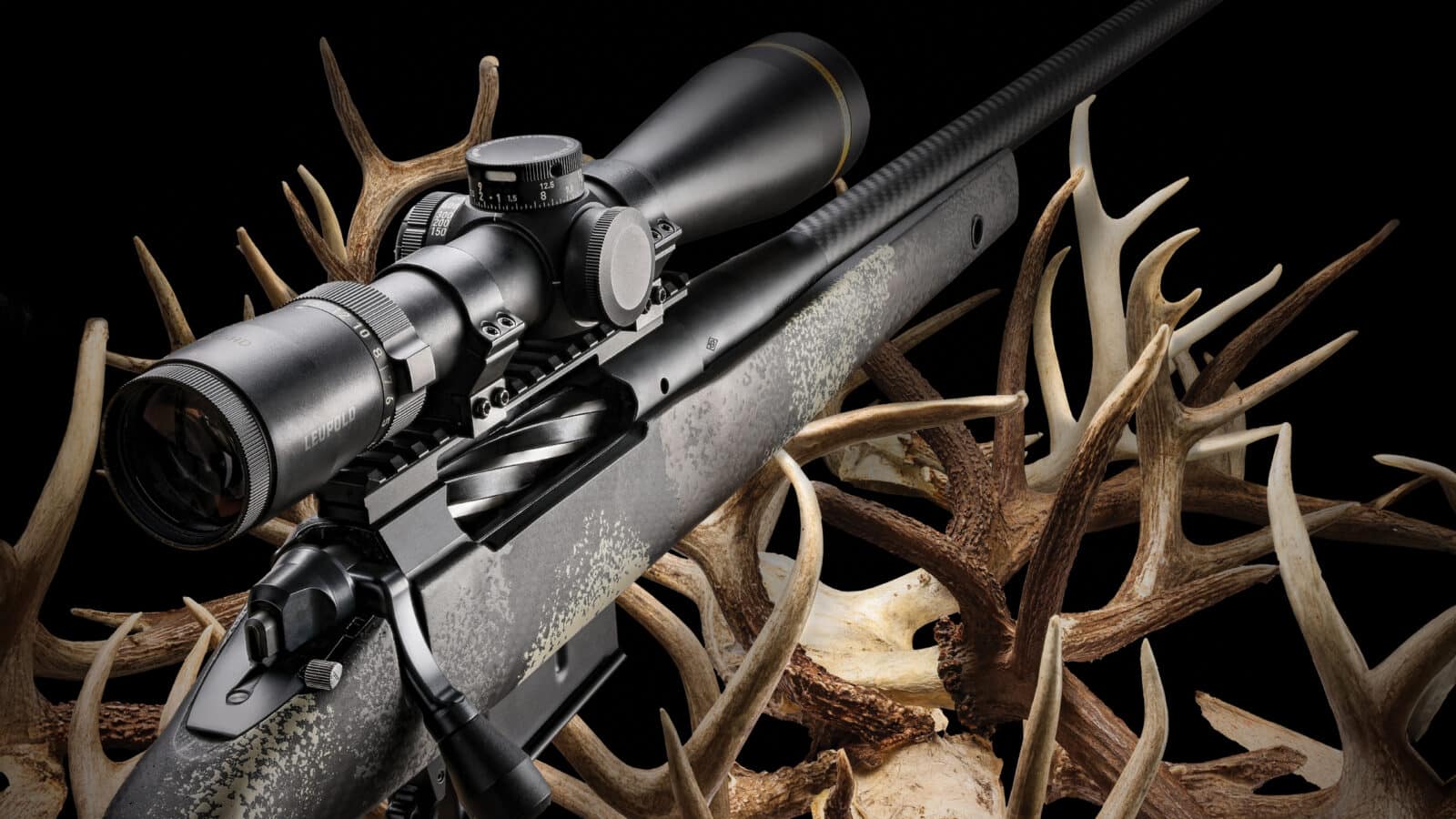
Working in the firearms industry and reviewing shooting gear offers a front-row seat to the cutting edge of gun-related tech and trends. And while some categories, such as optics, chronographs and suppressors seem to advance in leaps and bounds, other products progress through an unassuming procession of modest refinement. New materials, enhanced ergonomics, and original combinations of pre-existing features and components denote new generations of long-trusted designs.
For proof of my supposition, look no than the ubiquitous bolt-action rifle.
The modern bolt action can trace its roots back nearly 200 years, to 1841 and Prussian arms maker Nicolaus von Dreyse. His military long arm, popularly dubbed the “needle gun” for its lengthy firing pin, was the first bolt-action rifle to feed and fire self-contained metallic cartridges.
Fast forward to today. We live in a time of super materials such as metal alloys and carbon fibers that are lighter, stronger and more heat-resistant than traditional walnut and steel. Too, our ammunition and cartridge ignition systems have come a long way from match cord, mercury fulminate caps, and, yes, “needles.” But upon careful inspection, we can also find many similarities between modern bolt-action rifles and Dreyse’s original military arm.

Bolt-action rifles remain the most popular style of sporting gun in the world. They have proven to be accurate, robust, dependable and powerful. They are also eminently configurable for specific pursuits through the selection of appropriate chamberings, optics and other features.
I’m sure you can guess that if I could only have one firearm for North American hunting, it would indeed be a bolt-action rifle. But in a world of so many choices, what features am I looking for, and what model would I choose?
Non-Negotiables & Nice-to-Haves
We all build biases and preferences based on experience, as well as requirements derived from the intended quarry and terrain. In a one gun for North America scenario, I’m setting my sights on big game ranging from whitetail deer to elk and moose. I also need it to be capable of taking a grizz, in a pinch.
That game consideration eliminates, in my mind, almost all non-magnum cartridges, as well as those that tend to use bullets weighing less than 150 or 160 grains. I love my 6.5 Creedmoors, but I want more power and energy potential. The beloved .308 Winchester is also out. Sure, it’s capable of carrying a heavier payload, but its default loadings are a little light for my taste, and the cartridge’s case capacity restricts its potential. Ultimately, I’m looking for a cartridge that is both powerful and versatile.

Other requirements include a means for easily mounting optics, and swapping scopes if needed. In my mind this is Picatinny rail, as opposed to a make- or model-specific mount and ring combination. An excellent trigger is also a must. It doesn’t need to be featherlight, but it should be smooth and reliable. Finally, this rifle could see terrain ranging from dense woodland to the West’s wide-open plains. It may be carried from the truck to the tree stand, or many miles up and down mountains. Therefore, it should present a trim, portable package, and its construction should be robust and weatherproof.
While not required, there are additional features I would prefer to see. The first is a detachable magazine, preferably with standardized dimensions. In my experience, this set-up makes ammunition management easier than with internal magazines, and it’s a good idea to have at least a couple spares stashed away in case of loss or damage.

Live The Armory Life. The latest content straight to your inbox plus an automatic entry to each of our monthly gun giveaways!
I also prefer a threaded barrel that can easily mount a suppressor. I’ve been hunting suppressed for years and greatly prefer it. Not only is a suppressed shot far safer for my hearing, but it is much easier to hear a hit when your ears aren’t plugged — or ringing. And, lastly, I like a stock that offers enhanced ergonomics and ample sling and support mounting options compared to traditional American sporters. Nothing beats the aesthetic of classic walnut and a sleek, straight comb, but shooting tools and techniques have evolved to improve stability and accuracy, and I’m here for it.
Model 2020 Waypoint
One rifle that ticks all the boxes is the Springfield Armory Model 2020 Waypoint chambered for 7mm PRC. I love a speedy 7 mil, and the PRC’s continuing rise in popularity and availability have cemented its place as my go-to North American (and beyond) hunting cartridge. I’ve used it with great success on deer, elk and moose, and it’d be tough for anyone to argue against the hunting efficacy of a designed-for-precision cartridge launching 175-gr. bullets at nearly 2,900 feet per second (fps). It’s a cartridge that is as viable at 500 yards as it is at 50, and the recoil is significantly less than comparable .30-cal. magnums.
Featuring a Model 700 pattern, the Model 2020 receiver is drilled and tapped for Remington-pattern scope rings and bases and comes standard with a Picatinny optics rail installed. For its trigger, Springfield includes a TriggerTech Field model in its Waypoints. User adjustable for a pull weight between 2.5 and 5 lbs. and featuring a wide trigger shoe, TriggerTechs are acclaimed for their clean travel, crisp break and overall durability. My rifle’s trigger came set at 4 lbs., 4 oz., according to my Lyman digital gauge, and offered an enviable shooting experience. Still, following TriggerTech’s instructions, I was able to reduce that by a pound with just a couple rotations of an Allen wrench.

Springfield’s Model 2020 Waypoint line-up offers a variety of configurations, and customers need to make some selections to home in on their preferred model. First, the barrel. Two options are available for most chamberings, either a fluted stainless-steel barrel or a carbon fiber barrel which features a stainless-steel inner liner supported and tensioned by a carbon fiber outer wrap. Both are threaded 5/8×24 — meeting my requirement for suppressor compatibility — and come standard with Springfield’s radial muzzle brake. I opted for the carbon fiber barrel to save several ounces of overall weight. In 7mm PRC, it’s a 24” barrel with a 1:8 rifling twist rate.
Stock configuration and finish is another selection that must be made. All the Waypoint stocks are constructed from carbon fiber by AG Composites. They offer a modernized profile and include advancements derived from competition circuits such as the Precision Rifle Series (PRS) and NRL Hunter matches. Evolutions include raised combs, vertical pistol grips, flat-bottomed forends, and plenty of places to attach bipods, slings and other accessories.

Springfield Armory offers Model 2020s with or without an adjustable comb, and in two custom painted camouflage patterns: Ridgeline, with brown, tan, and gray splotches; or the green, tan, and gray Evergreen finish. I personally prefer Ridgeline, though both patterns look great, and I selected the non-adjustable stock, which saves about 9 oz. of overall weight.
The exact model I selected for my one gun to rely on is cataloged as “Model 2020 Waypoint 7mm PRC Rifle w/ Carbon Fiber Barrel — Ridgeline.” Before adding a scope, it tips the scale at 7 lbs., 5 oz., and measures 46” from tip to tail. To me, this is a sweet spot as it’s not too light for shooting — and especially practicing with — the 7mm cartridge, but it’s not too heavy for backcountry excursions. And, yes, it feeds metal AICS-pattern detachable box magazines. My Model 2020 included Accurate-Mag’s .300 Win. Mag. magazine unit, 3.850-inch cartridge overall length, which holds and feeds three rounds of 7mm PRC without issue.
Specifications
| Chambering | 7mm PRC (tested) |
| Barrel | 24″ |
| Weight | 7 lbs., 5 oz. (rifle only) |
| Overall Length | 46″ |
| Sights | Picatinny rail |
| Stock | Carbon fiber |
| Action | Model 2020 |
| Finish | Cerakote |
| Capacity | 3 (one magazine) |
| MSRP | $2,295 |
Range & Field Ready
One additional consideration with any modern bolt-action is the selection of an appropriate riflescope. In these deliberations, I weigh both the cartridge’s capability and the intended pursuit. So, while an argument could be made that 7mm PRC is a 1,000-yard-plus cartridge and I ought to throw as much glass on top as possible, the agenda for this build is a North American game getter, and ethically killing an animal requires a different mentality than ringing steel on the far horizon.

I’ve come to prefer Leupold’s VX-5HD 3-15x44mm riflescope with the illuminated Firedot Duplex reticle. It offers plenty of magnification for extended shots in the hunting field but can also be dialed down for opportunities in close cover. The illuminated reticle isn’t a must-have for me, but I find it to be a significant advantage when pursuing dark-furred game.

For the price of around $1,300, it offers premium glass, Leupold’s refined controls including side-focus adjustments and zero-stop capability, and the option to take advantage of the company’s custom dial system. In my opinion, it’s one of the best values on the market, and adds less than a pound-and-a-half, rings included, to my rifle’s overall weight.
On the range, I tested the Model 2020 Waypoint with three 7mm PRC hunting loads: Federal Fusion Tipped 175-gr. PTB, Hornady Outfitter 160-gr. CX, and Hornady Precision Hunter 175-gr. ELD-X. Not surprisingly, the rifle loved the heavier loads, and both easily outshot Springfield’s .75 MOA accuracy guarantee. In a best-of-three-groups shootout, the Federal load just edged out Hornady’s Precision Hunter, though I doubt any hunter or game animal could have discerned the difference.

Hornady’s Outfitter load, with its lighter Copper allow eXpanding (CX) bullet also posted very respectable groups. I should note, though, I did not follow any strict maintenance regimes, as some would suggest, to prepare for the non-lead projectiles. For tests like this, I prefer to put all the ammunition on an even footing, fouling the barrel with some familiarization fire and while zeroing the optic, and proceeding through testing with only a quick bore check between loads. Still, I am a fan of having a copper-based option in my ammo box. Bullets like the CX tend to remain intact and retain their weight after impact, making them excellent penetrators. Too, as some locales restrict the use of lead-based bullets, copper alloy offerings may be a requirement.
Conclusion
I’m exceptionally confident in the capabilities of the 7mm PRC cartridge, and I’ve successfully hunted Montana elk and British Columbia moose with Hornady’s Precision Hunter Outfitter loads, respectively. Pairing that proven performance with the accuracy and feature set of Springfield Armory’s Model 2020 Waypoint bolt-action rifle and Leupold’s VX-5HD scope yields a premium package I would confidently rely on to hunt anything in North America. Looks like I have my “one gun to rely on.” Could it be yours?
Editor’s Note: Please be sure to check out The Armory Life Forum, where you can comment about our daily articles, as well as just talk guns and gear. Click the “Go To Forum Thread” link below to jump in and discuss this article and much more!
Join the Discussion
Featured in this article


Read the full article here