

Maximizing accuracy and performance seems to be a white whale we all chase. We want the shortest package with a minimal footprint to reach out to 500 and beyond with ease. But we still want to run the rifle fast at closer targets.
For this scenario, the low power variable optic (LPVO) has been a go to for military, law enforcement and competitive end users alike. But there have been none that do everything extremely well like clarity, usable reticle and a daylight-bright red dot. Well, Vortex took on the challenge. With a new contract optic on the table, the United Kingdom wanted a modern and compact LPVO that could meet very stringent specifications on size, weight and magnification.
This was not an industry-standard design nor something normal partners in the industry could produce while meeting a set budget for the project. I was able to travel to Vortex headquarters in Wisconsin recently and personally see how these optics are made and tested. But more on that and the specifics in a little bit.
An Operator’s Optic
The design requirements were specifically set by the British Ministry of Defense for United Kingdom Special Forces, commonly referred to as the SAS. The project was quickly named “Project Eleanour,” because the bar was seemingly unattainable and was a wink to the movie Gone In 60 Seconds, where Nicholas Cage could not seem to get the 1967 Mustang Fastback to his buyers without destroying it or ending up in jail.

The biggest hurdles to overcome were to include a usable MIL reticle, daylight-bright LED, strict weight requirements, dual zero ability, and minimal size to name just a few. It also had to withstand an insane amount of impacts. I got to see the impact testing machine in operation, and it was nothing short of punishing. It withstood thousands of .50 BMG-plus impulses during the testing process.
When speaking to Vortex engineers, two of the most difficult things to accomplish were the 1-10 power in such a minimal size, requiring the design of an all-new erector assembly internally. Then, stacking more lenses than ever before in an 8.4”-length optic in order to give it the power and clarity it has was not an easy task. Yes, you read that right — 8.4” long, 1-10 magnification and a daylight-bright LED red dot. Currently, no one else has been able to accomplish this, and the specifics of the erector assembly are a highly guarded secret. Vortex also had to make its own HD glass to accomplish this, which again is no small task.
How About a Quick Comparison?
Almost all of you have probably heard of or seen the Vortex Razor series 1-10 LPVO. This has been a long-time favorite of the military, law enforcement and civilians. So why not just slap a new coat of paint and a reticle in the already well-proven Razor line? Here’s why.

The Razor Gen 3 1-10 in its current form is 10.1” long, 21.5 oz. and has a fixed parallax of 150 yards. If we quickly compare that to the new AMG 1-10, there are some surprising differences. The AMG is 8.4” long, 18.8 oz. and has a fixed parallax of 250 yards. The field of view for the AMG is 116’ and 12’ at minimum and maximum magnification. So, we save 1.7’ on length and 2.7 oz. of weight. And the parallax being set to 250 yards helps with more intermediate ranges.
The other additions in options include the truly daylight bright reticle, dual zero turret design, faster focus ocular ring and a more coarse threaded throw ring to magnify quickly. You may be asking how do you get two zeros in one scope. Well, it’s a simple but elegant design. Under the capped turrets, you have two rings — an upper or lower with zero marking that can be independently set.

You may also be asking why you would want two different zeros. Well, a perfect example would be for sub- and supersonic ammo. It also makes for easy swapping from a defensive-based cartridge to a more precision-based cartridge without having to remember your adjustment. To me, this was one of my favorite small touches because I have two favorite ammo types that I go back and forth with.
How About Performance?
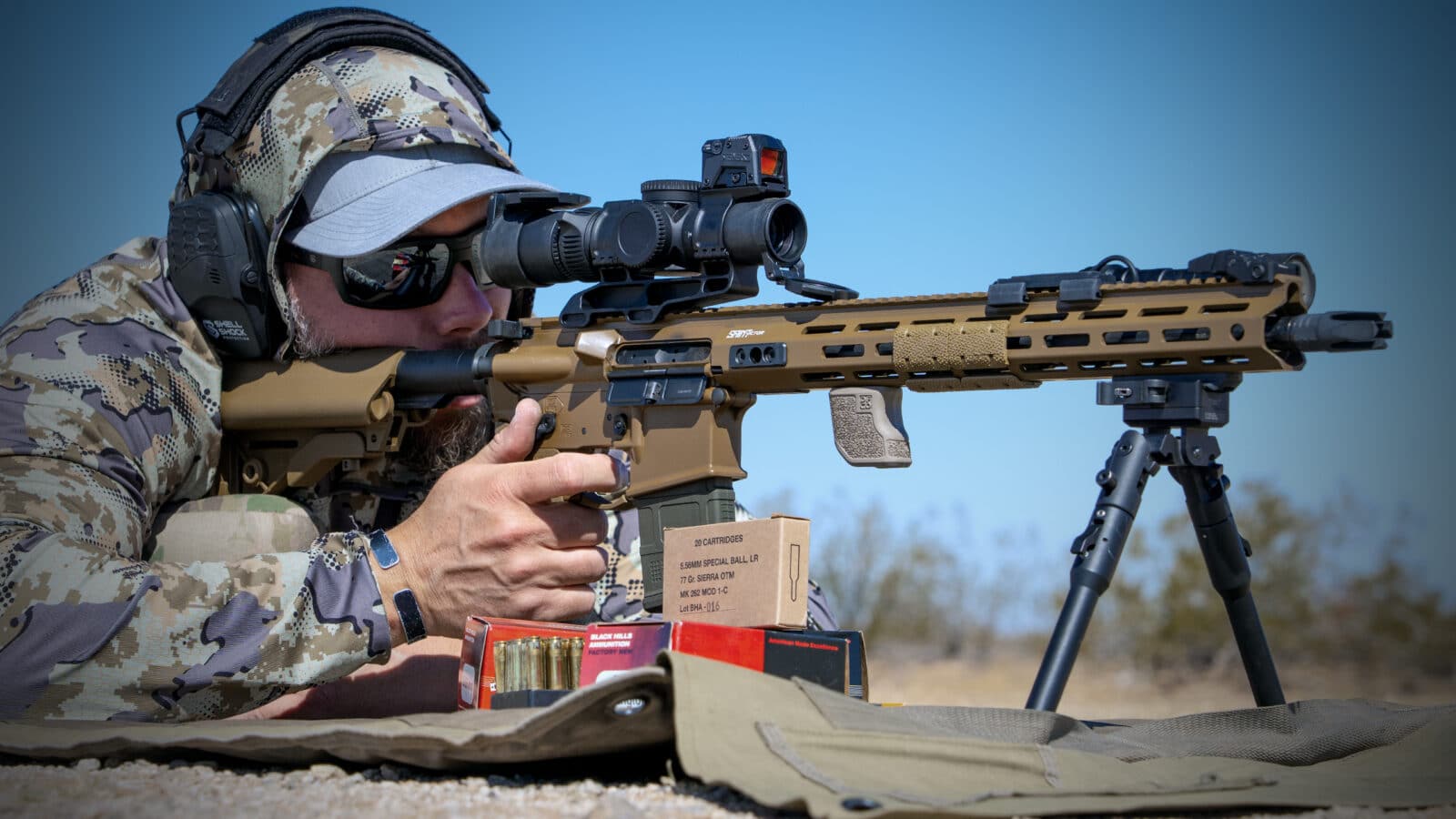
I figured the 16” Springfield Armory SAINT Victor was a great base rifle for this optic and mounted it into one of my favorite mounts from Zero Gravity. I have become a huge fan of the Zero Gravity mounts after using them in a class recently. They are light, strong, have a very nice ring attachment method, and give the ability to add a 12 o’clock red dot with their Sherpa Mount.

Since it is an all-around-use rifle, I added a Streamlight Protac HLX light, Die Free Company foregrip, and used a Warne Skyline Lite bipod for the initial zero and accuracy testing. For ammunition, I used Black Hills Mk-262 MOD 1C 77 grain, 69-gr. OTM, 77-gr. OTM and 75-gr. Match HP. I do have to say the Black Hills ammo performed and I shot some of the best groups I have in a while.
Once I was zeroed up, I printed the following groups and tracked velocity for the different projectile weights. The 75-gr. Match HP maintained a healthy 1.133” group and the average velocity was 2,553 fps. Next was the 77-gr. OTM, which tightened up significantly to .766” with an average velocity of 2,622 fps. I was left wondering, heavier or lighter next? So, I tried the 69-gr. OTM and gave up a little bit coming in at .811” with an average velocity of 2,782, which was a substantial gain in speed. And with high hopes I laid down behind the rifle now loaded with the 77-gr. MK-262 and acquired an impressive group of .658”. Any of those groups are extremely impressive to me with a 1-10 optic on top of a 16” rifle.

Live The Armory Life. The latest content straight to your inbox plus an automatic entry to each of our monthly gun giveaways!
Since the accuracy was there and very achievable with the extreme clarity of the optic, I moved on to some faster drills using the daylight-bright red dot. The optic took everything I threw at it when testing, from fast target transitions to shooting at further distances. One thing to keep in mind is the AMG 1-10 is a first focal plane reticle. So, it gets larger as you add magnification and smaller as you take it away.
When engaging past 300 yards and really pushing into the higher magnification, your center section will require some getting used to. Remember, though, this is not a dedicated long-range system; it’s designed as a close- to intermediate-engagement reticle. And with a 5.56, your intermediate range is past 300 yards and to about 550 or 650 yards where you have reached max effective range of the ammo depending on barrel length.

I was also able to get some footage through the scope looking at a mountain 2,650 yards away and the clarity was impressive, especially for having a fixed parallax of 250 yards. Once you set the ocular adjustment to your eye, you lock it in with the fixed adjustment ring so it doesn’t back off. The EBR-9 MRAD reticle is very easy to use and hold over rather than having to dial elevation. The internal etched reticle had a total of 10 MIL of elevation hold markings and 10 MIL of windage left or right. There is also a built-in ranging design at the top center for quick distance acquisition on known target sizes.
The Biggest Benefits
Besides being smaller, lighter and more capable, there were some really standout features to me. First, the dual zero for all the reasons we discussed. The ocular adjustment lock is a huge plus for me since I wear glasses. I spend a good amount of time making sure it’s perfect for my eye in different conditions and, once I set it, I don’t want it to get moved on accident. The daylight-bright red dot was nothing short of daylight bright — which is where many other LPVO’s fall off. The edge-to-edge clarity and sharpness — while still providing a comfortable eye box — is another great help if you are new to LPVOs or happen to be running them in awkward positions.

It is pretty amazing they were able to build this AMG with everything it has in its size. But nothing is perfect for everything, right? It performed perfectly; however, there are things you have to keep in mind with something like the Vortex AMG 1-10.
The brightness settings are very bright. If you are in a low-light environment, you need to match your optic brightness to the conditions or you will get feedback due to the amount of lenses stacked into the optic tube. While this is an end-user issue mostly in very low-light areas, it will be noticeable very slightly at lower settings.

The reticle is very solid but, again, remember this is built to fulfill a specific need to encompass up-close targets, positive identification at longer distances and target engagements out to about 500 yards since its max magnification is 10. While none of these are negatives, I can see people wanting to get this and put it on an 18” rifle and try to hit 1,000-yard targets. And while this is possible, the center of the reticle was not designed for that. In my opinion, the new AMG would be perfect for a 14” of the Springfield SAINT Victor with a K-sized high-flow suppressor. This package would be pretty formidable, and you can add a top-mounted red dot like I did with a Steiner MPS to make really fast work of the 25 yard and in targets.
Is It Worth It?
This is the part where people will really have a deep discussion. The MSRP on the Vortex AMG 1-10 is currently $6,399.99 (although I am seeing it for sale closer to the $4,000 range). That is no small amount of coin to drop on an optic. For this, we need to think back to who this was built for, what the requirements were on size, weight and everything else. And we also need to understand this is not simply a re-branded razor. The new patented erector assembly and new internal lenses all had to be designed from the ground up. And they had to withstand insane impact testing as compared to other commercially available scopes.

The question of whether it is worth it will depend on what you intend to do with it. If you want an extremely durable, small, and lighter 1-10 that seems to have everything you could want, then yes, it’s amazing. If you are using this for military or law enforcement work on, say, a tactical team, then it is again worth it. Or, if you are an advanced civilian shooter with the budget for an optic like this, it’s an easy “yes.” Just remember to use good ammo — it deserves it!
Editor’s Note: Please be sure to check out The Armory Life Forum, where you can comment about our daily articles, as well as just talk guns and gear. Click the “Go To Forum Thread” link below to jump in!
Join the Discussion
Featured in this video



Read the full article here