

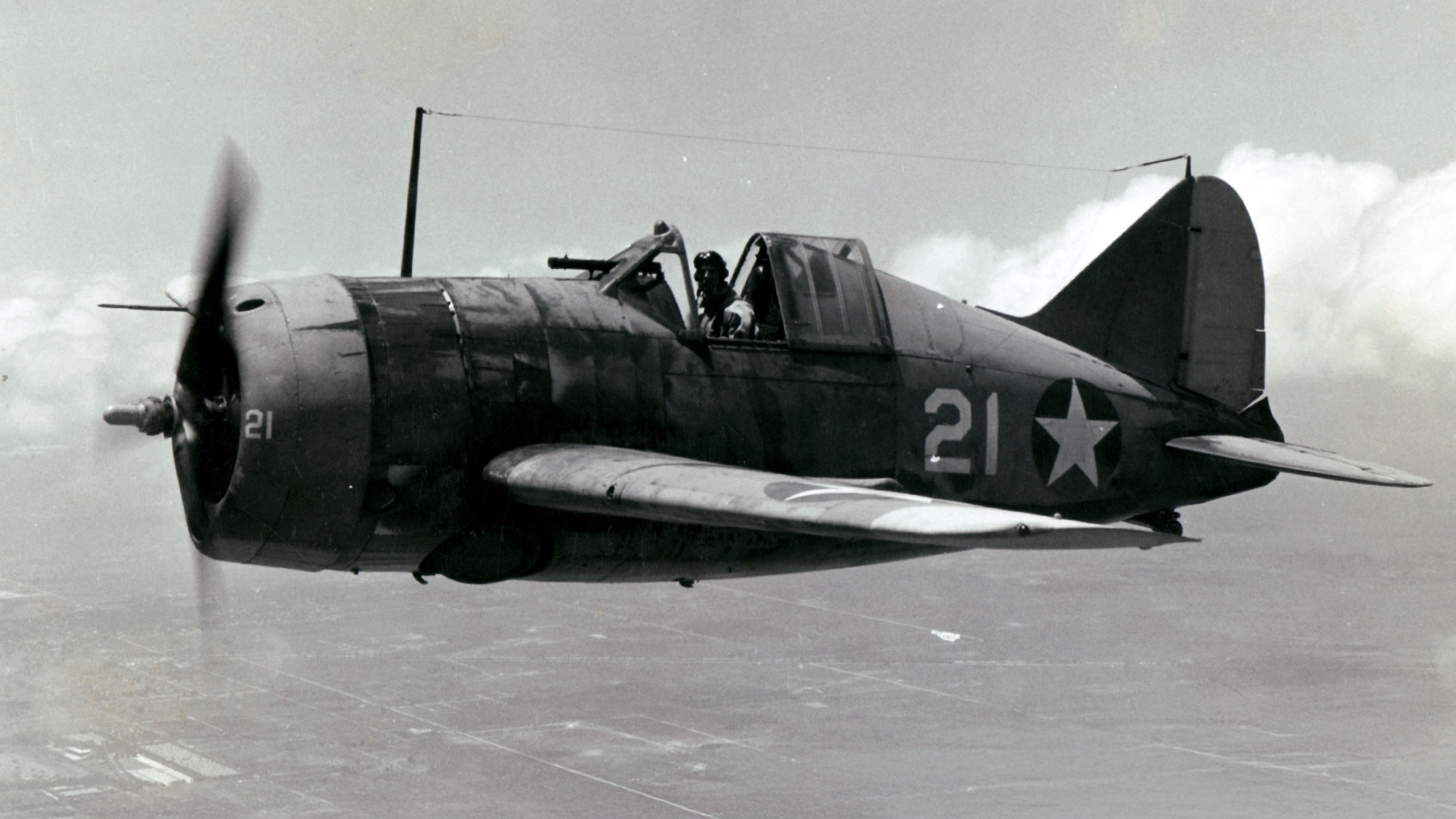
The air war during World War II saw the transition from the last of the biplane fighters to the beginning of the jet age. A myriad of aircraft were in action around the globe; some have become enduring icons while others faded into obscurity. The Brewster F2A Buffalo can legitimately claim membership in both groups. It is simply a matter of whom you ask.
US Navy’s First Monoplane Fighter
In 1935, the US Navy sought to replace its nimble but aging Grumman F3F fighters. In a 1938 competition of “carrier capable” aircraft, the F2A Buffalo emerged as the winner and became the Navy’s first monoplane fighter. Made by the Brewster Aeronautical Corporation from Long Island City, New York, the Buffalo beat out the early version of the Grumman F4F Wildcat, and the Navy placed an initial order for 54 F2As.

In the mid-1930s, the Buffalo featured a massive “greenhouse” canopy that provided excellent visibility for the pilot. The F2A also had hydraulically operated, retractable landing gear and was one of the first Navy monoplanes to feature an arrestor hook. After a few airframe modifications, the Buffalo’s 950 hp single-row Wright R-1820-22 Cyclone radial engine gave it a top speed of 304 mph. Early variants lacked self-sealing fuel tanks and an armor plate for the pilot, but the early Buffaloes were well-liked by Navy and Marine Corps pilots. Legendary USMC ace, Colonel Gregory “Pappy” Boyington, claimed that the early F2A’s “could turn and roll in a phone booth.”
While the prototype Buffalo performed well in the air, Brewster’s production couldn’t keep pace on the ground. The Brewster facilities were completely inadequate for mass production — aircraft sub-assemblies were made on different floors and then shuttled back-and-forth inside the building on freight elevators. Produced within the tight confines of America’s largest city, the completed aircraft had to be disassembled and driven to a nearby airfield to be reassembled for test flights.

Production lagged even after the Navy recognized the ridiculousness of the cumbersome process at Brewster. To make matters worse, Brewster’s management was riddled with incompetence and scandal. With war clouds looming and the Navy looking to maintain Brewster’s production capability, an order was placed for more than 100 of the F2A-3. The final version of the Buffalo would become the only type to see combat with US forces.
With the F2A-3, the barrel-like Buffalo gained considerable weight, including a larger, self-sealing fuel tank in the fuselage, four .50-caliber MGs and armor protection for the pilot. A more powerful engine and an improved propeller could not overcome the additional weight and the F2A-3 was notably sluggish compared to its previous variants. Worse still, more than 500 extra pounds brought on a greatly increased percentage of landing gear collapse during carrier landings.
Defending Midway with the Brewster
During the Battle of Midway in early June 1942, the Brewster Buffalo saw its greatest action as a US fighter aircraft. Twenty F2A-3 Buffaloes of USMC VMF-221 (along with six F4F Wildcats) took off to intercept more than 70 Japanese bombers escorted by 36 Zero fighters. The Marine pilots did the best they could, downing four Japanese bombers and a single A6M Zero.

The F2A-3s proved a frustrating mix of problems. Some of the Buffaloes’ nose guns were inoperative, reducing their firepower by half. Others flew without armor plate for the pilot. None of them were a match for Zero fighters and their highly experienced yet unconscionably brutal pilots. Several F2A pilots were strafed in their parachutes when they bailed out, including the commander of VMP-221, Major Floyd B. Parks, who was killed. Thirteen out of the twenty Buffaloes involved were shot down, along with two F4Fs.
The Buffalo was used at Midway simply because it was all that was available. U.S.M.C. Lt. Charles M. Kunz flew the F2A-3 during the defense of the Island, downing a pair of Japanese “Val” dive bombers, until his Buffalo was shot to pieces by a Zero. Afterwards, he commented: “In my opinion, the Zero fighter has been far underestimated. I think it is probably one of the finest fighters in the present war. As for the F2A-3, it should be in Miami as a training plane, rather than used as a first-line fighter.”
The time had come, and the Buffalo was retired from US combat squadrons. However, WWII was far from over for the Brewster fighter.
Buffaloes in British and Dutch Service
In 1940, with their nation at war with Nazi Germany, the British sought to add fighter aircraft beyond what their industry could produce at home. To this end, the British Purchasing Commission selected a US-export-approved version of the Brewster Buffalo, the B-339. The B-339 was a modified F2A-2, stripped of its naval equipment (arrestor hook, life raft container) and fitted with the 1,000-hp Wright R-1820-G-105 engine (a 200-hp downgrade from the F2A-2 engine). Belgium ordered 40 of the B-339s, but only eight were delivered before the country fell in May 1940. The remainder of the Belgian order, plus an additional 170, were acquired by the RAF and were called the B-339E, or “Buffalo I”, in British service.

Since the RAF fought a predominantly “high-altitude war” with the Luftwaffe, normally above 15,000 feet, the Buffalo didn’t have the level of performance that the British considered necessary for combat over Western Europe. However, RAF units in Singapore and Burma/India needed modern fighters, and by March 1941, two squadrons worth of Buffaloes had been delivered and assembled in Singapore. Some Buffaloes retained their four .50-caliber Browning guns, but there wasn’t enough ammunition and some of the AP ammo was said to be faulty. Attempts to replace the .50-caliber guns with British .303-caliber Brownings met with little success.
Geoff Fisken DFC was the British Commonwealth’s leading ace (11 victories) in the Pacific Theatre during WWII. He began his career flying Buffaloes with 243 Squadron defending Singapore. Fisken described the Buffalo as “a beautiful plane to fly”. He advised a diving attack on Japanese fighters: “The only way to get a victory was to bash in and fire a three or four-second burst and then get out of it.” In his view, dogfighting with the maneuverable Japanese fighters was suicidal. Fisken claimed six of his victories while flying the Buffalo.

Live The Armory Life. The latest content straight to your inbox plus an automatic entry to each of our monthly gun giveaways!
The Royal Netherlands East Indian Army (KNIL) ordered 144 Brewster B-339C/D, but only half were delivered to the Netherlands East Indies before the Japanese overran the islands. The remainder were diverted to the Royal Australian Air Force. The KNIL B-339Cs were lighter than those used by the British, and the Dutch made them even lighter by reducing the fuel and ammunition load in the wings. This increased maneuverability allowed the KNIL Buffaloes to have a better chance against Japanese Zero and Oscar fighters in a dogfight. Even so, the Dutch fighters were greatly outnumbered and soon overwhelmed.
In the early air battles over Malaya and Singapore, the Buffalo performed relatively well against the Japanese Nakajima Ki-27 “Nate” fighters. While the Ki-27 was supremely maneuverable, it was slow (290 mph max speed) and poorly armed (2x 7.7mm machine guns). The Imperial Japanese Army Air Service soon replaced the elderly Nate with the faster and more powerful Nakajima Ki-43 “Oscar”. The Ki-43 became legendary for its incredibly nimble dog-fighting ability, equal to or even better than the more famous Mitsubishi A6M Zero fighters of the Japanese naval squadrons.

With either foe, the Buffalo was at a severe disadvantage — Allied pilots needed to avoid the inclination to dogfight, hit the Japanese with their .50-caliber firepower, and then dive away as soon as possible. These tactics felt cowardly for many fighter pilots, but it was part of the deadly learning curve of air combat against the Japanese, who valued maneuverability over every other fighter aircraft attribute.
From its technical performance to the tactical training of its pilots, the Buffalo did not match up well with most of its Japanese opponents (even with the slight improvements made by the Dutch). The story of the Buffalo in the Pacific can seem like a sweeping Japanese victory — but the sacrifices of B-339 pilots brought on the necessary changes to later success. Without the harsh combat lessons learned in the disastrous early days of the Pacific war, the Allied pilots would not have known how to change their tactics to make the most of their aircraft. Men like Geoff Fisken survived to tell the tale and teach a new generation of Allied pilots.

Revised training and better aircraft, like the P-40 Warhawk, the twin-tailed P-38 Lightning, the F4F Wildcat, and Grumman’s F6F Hellcat were ultimately on their way. It was a long road to victory in the Pacific, and the combat experiences gained in the Buffalo represented the first steps of that difficult journey in the air.
The Sky Pearl in Finnish Skies
Editor’s Note: An important note about the Finnish Hakaristi symbol. The swastika (called “hakaristi” in Finland), is an ancient good-luck symbol used by many cultures. In Finland, the hakaristi was used in a straight alignment (colored blue on a white background) as the national marking of the Finnish Defense Forces between 1918 and 1945. In Finland, it had no connection to Nazism or Nazi Germany.
The Brewster Buffalo found its greatest success in an unlikely combat environment. While many think of Buffaloes in action during the early days of the Pacific air war, the Brewster fighter became a dominating element in Arctic skies. As the Soviet Union became increasingly threatening, the Finns sought to modernize their small air force.

Negotiations with American suppliers began in April 1939, and by October the Finns were approved to purchase export-ready aircraft. The U.S. State Department convinced the US Navy to part with 44 F2A-1s, to take a future shipment of the F2A-2. On November 30th, the Soviets invaded Finland, and the Red Air Force began bombing Helsinki. The Finns signed the contract to purchase 44 of the newly designated Brewster Model B-239E fighters (at $54,000 per aircraft) on December 16th. Only six of the B-239E’s were delivered before the Winter War ended on March 13, 1940, and none of them saw action. But combat opportunities were not far off.
The B-239E was built with a more powerful engine than F2A-1, as it was driven by 950-hp Wright R-1820-G5. Its overall weight was slightly reduced with the naval equipment (tailhook and life raft container) removed, and performance improved overall. Using their experience in the Winter War, the Finns made specific modifications to the B-239E.

The back of the pilot’s seat was covered with armor, and self-sealing fuel tanks were installed. A quietly important addition came in the form of the Vaisala T.h.m. 40 reflector sight (a license-built version of the German Revi 3c). This helped Finnish pilots take full advantage of the four .50-caliber MG armament — two in the nose and two in the wings.
Top speed for the Finnish B239Es was 297 mph at 15, 675 feet. The chubby Brewster was noted to be easy to fly and surprisingly nimble. The cool ambient air of the Finnish front helped too, as the natural conditions worked to keep the Brewster’s Wright Cyclone engine from overheating.

In Finland, the B-239 had many nicknames, but it was never referred to as the Buffalo. “Sky Pearl” and “American Car” were popular. Sometimes it was known as “The flying beer bottle”. Most often, it was simply called “The Brewster”.
Lessons Learned with the Brewster F2A Buffalo
After the Winter War, the Finnish Air Force conducted vigorous training along with the application of modern fighter tactics. The four-plane swarm (Finnish: “Parvi”) formation became standard, and gunnery was a primary focus in training. Finnish doctrine prescribed that the attacking fighter held their fire until within 50 meters of the enemy. Many fighters of the early war era were lightly armed, and short-range shooting was a necessity. The Brewster’s four .50-caliber Browning MGs (sometimes captured Soviet Berezin UB 12.7mm guns were used) proved devastating at close range.

Eino Juutilainen was Finland’s leading ace with 94 confirmed victories, with 34 of his total coming while flying the Brewster B-239. Juutilainen was a staunch proponent of close-range attacks that maximized accuracy and damage to the opponent, only firing when, as he said, “I could count rivets on the target.” As for the Brewster fighter, Finland’s greatest ace proclaimed, “We were happy to fly them anywhere to take on any opponent.”
In combat, new pilots were paired with a veteran until the experienced pilot believed the rookie was ready for his own combat assignment. Finnish training and discipline turned the often-derided Brewster into a consummate killer. Between June 25, 1941, and June 17, 1944, the Brewster B-239’s of Finland’s Lentolaivue 24 (LeLv 24) claimed 477 Red Air Force planes shot down, against the loss of only 19 Brewsters. The result was an incredible victory-to-loss ratio of 26 to 1.
F2A Aces in the Air, Miracle Workers on the Ground
Despite the achievement of the Finnish pilots, the record of the Brewster ground crews was even greater. The original order of 44 B-239’s was the extent of the complete aircraft that Finland received.
By late 1942, the Finns no longer had access to spare parts from America, as Finland was at war with the Soviet Union, an erstwhile American ally. Finnish mechanics became experts in troubleshooting and modifying the Brewster Wright-Cyclone engine. This included using parts from, or even complete Soviet M-63 engines, a license-built version of the Cyclone.

Finnish mechanics recycled and reused any essential part — scouring scrap yards and wreck sites to help keep the beloved Brewsters flying. Somehow, against long odds, they made it work throughout the three years of Finland’s Continuation War.
The Finnish Brewsters faced a wide range of Soviet aircraft. Early opponents were often the highly maneuverable Polikarpov I-153 biplanes, and the equally nimble Polikarpov I-16 “Ishak”. During the Continuation War, lend-lease provided the Russians with fighters from England and America, like the Hawker Hurricane and the Curtiss P-40.
By 1943, the Red Air Force deployed its next-generation fighters to the Finnish front, including the Yak-9. The Brewster faced them all. And while Soviet pilots lacked the extensive training of the Finns, they were greatly superior in numbers. The Finnish pilots shrugged off the disparity and used the battle cry of the Winter War — “So many Russians…where will we bury them all?”
The Brewster’s last victory of a Soviet aircraft was confirmed above the Karelian Isthmus on June 17, 1944. By the end of September 1944, there were only eight Brewsters left in Finnish service.
Final Thoughts on the Brewster Buffalo
For the Brewster Buffalo and its export variants, it had been a long and varied combat career. Reviled by some and forgotten by many, in Finland, it remains the Sky Pearl. An enduring symbol of Finnish courage and skill.
Editor’s Note: Please be sure to check out The Armory Life Forum, where you can comment about our daily articles, as well as just talk guns and gear. Click the “Go To Forum Thread” link below to jump in!
Join the Discussion
Read the full article here