

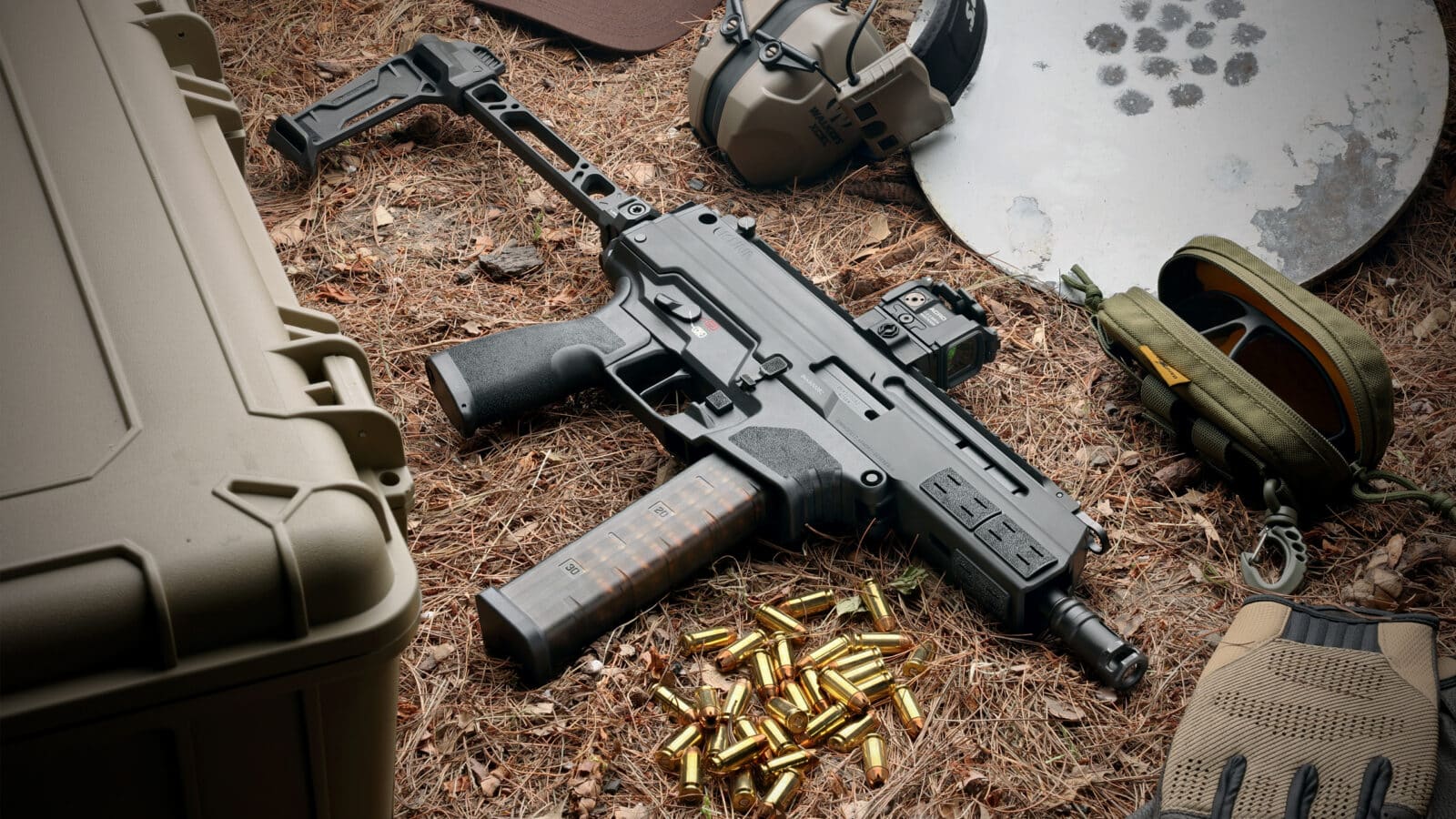
In today’s article, Beyond Seclusion reviews the new Springfield Kuna chambered for the .40-caliber cartridge. Developed specifically for international law enforcement use, this PDW is now being offered to U.S. citizens looking for a bit more thump than the 9mm offers. The firearm used in this article was provided on loan to the author for this evaluation.
One of the latest and greatest in firearms today is the PDW, or “Personal Defense Weapon”. Folks are looking for smaller, lighter and easier-to-maneuver firearms — which makes sense. Why would you want a firearm any bigger than it needs to be? More punch in a smaller package is better for everything such as self-defense, home defense, and even hunting.

That is exactly why the Kuna in the 9mm was such a huge success. It went even further with being one of the few roller-delayed blow-back systems out there. Has Springfield set the new standard and raised the bar?
The Foundation
The original Kuna was and remains a huge success in the 9mm round. There has always been debate surrounding the 9mm’s effectiveness regarding “stopping power” or “punch,” and many prefer something with more energy like the .40. Springfield just released the Kuna in the more potent .40 to the civilian market to address that concern. [Don’t miss our article on the 9mm vs. .40 debate.]

The roller-delayed operating system is the heart of the Kuna. This uses a unique single top-roller design that is the pinnacle of simplicity and reliability. It was engineered to reduce reciprocating mass, and also reduce recoil and muzzle rise. It gives you unmatched muzzle control, especially with rapid fire.

By employing a roller to temporarily lock the bolt into battery, the Kuna eliminates the need for a heavy bolt or gas system, decreasing fouling, producing minimal vibration, higher accuracy, and delivering a lighter firearm with superior handling and also the ability to have a folding brace. Because this was engineered around the .40 caliber, it does use proprietary polymer straight magazines.
Where It Counts
Originally, the Kuna .40 was created for a contract for the Brazilian São Paulo State Military Police (PMESP), the largest police force in Brazil, in 2024. Why in .40? Because they specifically mandated the .40 caliber as their standard police sidearm. Because of its success in this role, this allowed Springfield to introduce the semi-automatic pistol version to U.S. civilian market.

Let’s find out how this performs and see what we can do with Kuna .40. What I want to do is test:
- Function and reliability
- Look at recoil and muzzle rise in slow-motion
- Accuracy and groups using a variety of ammo at 50 yards
- Test accuracy at distance on steel targets as far out as we can go, 100-200 yards?
- Look at a couple of ballistics charts showing the .40 caliber out of the Kuna
Real quick, “KISS” (Keep It Simple Stupid), check of the features of the Kuna:
- Monolithic aluminum upper
- Roller-delayed operating system
- Fully ambidextrous
- Pic rail end plate
- Lots of M-Lok real estate
- AR-pattern grip
- Flat aluminum trigger
- Hybrid flip-up sights (low and high profile)
- Cold hammer forged 6” barrel
- Optional folding brace
- Suppressor-ready 9/16×24 thread pitch
To maximize accuracy, I put a Primary Arms GLx 1x MicroPrism w/ Red illuminated ACSS Cyclops Reticle on the Kuna. I choose this optic because of the wide FOV (Field of View), clarity, size and weight, and the reticle. I have found I can get the best accuracy with a micro optic like this or red dot with the Chevron reticle rather than a dot or crosshairs.

In the video, I show you the FOV so you can see what I am seeing shooting at the different distances. Take a look and see what it looks like at the different distances before we get to shooting. I didn’t use the iron sights in this review as my vision is such that at those distances on the gun, the sights are completely blurry. I have little doubt that they would be more than acceptable, however, for these old eyes, I needed the Primary Arms optic so I could adjust for my vision.
Added Punch
As far as the ballistics go, they were better than that of the 9mm, with an advantage in energy — not so much in speed. A lot of folks want heavier bullets, more energy or punch. Using the really heavy bullets like the 180 grrain, the speed was slow enough that the energy was similar to the 9mm 115-124 grain in energy.

In my experience, to really maximize the energy or punch of the .40, go with the lighter weight bullets and then you really see a difference. I would like to do a follow up review of the best rounds for energy for this, include some really light bullets and see what we can get for maximum energy.

The ballistic charts are in the video along with some of the 9mm from the Kuna to compare too. For the ballistic testing, I used the following:
- Federal Punch 165-gr. JHP
- Hornady Critical Duty 175-gr. JHP
- AAC 180-gr. XTP HP
I did re-zero it with the Federal ammo as I had the most of that for banging on the steel and the groups were pretty good, especially for not have seasoned the barrel. The groups remained the best, however, with the Fiocchi after shooting the steel and then checking the group with the Fiocchi when all finished compared to the Federal. It was still zeroed for the Federal at 200 yards with this group.
15 yards on paper and CQB speed shooting on steel was easy and more than enough for a PDW. The roller delayed system made the recoil very minimal for a .40, allowing for fast follow-up shots and quick transitions.

Live The Armory Life. The latest content straight to your inbox plus an automatic entry to each of our monthly gun giveaways!
50 yards was not even challenging on a full-size IDPA steel target, I could just mag dump about as fast as I could pull the trigger. Recovery time was slightly more than the 9mm, but not much. I was able to get off eight shots on target standing on the steel in 3.8 seconds, or 0.48 seconds per shot. I would say that works, especially at 50 yards.
Reaching Out
I jumped to 100 yards and was able to get off the shots almost as fast as at 50, and with outstanding accuracy. At 100 yards benched, was still able to get off eight shots on target (full-size IDPA) in 6.3 seconds, or 0.79 seconds per shot.

Standing, I was able to get about one second per shot with still excellent accuracy. For a PDW at 100 yards, I would again say, this is more than enough accuracy and stability to do the job. I am a bit out of practice and have not been able to spend any time on the range due to some recent surgeries, and I suspect with a little practice I could get those times down even more.
With that said, recoil is not my friend anymore, not that it ever was, and I can honestly say, this was comfortable to shoot, no issues at all.

200 yards was much more challenging. I would say the biggest factor was trying to bench this with that long stick mag. I had to sit on a pillow just to get high enough to properly hold the gun while keeping the mag off the bench. Even then, it was ultimately pretty easy to hit the steel (full-size IDPA) at 200. However, I did need to really slow it down to hit consistently. I would love to see what I could do with a proper bench setup at 200 and even 300.
Bottom Line
If you liked the Kuna in 9mm, you will like it in .40 with added PUNCH. For the folks who want a PDW with more punch/energy, you should try this version of the Kuna. The punch is on the target, not your shoulder — trust me.
Editor’s Note: Be sure to check out The Armory Life Forum, where you can comment about our daily articles, as well as just talk guns and gear. Click the “Go To Forum Thread” link below to jump in!
Join the Discussion
Featured in this video


Read the full article here