


The classic American service rifle, the M14 in 7.62x51mm NATO, was the replacement for the M1 Garand, adding (among other things) a 20-round detachable box magazine and select-fire including fully automatic. It was the primary service rifle for the U.S. until Vietnam where it was replace by the smaller, lighter, and easier to handle intermediate cartridge 5.56x45mm NATO in the M16.
In 1974, the Geneseo-based Springfield Armory released the M1A semi-automatic rifle for the civilian and law enforcement markets in the U.S. The M1A is a civilian-legal, semi-auto-only variant of the M14 rifle. It offers long-range, heavy-hitting performance.
My Case
I wanted a M1A as long as I could remember, and my first was the M1A Loaded 20+ years ago. I added in the Archangel stock, making it basically the same as the M1A Loaded Precision that Springfield Armory would later offer. It was exactly what I expected, and a fun factor of 10 to shoot. Now, 20 years later and owning many different fully powered .308 rifles, I wanted to just see how my old rifle stacked up.

Is this old gal still holding her own in todays high-tec world? Let’s see what I can do with a variety of modern match grade ammo with an old Nikon P-308 optic. I also want to see how I can do with good old, military-grade FMJ ball ammo.
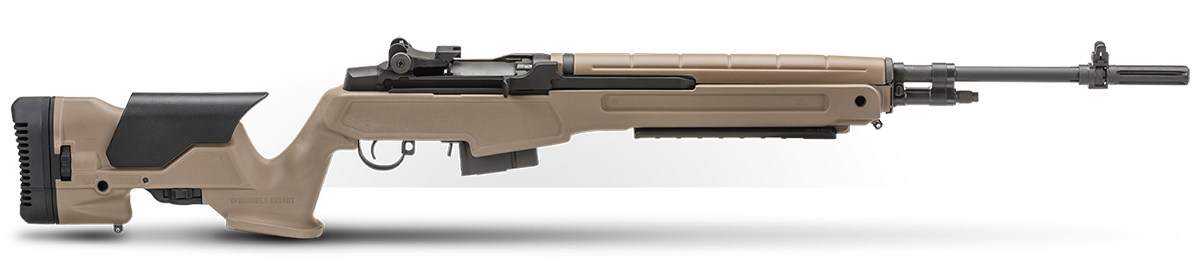
Take a quick look at the specifications of my M1A Loaded Precision:
- 22” NM Medium Weight Barrel with a 1:11 six-grove carbon steel barrel (maintaining great ballistics and accuracy)
- 11 lbs., 4 oz. with synthetic stock
- Desert FDE Archangel Fully Adjustable Stock
- Two-Stage NM Trigger (outstanding trigger)
- National Match Front Sight 0.062” blade (improved accuracy)
- National Match Rear Sight Non-Hooded .0520 Aperture, ½ MOA Adj.
- Flash Suppressor
- 5, 10, or 20 rd Magazine
- Nikon P-308 4-12x40mm BDC 800 (no longer made)

This optic was perfect 20 years ago for the Loaded M1A:
- Variable power for close to midrange
- Generous 9.2 to 12” eye relief
- Light weight at only 17.5 oz
- ¼ MOA Adjustments
- High-grade glass and multicoating’s to increase light transmission
- Shockproof, waterproof, and fog proof (Nitrogen filled)
- Easy to use BDC out to 800 yards
20 years ago, when I purchased my M1A Loaded, it came with a light weight synthetic stock. The Archangel stock had just hit the market and was really big with the M1A. Tt was not offered from the factory from Springfield as it is now. I will say, I have this stock for my rifle 20 years now and I love it. It’s highly recommended.
Range Time
I used a variety of ammo to test accuracy at 100 yards, see what kind of groups she could get and then test a few at 500 yards and also have some fun on the steel. I wanted a good variety from hunting rounds to match grade target and I also wanted to test the cheapest ammo I had including some really old NATO rounds — ones I am guessing as old as I am, 40-50 years old.

Here is what I chose to use:
- NATO military surplus from South Korea
- PPU M80 FMJ Ball
- TulAmo 150 gr FMJ
- AAC 168-gr. BTHP Match
- AAC 168-gr. SMK
- Hornady Superformance Match 168-gr. A-Max
- Hornady Black 168-gr. A-Max
- Federal Premium Gold Medal 168-gr. OTM
- AAC 175-gr. OTM
- AAC 178-gr. BTHP Match
Every gun/barrel is different and definitely has its preference for bullet weight and round. One gun will love a particular ammo, and the next hates it. I have found sometimes even the same type of gun will prefer a different round, thus you have to find what it likes best. Often, it will surprise you.

I shot five shot groups from a cold bore and waited 10 minutes between groups to let the barrel cool back down to outdoor temps. The medium weight barrel heats up and cools down much quicker than the heavy barrels used in most long-range precession rifles. Remember, this was originally designed to be a service rifle, and weight is critical when you carry it all day.

Live The Armory Life. The latest content straight to your inbox plus an automatic entry to each of our monthly gun giveaways!
The Hornady Superformance 168-gr. was hands-down the best group, with all but the first shot touching and an overall MOA group. It took 10 different types of ammo to find her favorite, but an MOA group like this is pretty darn good in my eyes.
The PPU M80 Ball was another one that didn’t surprise me, I have found that round to be very accurate, and I have a lot of it purchasing a large quantity years ago for pennies on the dollar, like $0.30 rd. That’s right, thus why I purchased a lot.
Reaching Out
It was time to move out to 500 yards and see what I could get for groups. Unfortunately, I was on my last box of the Hornady Superformance and, because this was a service-style rifle, I wanted to start off with the PPU M80 as it seemed fitting. After playing on the steel, I came back to the M80 to test the zero and was really impressed.

I also had a lot of Hornady Black on hand and did another group with that after the barrel cooled down. I shot almost the exact same group turned on its side and was able to cover it with my hand (minus the first shot).
The ammo that I had the most of was the Tula. Because this is Russian steel-cased, bi-metal ammo and considered the cheapest of the cheap, I had to see what I could do with it shooting the steel. I have shot this before in this gun and never had one single jam, failure to feed or extract and got surprisingly respectable accuracy. The final test in my opinion of a rifle like this is, will it eat up and spit out anything you put in it with respectable accuracy? It did.

I started off at 400 yards and was able to put all five shots on the steel IDPA in 9.8 seconds. I probably could have gone faster, but I have to wait for the DING before sending the next round so you can hear it. Remember, this was not zeroed for the Tula, it was zeroed for the PPU — making this even better. At 500 yards, I was able to get 3/5 shooting fast. Not bad. I then moved to my 6” gong at 200 yards using the BDC and nailed it, then the same at 300 yards.
Bottom Line
If you have never shot the M1A, there is something about it that is just fun. Frankly, it’s much more fun doing what I did with it than doing the same with a precision long range rifle. This rifle did not disappoint and, considering we are in the technological age of precision rifles, classic platform is still holding its own.
Editor’s Note: Please be sure to check out The Armory Life Forum, where you can comment about our daily articles, as well as just talk guns and gear. Click the “Go To Forum Thread” link below to jump in and discuss this article and much more!
Join the Discussion
Featured in this video


Read the full article here