

In early 1918, as the American Expeditionary Force prepared to face battle-hardened German troops in France, the bayonet was a vital component of the Doughboys’ combat equipment.
It is difficult for many people today to understand the importance the U.S. military placed on “cold steel” during the Great War. Beyond the material components of a long blade fixed to the end of a battle rifle, the American concept of bayonet fighting was as much spiritual as it was physical.
This feeling is described in the U.S. Bayonet Fighting Manual, prepared at The School of Arms at Fort Sill, Oklahoma during February 1918 under the heading “The Spirit of the Bayonet”:
It is an easy matter to teach the few simple technical details of bayonet combat, but an instructor’s success will be measured by his ability to instill into his men the will and desire to use the bayonet.
This spirit is infinitely more than the physical efforts displayed on our athletic fields; more than the enthusiasm of the prize-ring; more, even, than the grim determination of the firing line — it is an intense eagerness to fight and kill hand to hand, and is the overwhelming impulse behind every successful bayonet assault.

Bayonet fighting is possible only because every red-blooded man naturally possesses the fighting instinct. This inherent desire to fight and kill must be carefully watched for and encouraged by the instructor. It first appears in a recruit when he begins to handle his bayonet with facility and increases as his confidence grows. With the mastering of his weapon there comes to him a sense of personal fighting superiority and a desire for physical conflict. He knows that he can fight and win. His practice becomes snappy and full of strength. He longs to test his ability against an enemy’s body; to prove that his bayonet is irresistible. He pictures an enemy at every practice thrust and drives home his bayonet with strength, precision and satisfaction. Such a man will fight as he has trained consistently, spiritedly, and effectively. While waiting for zero hour he will not fidget nervously. He will go over the top and win.
[Be sure to read Richard Johnson’s article about German WW1 flamethrowers.]
Fanning the Flame
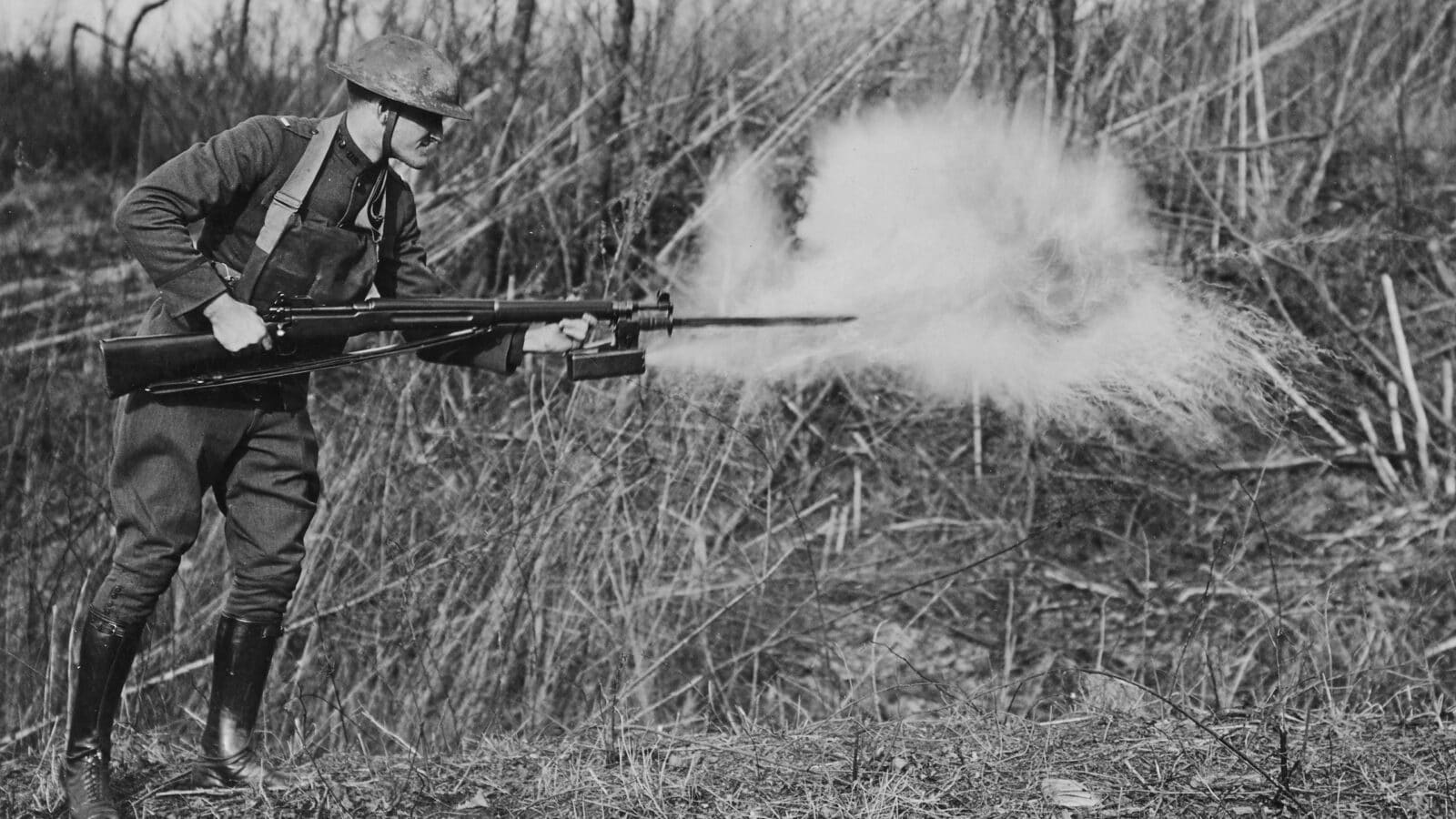
With the fighting spirit of the bayonet in mind, U.S. Ordnance sought to give the Doughboys’ bayonet charges a unique advantage. Consequently, they produced a small flame projector to attach to muzzle of the rifle — creating a flaming bayonet.

The unique device was described in a post-WWI U.S. Army Ordnance review of trench warfare materials:
“Flaming bayonet, liquid type, Mark I — the total weight charged was 7/8 pound. To be used as an accessory to the military rifle, by the projection of a spurt of flame 5 to 15 feet in length.”
At first, the flaming bayonet appears to give each infantryman his own single-use flamethrower. A little deeper examination shows that the device is not intended to replace the concept of a man-portable flame projector, but rather to enhance the individual Doughboy’s chances in bayonet fighting. The sudden burst of flame would act as a serious distraction to the enemy, causing him to turn his face away and leave his body open to the Doughboy’s bayonet attack.
This correlates with the stateside teaching, as described in the U.S. Bayonet Fighting Manual:
“The maximum killing range of the bayonet is about 5 feet (measured from the opponent’s eyes to your own), but more often the killing is at closer quarters, at 2 feet or less, when troops are struggling corps-a-corps in the trenches or darkness.

To sum up, the bayonet is only an offensive weapon, and its users must move over short distances straight up to the enemy’s position and without halting to fire. All the other details of an assault are to give the bayonet man an opportunity to close with the enemy, and the success of an attack depends upon, first, whether sufficient men can reach the enemy, and second, having closed with him, whether they are imbued with the spirit of the bayonet.”
A sudden burst of flame within five feet would certainly cause enough “shock and awe” to give the attacking Doughboy a much better chance to strike a killing blow. In “Hand to Hand Fighting: The Use of the Bayonet” (1918), author Haskell C. Billings notes that the attacker has but one chance to make a significant first impression with the bayonet:
“Don’t get excited and lose your head when you meet your man. Every thrust must count. Remember that in shooting you have five chances, with five cartridges in the chamber, but only one chance with the bayonet.”
The flaming bayonet attachment was essentially inconspicuous, and any man with a rifle and a bayonet could use one. Ordnance documentation describes the effect as “The weapon is intended for use at close range to temporarily disconcert the enemy immediately before the bayonet attack.”
Flaming Bayonet Mechanics
The first pattern of the device was basically a tiny flamethrower using liquid fuel. While innovative, the flammable fuel cannister suffered from unreliable ignition and inconsistent burning and projection when it worked.

Even so, the basic concept was considered sound, and the design evolved to use a six-shot pyrotechnic cannister, which was considered far superior. No information exists to whether each chemical “flame shot” could be triggered separately, or if they all ignited at once. It is also unknown if the cannister projector could be reloaded — by the soldier, by Chemical Warfare troops, or if it was a single use weapon. Issues regarding temperature variation, moisture, mud, and rough handling would have been significant challenges for the troops in the field.
As far as is known, the flaming bayonet was never issued for combat trials. The final prototype was said to produce a solid sheet of flame up to 10 feet in length, with white hot particles projecting out up to 30 feet.

Live The Armory Life. The latest content straight to your inbox plus an automatic entry to each of our monthly gun giveaways!
There is little photographic documentation of the device, and I’ve included all the images I’ve ever found for your review here. The flaming bayonet is a relatively simple device, but it was far from “soldier-proof”.
In Practice
Ultimately, it was an interesting concept, but with a very limited tactical application. When viewed in the context of the importance of bayonet fighting at that time, the flaming bayonet makes sense. But in the field, it quickly becomes cumbersome, and possibly more of a distraction to the user than it would have been to the enemy.

Any photos of the flaming bayonet show it attached to the .30-caliber M1917 rifle, the “American Enfield” — America’s most used combat rifle in World War I, with nearly 75% of all U.S. troops equipped with it.
The associated U.S. M1917 bayonet, with its 17” blade, was based on the British Pattern 1913 sword bayonet. Attached to the 46.3” M1917 rifle, the visual effect is that of a long and intimidating weapon. It seems that the flaming bayonet could have been adapted for use on the M1903 Springfield rifle, but this was never produced.
It is important to note that the flaming bayonet fell under the auspices of the Chemical Warfare Service, and flamethrower/flame projectors were never a priority for this branch of the U.S. military until 1942. After World War I, leaders of the Chemical Warfare Service generally considered flamethrowers to be a failed weapon system, and the flaming bayonet concept was abandoned by mid-1919.

Time marched on, and the American fighting man carried his rifle in conflicts around the world, trained as a marksman while still imbued with the spirit of the bayonet. Though truly fascinating, the flaming bayonet is ultimately an interesting footnote in this long and storied history.
Editor’s Note: Be sure to check out The Armory Life Forum, where you can comment about our daily articles, as well as just talk guns and gear. Click the “Go To Forum Thread” link below to jump in!
Join the Discussion
Read the full article here