

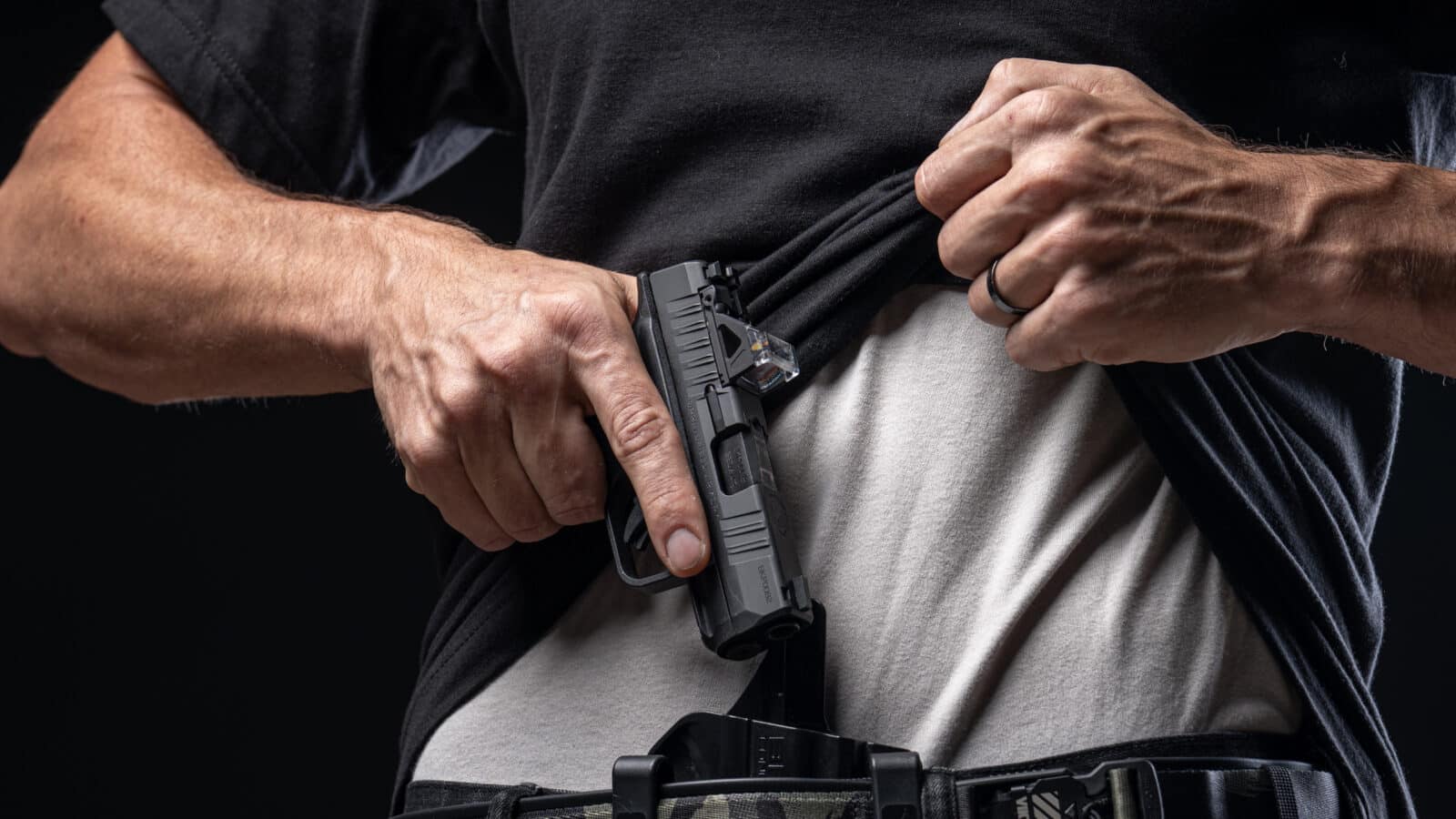
Springfield Armory came out with their Hellcat micro-compact pistol in 2019. The Hellcat helped establish the entirely new genre of micro-compact concealed carry pistols. Where previously you had the option of either a full-sized 9mm service pistol or an underpowered pocket gun, the Hellcat packed proper thump and respectable capacity in a package that would be easy to hide. The concealed carry world would never be the same.
In the past six years, the Hellcat has evolved significantly. While the beating heart remains the Browning-designed short-recoil, tilting-lock action that drives most every respectable combat handgun on Planet Earth, the Hellcat is now offered in three major configurations, two calibers, and several different hues. Nowadays, Springfield Armory offers a Hellcat to suit anybody’s individual proclivities.
Foundations
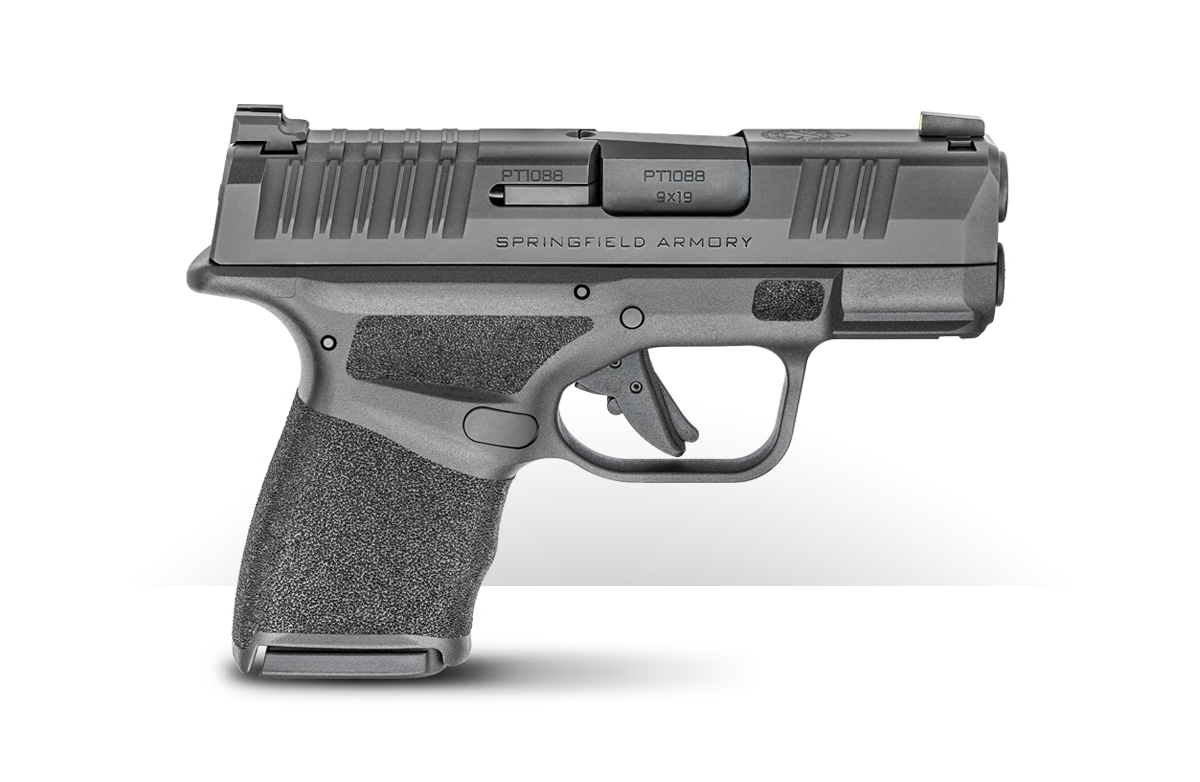
The entire Hellcat family orbits around a superb striker-fired trigger system with the obligatory multi-layered safety mechanisms. The only ones you can see on the outside are the blade safety in the trigger and the optional thumb lever if manual safeties are your bag. Personally, I like them. Use it if you want, ignore it if you don’t. I see no harm in having it.

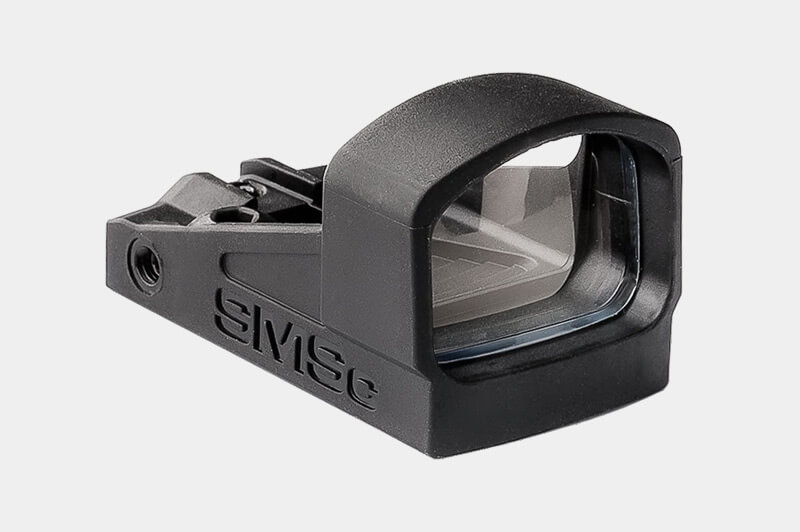
All of these guns include the superlative U-dot sighting system. This consists of a tritium-illuminated front dot partially circumscribed by a white semi-circle rear. Literally nothing is faster. They all can be had in OSP configuration as well. OSP stands for Optical Sight Pistol. In this case, the slide is cut to accept a Shield SMSc red dot sight or anything else that uses this same footprint. These sights do not require mounting plates.
The polymer frames are all adorned with a proprietary surface treatment called Adaptive Grip Texture. This stuff consists of a series of microscopic pyramids. The taller of the two are flattened on top so as not to abrade your skin or clothing. The shorter versions are left sharp but reside below the level of the blunt variety. This way your grip gets more serious the more firmly you squeeze. This has to be experienced to be appreciated, but it works, especially when you are sweaty, rushed, or terrified. There are also nifty little parking spots on both sides of the frame to give you a handy place to rest your trigger finger when not actively saving the world.

Barrels are hammer forged for exceptional accuracy, and there is a short length of Picatinny rail up front for lights and lasers. The use of Pic rail means you need not invest in some unique proprietary mount. There is a loaded chamber indicator. The magazine release is readily reversible, and the left-sided slide release is sufficiently discreet as not to hang on stuff. Most of us just slingshot our slides these days anyway, so that doesn’t much matter.
The steel bits are Melonite-finished. This high-tech surface treatment is hugely more robust than anything with which I grew up. All of these guns are about an inch wide and include a dual captive recoil spring with a full-length guide rod.

Live The Armory Life. The latest content straight to your inbox plus an automatic entry to each of our monthly gun giveaways!
I have run all of these pistols hard and have yet to experience a malfunction. In fact, Safety Solutions Academy has thus far fired more than 20,000 rounds through Hellcat serial number AT234795 without a hiccup. With all that as a common foundation, let us explore the various options.
The Standard Hellcat
Claiming a Hellcat is standard is like saying The Beatles were a fairly popular band. The basic Springfield Hellcat is chambered in 9mm Para and has ample cool-guy stuff thrown in for free. The gun comes with two magazines and three floorplates. The 11-round box rides flush, while the 13-shot mag sticks out enough to support your fifth finger. The barrel is three inches long, and the gun weighs 18.3 ounces with the extended magazine.

I have packed a Hellcat for years. The gun is small enough to fit in the palm of my hand. I can carry it in a proper holster in my customary right hip position and forget it is there. As a physician I wear surgical scrubs every day at work. These are not unlike pajamas. It is no great chore to conceal this compact 13+1 hotrod under my PJs and have no one be the wiser.
The standard Hellcat indeed strikes a lovely balance between compact size and proper power. Recoil is vigorous without being distracting. I can keep my rounds inside a juice can lid at typical across-the-room CQB ranges all day long without really trying hard. Fourteen 9mm hollowpoints will solve most any conceivable personal security problem. Also, a 15-round extended magazine is available as well.
The Hellcat Pro
All people are not the same. In fact, folks are lyrically, wildly, breathtakingly different. The standard Hellcat is optimized for concealed carry. So much so that it might even seem a bit small for folks like me with big monkey mitts. The 9mm Hellcat Pro makes everything just a wee bit bigger.

The Pro adds 0.7 inches to the barrel and 0.6 inches to the Hellcat’s overall length. The grip is extended just enough to accommodate a new set of magazines. The smaller of the two carries 15 rounds, while the larger packs a whopping 17. Despite this frankly amazing capacity, the Hellcat Pro is still markedly smaller and thinner than a conventional service pistol. I have no idea how they did that. Magic, I suppose.
The Hellcat Pro ups the overall weight by three ounces. However, the gun still rides in the same holster and, in my experience, really isn’t any tougher to tote. Once you deploy the pistol, the slightly longer grip helps mitigate recoil and muzzle flip. The stretched slide offers a longer sight radius and slightly higher velocities. The Hellcat Pro is available in both standard and compensated versions. The compensated variant has a port milled into the top of the barrel that corresponds with a slot cut in the slide. This porting helps redirect some of the chaos upward to further attenuate muzzle rise. Springfield Armory offers an extended threaded barrel of the Hellcat Pro as well.
The .380 Baby Brother
The 9mm Para is the most popular handgun cartridge in the world. It strikes a lovely balance between power and controllability. When stoked with modern high-tech bullets, the capacity of the 9mm Para to stop the threat is well-established. However, some folks still find the 9mm to be a bit spunky for their tastes, particularly in a pocket gun.

That’s not a pansy move. Many small-statured shooters regardless of gender do better with a gun that doesn’t jump about quite as enthusiastically as a standard 9mm sub-compact. The same thing applies to us old guys for whom arthritis might be a thing. In addition to a more placid comportment, the Hellcat .380 is easier to rack.
There are those who might denigrate the .380ACP as a defensive round. I get it. However, the Hellcat .380 comes with 11 and 13-round magazines. Fourteen rounds of .380ACP should be adequate to dissuade even the most determined miscreant.
Ruminations
So, which Hellcat is best? Well, all of them. That’s like asking whether somebody prefers blondes to brunettes, Mustangs or Camaros, or the M1A versus the SAINT 7.62. Variety is the spice of life, and the extensive line of Hellcat concealed carry pistols has something for everyone.
Big hands, small hands, loose clothes, or something a bit more snug — the Hellcat can be configured to keep you and yours safe under most any circumstances. Ask yourself what you need in a concealed carry gun and then juxtapose that against the expansive Hellcat family. One of these compact little predators will be just right for you.
Editor’s Note: Please be sure to check out The Armory Life Forum, where you can comment about our daily articles, as well as just talk guns and gear. Click the “Go To Forum Thread” link below to jump in and discuss this article and much more!
Join the Discussion
Featured in this article
Read the full article here