

For those who read the articles I published and the interviews I gave at the end of 2025, you would know that I was warning that this bullish metals cycle could be completing as we move into 2026. In fact, in an article I wrote for KITCO in late 2025 – which was picked up by a number of other sites – each and every commenter told me how I was absolutely wrong, and that this time is different.
While both gold and silver did exceed my ideal targets, it is rather clear now that a cycle has come to an end as per our expectations. Since the end of January of 2026, we have seen gold correct approximately 37%, whereas silver has corrected exactly 50% thus far. But we should be approaching the next buying opportunity.
As we were rallying into the high at the end of January, I sent a report out on January 28th to our retail and money manager clients at Elliottwavetrader.net entitled “Extreme and Dangerously So.” Within that report, I wrote the following:
“To call this move in gold now “extreme” is beyond an understatement. Moreover, not only did we get the spike out of the channel in continuation of this parabola, but it has even accelerated further, which now places us in what I believe to be a dangerous environment. These types of moves usually end with a VERY strong reversal . . .
Once this smaller degree structure completes, I have outlined the support levels on this new contract in red on the 60 minute chart, which must be strongly broken in a clearly sharp reversal to suggest a likely return towards the 4000 region. . .
Support for silver is the 98.50-100 region, which when broken, will likely suggest that this upside is done, and a very large correction will likely ensue. . .
So, in summary, I think we are in a very dangerous point in this parabolic rally, which can really end at any time now, for which a reversal can be quite destructive to those that are still strongly looking higher.”
In that same report, I outlined that I had reduced my mining stocks holdings down to 2% of what I had initially purchased in the last quarter of 2015. Yes, I was expecting what could be a sizeable correction and I was cashing in the profits I had earned since buying into the complex in the last quarter of 2015. Thereafter, the metals moved higher later that afternoon and evening, so I posted the following trading alert in our trading room:
“I just halved what I still have left in mining stocks. And, will either continue to do so each day should we go higher, or I will be stopping out and buying back at the 4th wave target. This is too much risk for me personally the way this is now rallying.”
Needless to say, those that followed me cashed in their positions and protected their massive profits before the bottom fell out of the metals market later that very day.
Yet, at the same time, I saw tremendous table pounding by many “pumpers” and “analysts” who were claiming that this parabola was going to substantially continue with another “certain” 50%+ gains (just as we were striking the highs). And, as I said in a note that week to my clients, it reminded me of something I read in David Crosby’s book, The Behavioral Investor:
“Our flawed brain leads us to subjectively experience low levels of risk when risk is actually quite high, a concept that Howard Marks refers to as the “perversity of risk.”
While we tend to think of bear markets as risky, true risk actually builds up during periods of prosperity and simply materializes during bear markets. During good times, investors bid up risk assets, becoming less discerning and more willing to pay any price necessary to take the ride. Risks compound during such periods of bullishness, but this escalation goes largely undetected because everyone is making money and the dopamine is flowing. You likely grasp this intellectually, but your brain will do everything in its power to make sure that you don’t act accordingly.”
And, as what happened to all these same pumpers, analysts and investors in 2011, they got caught uber-bullish at the highs, not recognizing the risk in the market at the time.
We all know now that we experienced a sizeable spike down in the metals market in very quick fashion at the end of January. Yet, as the market began to bounce, those same pumpers and analysts began shouting their mantra’s even louder that the bull market was going to immediately continue to 50%+ levels from the recently struck all-time highs.
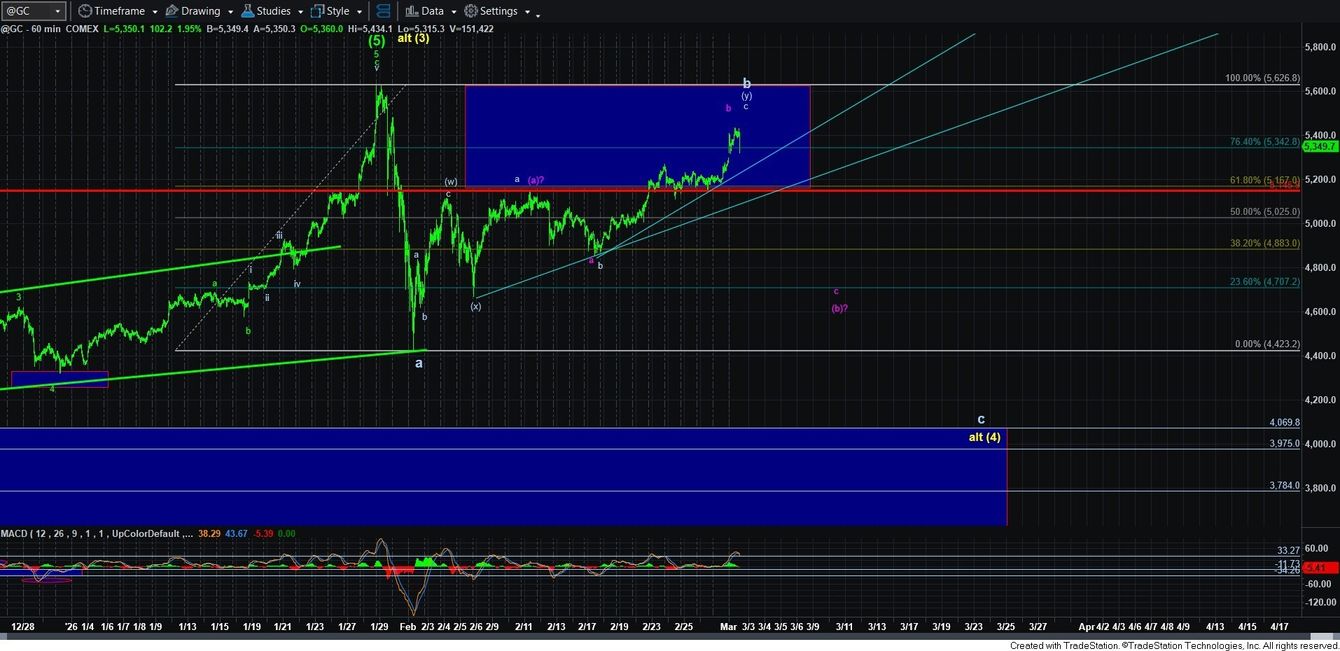
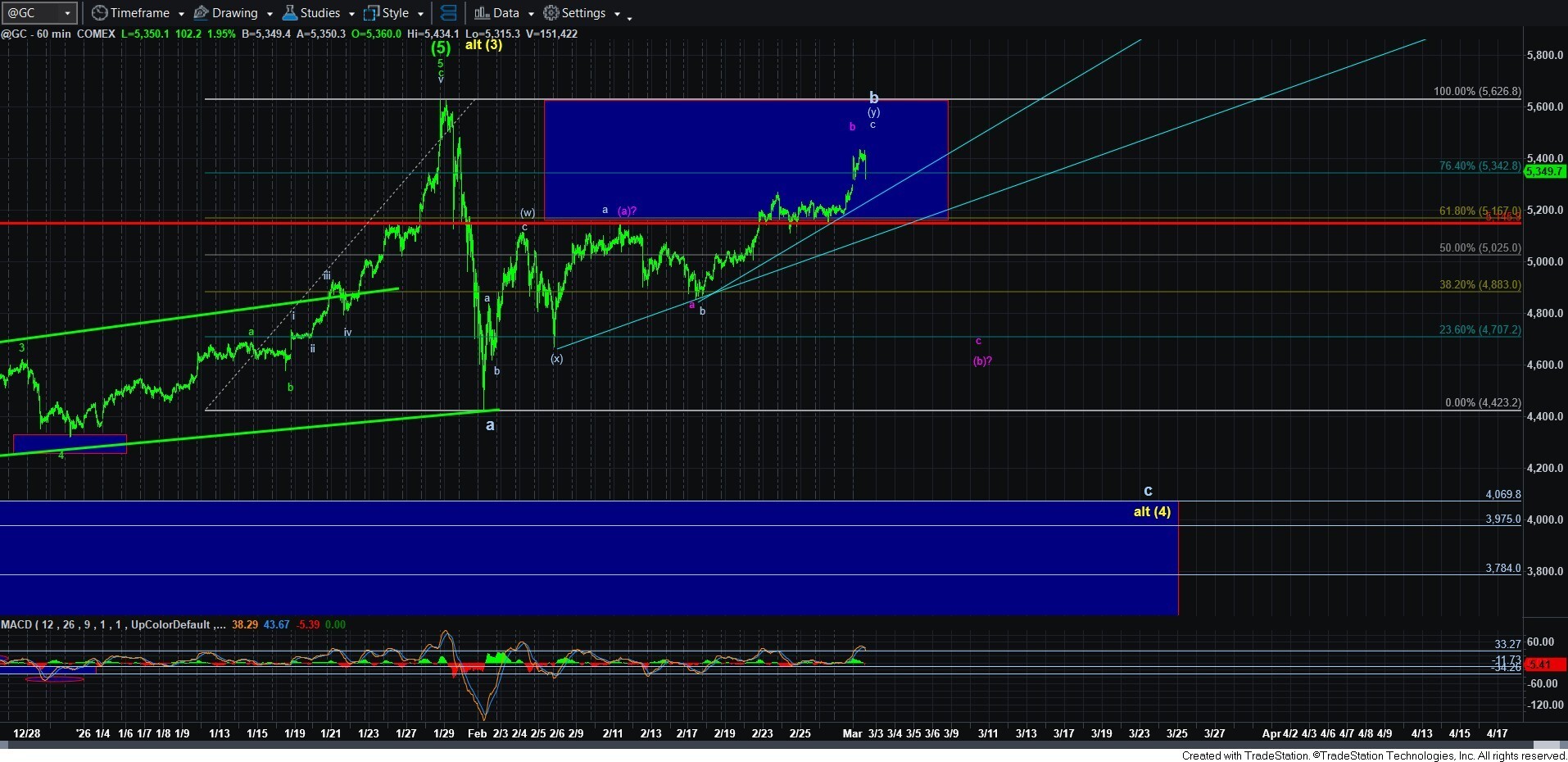
However, I was again standing relatively alone in the breach, and outlining to our clients that we were going to see a secondary decline phase, the outlined set up for which can be seen in the following gold chart I provided to my clients at the time:

When I was outlining the latest decline structure in gold, not only did I get pushback in the public pages where I generally expressed my view, but even within the cyber-walls of Elliottwavetrader, one of our newer members posted the following words of extreme disbelief:
“Do people here really believe Gold price will crash when war is going on and oil to 100+ a barrel?”
My simple answer was “yes.” But, I also understand how hard it is for many of you to give up all you have supposedly learned as truths about the market and adopt something that seems to be so counter-intuitive.
All these years, it has been drilled into your heads by these analysts and the media that gold is a “safe haven.” Yet, if anyone ever bothered to actually review historical patterns alongside news events, you would know that gold does not react consistently to wars. It has proven itself through history not to be the “safe haven” expected by the masses. And, this time was no different.
Unfortunately, too many have learned to believe in the fallacies propagated, and so often regurgitated, about the market by these analysts and the media that they have become their “truths.”
As Daniel Kahneman noted in his book “Thinking Fast and Slow,” “[a] reliable way to make people believe in falsehoods is frequent repetition, because familiarity is not easily distinguishable from truth.” This is exactly what our financial media and many analysts do so well. They continually regurgitate these fallacies about the market to the point that the public believes they are truth rather than bull excrement.
But, as Daniel Crosby noted in his book “The Behavioral Investor,” “trusting in common myths is what makes you human. But learning not to is what will make you a successful investor.” Or, as Yoda put it, “you must unlearn what you have learned.” So, it is up to you as to whether you want to become a better investor, or whether you simply want to go through life believing in these common myths and seeing your investment account shrink due to your misplaced trust.
In the natural cycle of life, everything has periods of progression and growth along with periods of regression. And, financial markets -including the gold market – are no different. As Ralph Nelson Elliott stated:
“The causes of these cyclical changes seem clearly to have their origin in the immutable natural law that governs all things, including the various moods of human behavior. Causes, therefore, tend to become relatively unimportant in the long-term progress of the cycle. This fundamental law cannot be subverted or set aside by statutes or restrictions. Current news and political developments are of only incidental importance, soon forgotten; their presumed influence on market trends is not as weighty as is commonly believed.”
If you would like to learn more about these perspectives, I strongly encourage each and every investor to read a book entitled “The Socionomic Theory of Finance” by Bob Prechter. It will be an absolute eye opener to you and probably the best book I have personally ever read in the world of finance. And, this is coming from an avid reader who began their investing career being college-trained in economics and accounting.
One of the wisest quotes from Bob’s book is something that many investors may have learned the hard way, but, for some reason, for which many still are unable to avoid the trap:
“Observers’ job, as they see it, is simply to identify which external events caused whatever price changes occur. When news seems to coincide sensibly with market movement, they presume a causal relationship. When news doesn’t fit, they attempt to devise a cause-and-effect structure to make it fit. When they cannot even devise a plausible way to twist the news into justifying market action, they chalk up the market moves to “psychology,” which means that, despite a plethora of news and numerous inventive ways to interpret it, their imaginations aren’t prodigious enough to concoct a credible causal story.
Most of the time it is easy for observers to believe in news causality. Financial markets fluctuate constantly, and news comes out constantly, and sometimes the two elements coincide well enough to reinforce commentators’ mental bias towards mechanical cause and effect. When news and the market fail to coincide, they shrug and disregard the inconsistency. Those operating under the mechanics paradigm in finance never seem to see or care that these glaring anomalies exist.”
And, boy, did many engage in mental gymnastics while trying to invent mechanical paradigms as to why the “safe haven” of gold surprisingly dropped during the military conflagration between the United States, Israel, and Iran, especially during a time when Iran was also attacking many of its neighbors.
In fact, this was a response to a post I made on Yahoo Finance regarding my expectation for another leg lower in gold, and it was a great representation of mental gymnastics to invent mechanical paradigms:
“Interesting opinion and, at least in the short term, spot on! That said, I would say that unexpected world events which occurred after you published your opinion were the reasons that gold has recently corrected from its Jan. 29, 2026 high.
On March 2, 2026, the first trading day after the US surprise-attacked Iran, gold rallied to near the Jan. 29 high (and actually exceeded the Jan. 29 close intraday, a failed rally). Subsequently and very shortly thereafter, various world-wide financial markets, stocks, bonds (including US issued debt), metals sold off (and continue to do so). I have seen many recent opinions recite that money is flowing to the “safety” of the dollar causing gold to decline, but that can’t be correct because US treasuries are selling off too.
IMO it’s not a long term dollar rally, it’s the dollar rising because it is being sold with less intensity relative to other currency selling, currencies more directly impacted by Iran-based energy disruption (EU, for example), thus explaining global rising interest rates. Coupled with that currency trading curiosity is the fact that Global oil trade is in US dollars, meaning that war-induced oil price increases has significantly increased the demand for actual US dollars in oil contract settlements.”
And, I am sure that this made sense to many of you. Yet, as one trained in classical economic theory, I can tell you that there are a number of holes in this mechanical paradigm. But, I digress.
So, I am going to remind you of Mr. Prechter’s quote above, and that most investors and analysts alike engage in mental gymnastics in order to maintain their erroneous mechanical beliefs about markets. It also reminds me of a quote from Benjamin Franklin:
“So convenient a thing it is to be a reasonable creature, since it enables one to find or to make a reason for everything one has a mind to do.”
But, what really made me chuckle was right after the Yahoo Finance commenter posted his mechanical paradigm, we saw gold, oil, the stock market, bonds and the dollar all decline on the same day. This kinda threw a wrench into his mechanical paradigm. So, when I asked about this, well, all I heard was crickets. And, I am quite sure this goes for most analysts and investors in the market who engage in similar gymnastics. Yet, most of you will either ignore it, or simply move on to another intellectually dishonest mechanical paradigm. But, remember, that choice is yours.
Now, as far as my views on gold and silver, I will start by telling you that I have begun to layer into various individual mining stocks as we struck those lows this past Monday morning, which I am now getting on sale. Based upon my trading/investing rules, I will usually layer into positions as I view the correction coming to a conclusion. So, while I think there could still be lower levels being struck by most of the mining stocks, some may be bottoming earlier than others, as we saw in the last quarter of 2015 as well.
But, I do not think we are yet done with this correction in gold and silver. I think there is one more near-term leg lower, with an ideal target for gold being that 4000 region (and maybe even a spike lower) and the minimum target I have had for silver was the 53.50 region. The only thing that I am questioning is whether we see a small rally or a larger corrective rally before we reach those targets. And, the nature of the price action we see in the coming days will guide me.
I also want to take this moment to remind you that there is nothing certain in markets. And, anyone who tells you otherwise should be summarily dismissed. Everything you do in markets should be based upon a probabilistic perspective, which also means you need to have an objective manner in which to determine when you are wrong well before you have to take a 30%+ drawdown.
This brings me to my next perspective about gold and silver. When I provide my analysis, I often tell my clients when I have a high probability expectation or when I am uncertain. And, due to my adherence to an intellectually honest perspective, I am not afraid to admit when I am not sure. When it comes to the bigger picture in gold and silver for the rest of 2026, I am a bit uncertain. Allow me to explain.
While I view a drop down to the targets I outlined above as a potentially great buying opportunity in gold and silver (depending upon the structure with which we strike those targets), I am unsure whether the rally I expect thereafter will be a bigger corrective rally, ultimately leading us to even lower levels, or whether it will take us to new all-time highs.
You see, if we mirror the correction we experienced in silver in 2011, we would recognize that another drop in the metals will only complete the first larger wave down in a 3-wave longer-term correction. And, such a correction can easily take us a few years. That would mean that the rally I expect after we complete the next drop would only be a corrective rally, as was seen in silver in 2011, thereafter leading to another sizeable decline.
Unfortunately, I will not be able to make that determination until I see the nature of that intermediate-term rally. If it takes shape as a 5-wave structure, then we will likely be on our way to new all-time highs. However, if it takes shape as a corrective structure, then we can be mired in this correction for much longer, as was seen in 2011.
So, for now, I am seeing a nice opportunity developing to buy back into the complex. And, I will need to see the nature of the next major rally phase to know which path the market is going to take for the rest of 2026 and potentially much longer.
In the meantime, I am going to remind you again of the wise words of Daniel Crosby when he noted that “trusting in common myths is what makes you human. But learning not to is what will make you a successful investor.”
So, again, it is up to you as to whether you want to become a better investor, or whether you simply want to go through life believing in these common myths regarding mechanical paradigms and seeing your investment account shrink due to your misplaced trust.
Read the full article here