

Gold still looks unstoppable, a mighty juggernaut. After essentially tripling in about a couple years, gold inexorably continues grinding higher. Remarkably this great strength is defying gold’s own half-century-plus precedent of serious drawdowns following extreme gains and overboughtness. Interestingly gold’s latest monster record bull also had episodes of gold refusing to sell off substantially out of overbought extremes.
As I marvel at gold’s staying power, that word juggernaut keeps coming to mind. It is based on the name of an Indian god Jagannath. One way he is celebrated is during a festival for which enormous temple cars or chariots are built. These can be up to 90 feet tall and weigh a staggering 300 tons! Hundreds of devotees manually pull each through the streets with giant ropes, and once moving their inertia is unstoppable.
They can’t be steered and are very difficult to stop. Apparently some centuries ago, fanatics would throw themselves under the giant wheels of these Jagannath chariots and get crushed to death. I’d love to see that Ratha Yatra festival in India someday, but would keep my distance from the juggernauts. Gold reminds me of these, its upward inertia increasingly looking like an unstoppable force. This is both amazing and vexing.
Why the latter? Like all financial assets, gold has a long history of meandering in alternating cycles. As the dollar was severed from the gold standard in August 1971, that effectively birthed dollar-gold’s entire record. Since 1971 gold has seen 32 cyclical bulls with 20%+ gains, 11 smaller 10%+ uplegs that fell short of achieving bull status, 17 cyclical bears with 20%+ losses, and 24 additional 10%+ corrections.
These cycles are important and inevitable, and make trading possible. Its mission is to buy low then sell high, requiring timing gold’s inexorable cyclicality. From early October 2023 to late January 2026, dollar-gold’s biggest-ever cyclical bull by far powered to extraordinary 196.4% gains over 27.8 months! The notorious January 1980 gold bubble was a distant second, at 127.9% cyclical-bull gains over just 2.6 months.
Gold’s latest epic cyclical bull wasn’t only its biggest dwarfing everything else in dollar-gold’s entire 55.2-year history, but it soared to some of gold’s most-overbought levels ever in late January 2026. Gold peaked an eye-popping 43.4% above its baseline 200-day moving average! That proved a wild 45.9-year secular high, gold’s most-extreme overboughtness since March 1980 for another popular speculative mania!
In the annals of dollar-gold cyclical bulls since 1971, that was gold’s fifth-most-overbought episode. All the worse ones happened during gold’s enormous 1970s cyclical bulls. I wrote an essay warning about this one day before gold’s reckoning erupted with a vengeance. Exiting January, gold crashed 10.3% in a single day! That proved its third-worst down day since 1971, and was also a correction-grade 10%+ selloff.
That formally slayed gold’s monster record bull of recent years, and extended to a 13.3% correction the next trading day. That week I wrote another essay analyzing all subsequent drawdowns after gold’s largest cyclical bulls and most-overbought cyclical-bull toppings since 1971. The next-ten-largest in each were both quickly followed by big-and-fast average selloffs near 20.8% in 2.1 months! Gold was well on its way.
But amazingly, gold since defied its vast historical precedent and the odds to grind back up challenging late January’s peak! By this Monday, gold had rallied back to $5,229 regaining over 3/4ths of its brutal two-trading-day losses. That left gold just 3.0% under late January’s last record, transforming the nearly-month since into a high consolidation. Gold’s history argues this is all but impossible, yet here we are.
If there’s one thing studying markets and actively trading demands, it is adaptability. I often think about the famous quote attributed to legendary English economist John Maynard Keynes. During a high-profile debate, he was credited with saying “When the facts change, I change my mind. What do you do, sir?” I’m not ready to ignore 55 years of history screaming for a major gold selloff, but maybe gold can get lucky.
If gold manages a miraculous high consolidation out of its biggest and one of its most-overbought cyclical bulls ever, that will actually be its fifth in recent years! Gold’s monster record bull since October 2023 proved remarkable in many ways. One was its drivers. Gold’s previous cyclical bulls in the past quarter-century were primarily fueled by major American buying, from both stock investors and gold-futures speculators.
But in recent years, massive demand from Chinese and Indian investors and speculators and jewelry buyers along with central banks usurped Americans’ traditional leading role in driving gold. That was so steady it really smoothed gold’s swings within that huge cyclical bull. Incredibly gold didn’t suffer a single 10%+ selloff between early October 2023 to late January 2026! That’s what allowed this bull to grow so huge.
Within it there were four separate times that gold soared to extremely-overbought levels that really necessitated correction-grade selloffs to suitably rebalance overextended technicals and excessively-greedy herd sentiment. But instead of rolling over, gold mostly drifted sideways. High consolidations can and do rebalance away extremes, but are much slower than selloffs taking more time to accomplish their missions.
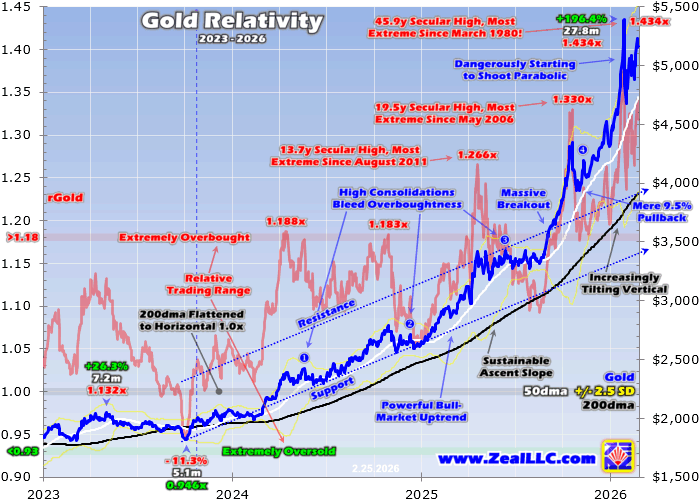
So trying to wrap my head around another potential high consolidation defying all precedent, I wanted to compare it to the late gold bull’s previous four. Maybe that would provide sufficient justification to help contrarian traders expecting normal cyclicality to avoid getting crushed to death under this juggernaut’s wheels. This chart superimposes gold in recent years over a construct called rGold measuring overboughtness.
Relative Gold is calculated by simply dividing gold’s daily close by its 200-day moving average. That empirically quantifies how far and fast gold has surged relative to its own history. Those multiples flatten gold’s 200dma to 1.00x, and recast gold in constant-percentage terms off that regardless of prevailing price levels. In the past five calendar years, gold’s extreme-overboughtness threshold started at 1.18x.
Gold first exceeded that when its monster record bull was young, closing at 1.188x its 200dma in mid-April 2024. At that point gold had surged 31.2% in 6.4 months, already a powerful bull run. That was a 3.7-year secular high in overboughtness, the highest since gold’s previous monster 40.0% bull peaked in August 2020. Instead of correcting, gold consolidated high from there to rebalance technicals and sentiment.
While three higher closes were seen in subsequent months, gold didn’t decisively resume powering higher again until mid-August 2024. So this late bull’s first high consolidation lasted 3.8 months. At worst in that long rebalancing span, gold merely fell 5.7%. Gold’s closes during it averaged 1.127x its 200dma, which was nowhere near oversold. Gold’s extremely-oversold threshold starts way down under 0.93x.
Following that first high consolidation, gold began surging again into late October 2024. There it shot back up into extreme-overbought territory at 1.183x its 200dma, as its monster bull’s gains grew to 53.1% over 12.9 months. Again precedent argued more for a big-and-fast drawdown rather than another high consolidation. Gold got lucky again, drifting sideways on balance for the next 3.0 months into late January 2025.
At worst within that second high consolidation, gold suffered a larger 8.0% pullback. Its average closes in rGold terms were 1.090x, better than the first high consolidation’s but still pretty high. Again avoiding a cyclical-bull-slaying correction, gold resumed blasting higher after that rebalancing drift. By mid-April 2025, gold had extended its monster bull to 88.0% gains over 18.5 months in way-more-extreme overboughtness!
Gold crested then at 1.266x its 200dma, a 13.7-year secular high not witnessed since August 2011! After that last comparable episode ending gold’s ninth-biggest cyclical bull ever, gold suffered a sizable 14.9% selloff in just 1.2 months. Yet in summer 2025, gold defied the odds again to consolidate high for the third time in its remarkable monster bull. While gold did see two new marginal highs within it, that lasted 4.2 months.
At worst within that long sideways drift, gold rapidly plunged 7.1% still well under a 10%+ correction. Throughout that entire third high consolidation, gold closes averaged a lofty 15.3% above its 200dma! Not only far from being oversold, gold lingered way up near overbought extremes. Then this remarkable bull resumed blasting higher, soaring into mid-October 2025 extending its gains to a record 139.1% in 24.5 months!
Gold crested at 1.330x its 200dma, which was the most overbought it had been in 19.5 years since May 2006! That was when gold’s sixth-biggest cyclical bull since 1971 peaked, immediately followed by a big-and-fast drawdown of 21.9% over just 1.1 months! Gold’s initial selloff out of mid-October 2025 plunged to 9.5% in just a couple weeks, threatening a bull-slaying correction. It kicked off with an ugly 5.3% down day.
That was gold’s worst daily loss in 5.2 years, which gold stocks amplified by 2x to 3x like usual stopping out everyone running trailing stops including us. That drawdown should’ve snowballed into a much-worse one, but remarkably gold bounced out of it to start what would later prove that monster bull’s fourth high consolidation! Chinese investors dominating gold was the main driver, buying aggressively into Mondays.
I wrote a whole essay in late January analyzing gold’s China takeover. The great majority of gold’s gains since mid-October’s peak accrued overnight into Mondays, which is the only time Chinese trading rules global gold pricing unopposed. Increasingly-frenzied Chinese buying truncated that high consolidation at just 2.0 months, much shorter than the prior three averaging 3.7 months. Overboughtness remained extreme.
During that record bull’s final and shortest high consolidation, rGold still averaged a super-high 1.211x! At the time that seemed way too risky to redeploy in gold stocks, since the probability of gold suffering a major drawdown was high based on its entire history since 1971. But another China Monday gold surge into the quiet US Christmas week ended that fourth high consolidation, leading into a popular speculative mania.
Over the next five weeks or so into late January, gold soared another 24.3% higher extending its monster record cyclical bull to 196.4% gains over 27.8 months! Again that crested at an insane rGold extreme of 1.434x, the most overbought gold had been in 45.9 years! That craziness should’ve guaranteed a big-and-fast 20%+ cyclical-bear-grade drawdown, which I’ve been warning about in all my recent essays.
Yet like those juggernaut temple cars, gold’s massive momentum remained strong enough for it to keep on moving. After suffering that brutal 13.3% two-trading-day crash formally slaying that cyclical bull, gold resumed rallying again mostly on frenzied Chinese New Year buying. Traders who bought high chasing January’s popular speculative mania loved that vanishingly-short dip, but it confounded students of markets.
What could be shaping up to be a nigh-on-miraculous fifth high consolidation out of overbought extremes in recent years was only 0.9 months old midweek. And the average rGold close across that sideways drift stretched way up to a wild 1.298x! That compares to this late gold bull’s prior four high consolidations at 3.8, 3.0, 4.2, and 2.0 months averaging 3.2. So gold’s apparent fifth one remains quite young by recent standards.
Gold’s average closes in rGold terms in that monster record bull’s four high consolidations ran 1.127x, 1.090x, 1.153x, and 1.211x. Those in turn average to 1.145x. So today’s 1.298x in only 0.9 months is way outside the last gold bull’s example, far more extreme! This makes me more nervous gold is still in store for a big-and-fast drawdown soon. But despite serious-selloff fears, Keynes’ adapting quote haunts me.
Gold’s massive surge higher in recent years has proven an unstoppable juggernaut, unlike anything else in dollar-gold’s entire history. Riding it in gold, silver, and their miners’ stocks has proven wildly profitable. Despite getting stopped out in mid-October, our 60 newsletter stock trades in 2025 averaged fantastic +119.9% annualized realized gains! Still being out in recent months looking for a selloff is getting more painful.
Could this juggernaut keep on rolling higher on inertia alone, history be damned? Anything is possible in the markets. Since gold’s popular-speculative-mania-grade buying frenzy into late January 2026 was largely fueled by frenzied Chinese gold demand, that’s probably the key to gold’s near-term fortunes. And seasonally it peaks in the month leading into Chinese New Year, which is a week-long-holiday festival in China.
Gold seasonally slumps after that as Chinese demand normally wanes from late February into mid-March. This timeframe is one of gold’s weakest of the year seasonally. So it seems prudent to wait a few more weeks until that passes to make a decision on holding our noses and buying super-high. While the odds of a serious big-and-fast drawdown erode with each passing week, they still remain on the high side now.
Based on my quarter-century-plus of studying gold and actively trading its miners’ stocks, the minimum time necessary to declare a high consolidation is six weeks after the previous peak. Gold has to spend at least that long drifting sideways on balance after extreme toppings to sufficiently pare the likelihood of rolling over into a major drawdown. We’re just over halfway into that minimum, which gold could get to in mid-March.
That’s typically when gold’s spring seasonal rally gets underway following the post-Chinese New Year lull in Chinese gold demand. While gold’s spring rally is the weakest out of its big seasonal ones averaging 4.3% gains in 22 of the last 25 years when gold was in bull markets, it is still important. For reference gold’s autumn rally averaged 5.5% gains and its winter rally into late February saw seasonally-best 7.9% ones.
If this gold juggernaut can trundle along for another few weeks, it increases the chances gold will continue powering higher on balance after a miraculous fifth high consolidation. Things sure look that way today, but remember markets can change fast. Gold again plummeted 5.3% in a single trading day out of mid-October’s peak, and crashed 10.3% in one day after late January’s! So caution in redeploying remains in order.
And the still-considerable downside risks in gold are dwarfed by those in its miners’ stocks. The major gold miners of GDX have long tended to amplify gold moves by 2x to 3x. So a 10% gold correction will almost certainly translate into 20%-to-30% gold-stock losses, and a 20% gold bear to catastrophic 40%-to-60% ones! So buying super-high to chase gold deep in unchartered territory remains a very-risky proposition.
Successful trading demands always staying informed on markets, to understand opportunities as they arise. We can help! For decades we’ve published popular weekly and monthly newsletters focused on contrarian speculation and investment. They draw on my vast experience, knowledge, wisdom, and ongoing research to explain what’s going on in the markets, why, and how to trade them with specific stocks.
Our holistic integrated contrarian approach has proven very successful, and you can reap the benefits for only $10 an issue. We extensively research gold and silver miners to find cheap fundamentally-superior mid-tiers and juniors with outsized upside potential. Sign up for free e-mail notifications when we publish new content. Even better, subscribe today to our acclaimed newsletters and start growing smarter and richer!
The bottom line is gold continues to prove an unstoppable juggernaut, its upward momentum crushing contrarians in gold’s way. While such strength out of such unbelievable extremes is unprecedented in all of dollar-gold’s history, gold has been consolidating high rather than selling off in recent years. Massive Chinese gold demand taking the lead in global buying is the main reason, consistent enough to moderate selloffs.
If that persists even in this post-Chinese New Year slump, gold may well be in a nigh-on-miraculous fifth high consolidation out of overbought extremes in the last couple years. Contrarians still believing in market cycles may have to grudgingly adapt to that. But high consolidations need to extend to at least six weeks to sufficiently reduce the odds of serious drawdowns. Today’s is only halfway there, needing to run into mid-March.
Adam Hamilton, CPA
February 27, 2026
Copyright 2000 – 2026 Zeal LLC (www.ZealLLC.com)
Read the full article here